
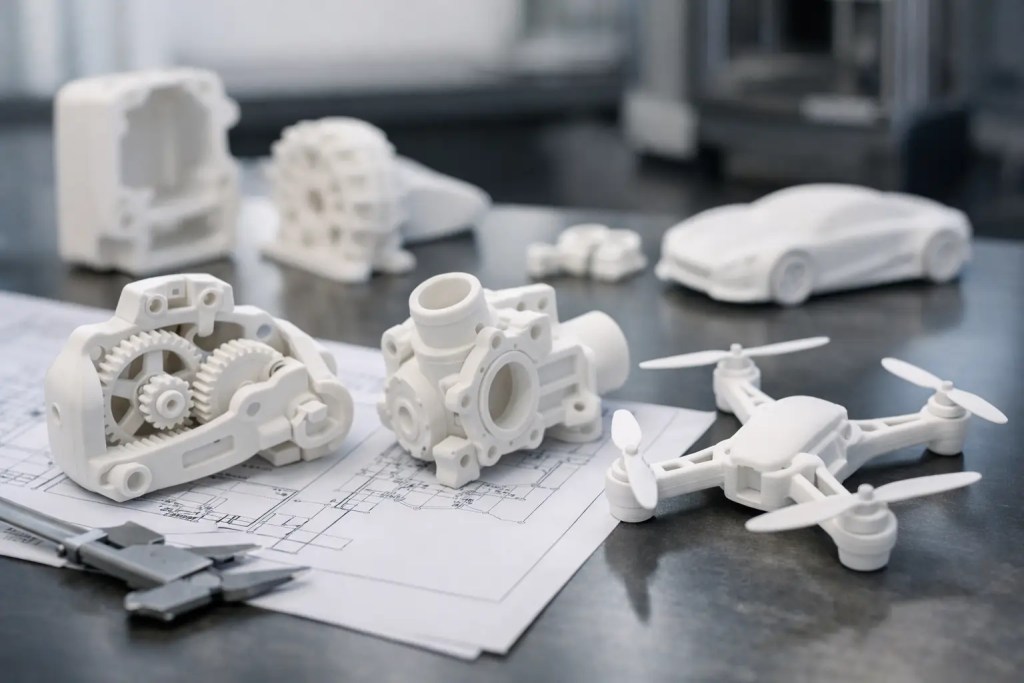
A prototype that looks right but fails the first assembly test wastes more than material. It burns engineering time, delays procurement decisions, and forces another design loop. That is why many product teams use SLS nylon functional prototypes when they need parts that can be handled, fitted, loaded, and reviewed with realistic confidence rather than treated as display models.
Selective Laser Sintering, or SLS, builds parts by fusing nylon powder layer by layer. For functional prototyping, that matters because the process produces strong, usable parts without the support structures required in many other additive methods. The result is a practical route for engineering teams that need fast iteration, good mechanical performance, and geometries that would be difficult or time-consuming to machine.
Why SLS nylon functional prototypes are widely used
The main reason is simple. SLS nylon parts behave like engineering components, not presentation samples. PA12 and PA11 materials offer a useful balance of strength, toughness, and dimensional stability, which makes them suitable for testing fit, basic load paths, enclosure assembly, clips, brackets, ducts, housings, and light-duty end-use scenarios.
For many teams, the value is not just the printed part. It is the decision speed that comes with it. If a design team can validate latch engagement, cable routing, wall thickness, or fastener access before committing to tooling or production setup, the development process moves with fewer late-stage corrections.
SLS also supports design freedom that matters in real hardware programs. Internal channels, nested features, living-clearance assemblies, and weight-reduced structures are all more feasible than they would be with subtractive methods on an early prototype schedule. That flexibility is especially useful when the geometry is still changing and the part needs to be tested, not just reviewed on screen.
What makes SLS a functional process, not just a visual one
A functional prototype has to answer more than one question. It should tell you whether the part fits, whether it survives handling, and whether it performs well enough to expose design weaknesses. SLS is strong in that middle ground between concept modeling and production manufacturing.
Because the surrounding powder supports the part during the build, engineers are not restricted by support-contact marks in the same way they are with some other processes. Complex geometry is easier to print, and multiple parts can be packed efficiently into a single build. That improves throughput and often helps shorten iteration cycles.
Surface finish is one trade-off to understand early. Standard SLS nylon has a matte, slightly granular texture. For brackets, housings, fixtures, and test assemblies, that is often acceptable. For cosmetic reviews or transparent features, another process may be a better fit. Functional prototyping is usually about performance first, and SLS serves that need well, but appearance requirements should still be defined up front.
Where SLS nylon functional prototypes fit best
The best use cases are parts that need realistic mechanical handling without the cost or delay of hard tooling. This includes snap-fit enclosures, sensor mounts, robotic end-effector components, airflow ducts, medical device housings for non-implant evaluation, jigs and fixtures, and low-volume bridge parts.
SLS is also useful when one prototype is not enough. Engineering validation usually involves several design revisions, and procurement teams want confidence that a selected process can keep pace. If the geometry changes often and the part must still be physically tested, SLS offers a practical balance between speed and repeatability.
This is also where process selection becomes an operational decision rather than just a design preference. A service bureau with in-house additive and conventional manufacturing can help teams start with SLS for early functional validation, then move to CNC machining, vacuum casting, injection molding, or short-run additive production as requirements stabilize. That continuity reduces supplier handoffs and helps maintain design intent across stages.
Material choice matters: PA12 vs PA11
Not all nylon prototypes should be treated the same. PA12 is often the default for SLS because it offers consistent dimensional performance, good detail retention, and balanced mechanical properties. It is well suited to general-purpose engineering prototypes where fit, assembly, and moderate functional loading are the main goals.
PA11 is typically chosen when added ductility and impact resistance are more important. If the part will see repeated flexing, tougher handling, or a higher chance of impact during testing, PA11 may be the better option. The trade-off is that final part behavior, cost, and availability can vary by application and machine setup.
For engineering teams, the right question is not which nylon is best in general. It is which nylon best reflects the test objective. If the goal is dimensional verification and assembly checks, PA12 may be ideal. If the goal is stress testing with tougher handling, PA11 may justify the switch.
Design rules that improve prototype success
Good SLS results start before the file is uploaded. Thin walls, enclosed powder traps, oversized flat surfaces, and poorly controlled tolerances can all reduce prototype quality or create avoidable rework.
Wall thickness should match the part’s use case, not just the minimum printable threshold. A wall that technically prints may still be too weak for assembly testing. Long unsupported spans should be reviewed for warping risk, especially if the part includes broad flat panels. Internal cavities need escape paths for unsintered powder. Mating parts should be designed with realistic clearance rather than nominal CAD contact.
Tolerance expectations also need to stay grounded in the process. SLS is highly capable for functional prototyping, but it is not a substitute for precision machining in every case. Features such as bearing seats, threaded interfaces with strict engagement requirements, or sealed surfaces may need secondary machining or an alternate process. The best outcome usually comes from assigning each feature to the manufacturing method that suits it.
The trade-offs engineers should account for
SLS is not the automatic answer for every functional prototype. If a part needs a very smooth surface straight off the machine, SLA or post-processing may be more suitable. If the prototype must match the isotropic performance and finish of an injection-molded production resin, SLS can get close in function but not always in exact visual or tactile behavior.
Part size also matters. Very large components may exceed economical build limits or require segmentation. Tight cosmetic standards can add finishing steps. And while SLS supports excellent design freedom, that does not eliminate the need for DFM review. Parts still need practical wall transitions, sensible tolerances, and geometry that reflects the intended test conditions.
Cost should be viewed in context. A single SLS prototype may cost more than a simple FDM print, but if it prevents two failed design rounds or gives procurement enough confidence to release the next stage, the total program cost often improves.
How SLS nylon functional prototypes support faster development
The real value of SLS appears when teams treat prototypes as decision tools. A part that can be assembled, fastened, loaded, and reviewed by both engineering and sourcing teams reduces uncertainty across the program. That is especially important for startups moving toward pilot builds and for established manufacturers managing multiple product revisions under time pressure.
An effective workflow usually starts with a clean CAD file, a clear definition of the test objective, and early review of material and tolerance requirements. From there, teams can move quickly through quoting, manufacturability checks, production, and post-processing. At Additive3D Asia, that process is built around instant quoting, engineering-led review, and ISO 9001:2015-controlled production so customers can move from prototype to short-run manufacturing with fewer gaps between stages.
When to move beyond the prototype stage
One of the strengths of SLS nylon is that it can bridge the gap between prototype and limited production. In some applications, the same process used for validation can continue into low-volume end-use manufacturing. In others, the prototype serves as a checkpoint before transitioning to injection molding, CNC, or another method better suited to unit economics or final specifications.
That decision depends on volume, surface requirements, long-term mechanical demands, and part economics. If annual demand is low and geometry is complex, SLS may remain the right production method. If demand rises and the design stabilizes, tooling-based processes usually become more attractive.
The useful question is not whether SLS replaces every downstream method. It is whether it gives your team enough reliable information, fast enough, to choose the next step with confidence. When a prototype can withstand real handling, reveal fit issues early, and support credible functional testing, it stops being a placeholder and starts doing its actual job.
That is where SLS nylon proves its value – not as a visual approximation, but as a practical manufacturing step that helps teams make better decisions sooner.