
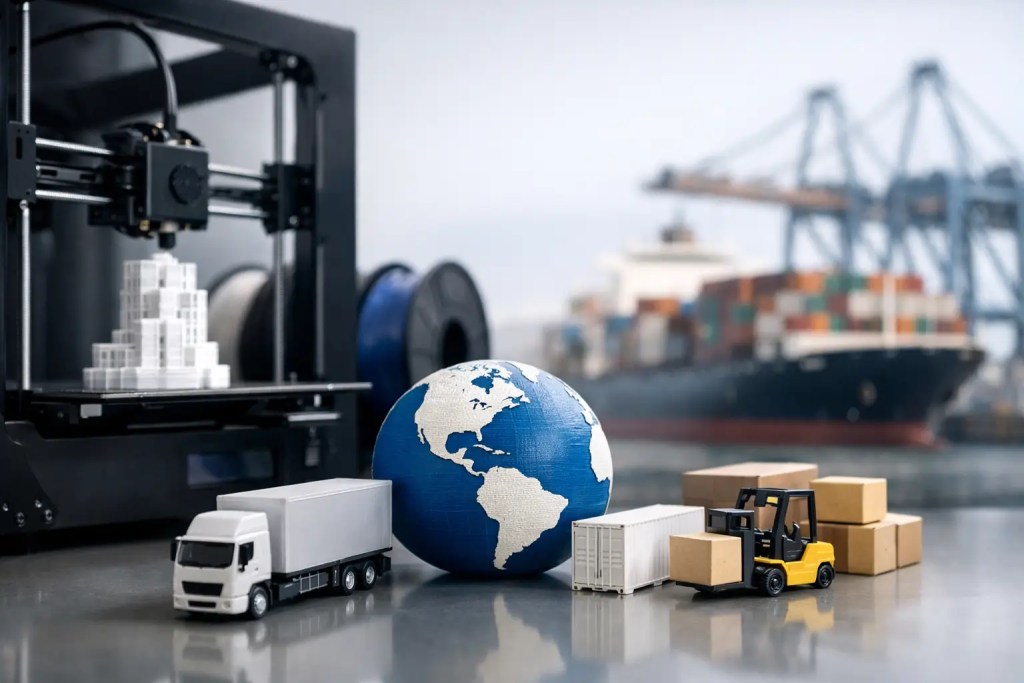
A delayed bracket, housing, or fixture can idle an entire line. That is why 3D printing supply chain resilience is no longer a side discussion for R&D teams. It has become a practical manufacturing strategy for companies that need to keep prototypes moving, support production continuity, and reduce dependence on long, fragile sourcing chains.
The value is not simply speed. Speed matters, but resilience comes from having more than one viable path to a part. When a component can be produced on demand from a qualified digital file, in multiple materials, through more than one manufacturing route, procurement gains options instead of waiting on a single supplier or overseas shipment.
What 3D printing supply chain resilience actually means
In manufacturing terms, resilience is the ability to absorb disruption without stopping critical work. For additive manufacturing, that usually means three things: digital inventory instead of physical stock, shorter sourcing cycles for low-volume parts, and the ability to shift between processes as demand changes.
A traditional supply chain is often optimized for unit cost at scale. That model works well for stable, forecastable demand. It becomes less effective when demand fluctuates, tooling lead times are long, or a part is too specialized to stock in high volumes. Additive manufacturing addresses that gap by producing parts directly from CAD data, without waiting for molds, dies, or extensive setup.
That does not mean 3D printing replaces every conventional process. It means the supply chain becomes more flexible. A polymer fixture may move from machining to Multi Jet Fusion for faster replenishment. A legacy spare part may be produced in SLS while original tooling is unavailable. A metal prototype in AlSi10Mg or SS316L may be qualified early, then transitioned to another process if volume later justifies it.
Where additive manufacturing improves resilience fastest
The biggest gains usually appear in parts that already create friction in purchasing or production. Low-volume service parts, bridge production components, tooling, and custom fixtures are common examples because they are expensive to hold in inventory yet disruptive when unavailable.
For engineers, the practical benefit is faster iteration with fewer sourcing bottlenecks. If a test enclosure fails, the next revision can move immediately. If a factory needs a replacement jig, there is no need to wait through a long procurement cycle for a machined tool that may only be used intermittently.
For procurement teams, the benefit is risk reduction. Relying on one fabrication method, one geography, or one supplier increases exposure. A multi-process partner gives buyers a second route when a material shortage, freight delay, or tooling issue affects the original plan.
The limits of 3D printing supply chain resilience
Resilience is not the same as universal fit. Some parts should stay in injection molding, CNC machining, or sheet metal fabrication because the economics, tolerances, or material requirements are better aligned there. If annual volume is high and geometry is stable, conventional production often remains the correct long-term choice.
There are also qualification considerations. Not every printed part can be dropped into an end-use application without testing, dimensional verification, and process control. That is especially true for regulated industries, load-bearing metal parts, and assemblies with strict mating tolerances.
The right approach is usually hybrid rather than additive-only. Companies get the most value when they use 3D printing where it improves lead time, supply continuity, or design freedom, then combine it with conventional methods when volume or cost structure changes.
Building a resilient part strategy
The strongest programs do not start by asking, “What can we print?” They start by asking which parts create supply risk. That shift matters because it ties additive manufacturing to operational outcomes rather than novelty.
A good first step is part segmentation. Identify components that are low volume, high mix, frequently revised, difficult to source, or costly to inventory. Those parts are usually the best candidates for digital manufacturing. Spare parts with unpredictable demand are also strong candidates because they tie up working capital when stocked physically.
Next comes process selection. A fixture that needs stiffness and fast turnaround may fit PA12 on HP Multi Jet Fusion. A geometry-heavy prototype with fine detail may suit SLA. A durable nylon part for functional testing may be better in SLS. A heat-resistant metal component may require SLM in aluminum or stainless steel. The resilience benefit only appears when the chosen process matches the part’s actual use conditions.
Then there is design discipline. A CAD file is not automatically production-ready because it exists digitally. Teams still need to account for wall thickness, tolerance strategy, support requirements, orientation effects, and post-processing needs. Repeatability depends on manufacturability being addressed up front, not after the first failed build.
Why quality systems matter more than speed alone
Fast quoting and short lead times are useful, but resilience falls apart if the delivered part is inconsistent. Engineering teams need confidence that a replacement part ordered today will match the performance of the last approved build.
That is where documented workflows and quality systems matter. ISO 9001:2015 certification does not guarantee that every part is suitable for every application, but it does indicate controlled procedures, traceability, and corrective action systems. For buyers managing production risk, that is more valuable than a vendor who can only promise quick turnaround.
Material control is another major factor. A printed PA11 fixture, an SLA master for vacuum casting, and an SS316L end-use component each have different validation needs. Reliable suppliers define process windows, inspection practices, and finishing methods clearly so teams know what performance to expect.
This is also why engineering support should sit close to production. If a file needs tolerance adjustment, orientation changes, or a different material recommendation, that feedback should happen before the order enters manufacturing. Resilience improves when fewer jobs need rework, not just when printers run fast.
Multi-process capability reduces single-point failure
One of the most overlooked risks in outsourced manufacturing is vendor fragmentation. A team may source prototypes from one supplier, CNC fixtures from another, molding from a third, and finishing from somewhere else. That can work, but every handoff adds delay, communication risk, and accountability gaps.
A one-stop manufacturing platform reduces that exposure. If a part is not ideal for additive, it can shift to CNC machining, urethane casting, injection molding, or sheet metal without restarting supplier onboarding from zero. That flexibility is operationally important because resilience depends on alternative production paths being available before disruption happens.
For example, a startup validating a new device may begin with SLA for form studies, move to MJF or SLS for functional beta units, then use injection molding for scaled production. An industrial manufacturer may use metal SLM for urgent spares while longer-term conventional sourcing is reestablished. In both cases, the strength of the supply chain comes from having multiple qualified routes, not from forcing every part through the same machine.
What buyers should ask before relying on additive for continuity
The key questions are practical. Can the supplier support both polymer and metal requirements? Are the materials defined clearly enough for engineering approval? Is there a documented path from prototype to short-run production? How are dimensional checks, finishing, and revision control handled?
Turnaround also needs context. A fast quote is useful only if the supplier can maintain schedule reliability at production quality. Global fulfillment, in-house post-processing, and clear communication on lead times matter because a resilient supply chain depends on predictability, not just urgency.
For many teams, the best partner is the one that can advise against 3D printing when needed. That kind of recommendation usually signals manufacturing maturity. A supplier focused on long-term outcomes will match process to function, cost, and timeline rather than treating additive as the answer to every part request.
At Additive3D Asia, that project-based, process-led approach is what makes digital manufacturing useful beyond prototyping. Engineers can move from CAD upload to manufacturability review, process selection, production, and shipment through a controlled workflow designed for speed and repeatability.
Resilience is built before the next disruption hits. The companies that respond best are usually the ones that have already identified vulnerable parts, qualified alternate production methods, and chosen suppliers with the systems to deliver consistently. 3D printing earns its place in that plan when it is treated as a manufacturing tool with clear strengths, clear limits, and a direct role in keeping production moving.