
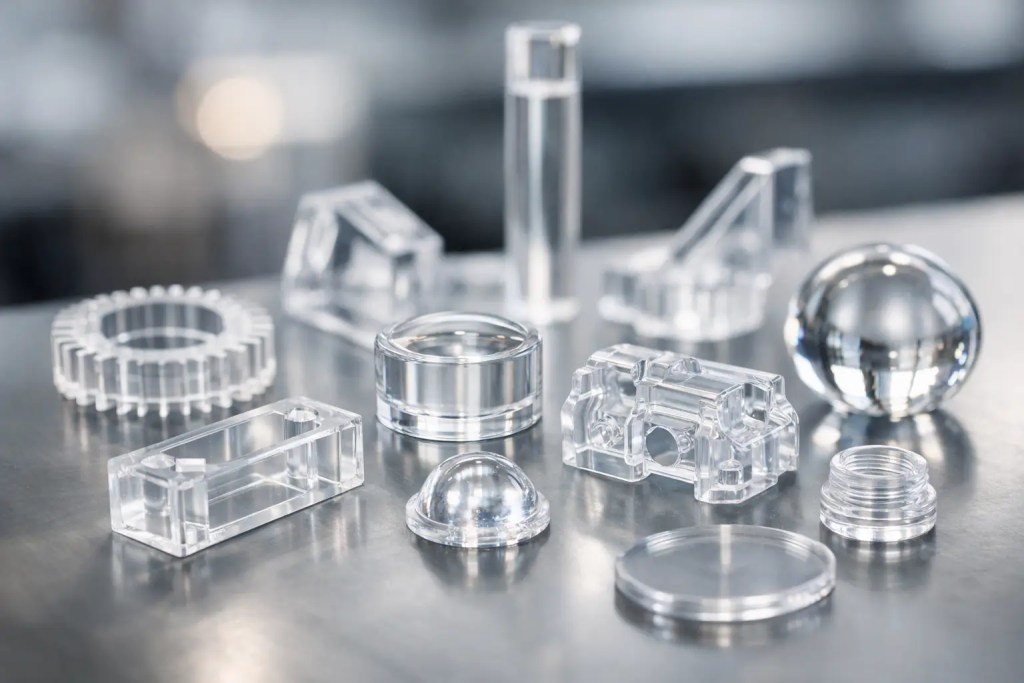
A clear prototype can answer questions fast that an opaque part cannot. If you need to inspect fluid flow, verify light transmission, check internal geometry, or present a product with a near-finished appearance, choosing the best materials for transparent prototype parts becomes a manufacturing decision, not just a cosmetic one.
The challenge is that “transparent” rarely means the same thing across processes. One material may machine into an optically clear lens-like part but cost more and require longer lead times. Another may print quickly with excellent detail yet still need sanding and coating to approach visual clarity. The right choice depends on what you are trying to prove – appearance, fit, function, or production intent.
What matters most in transparent prototyping
Engineers usually start with clarity, but clarity alone is not enough. A transparent prototype also needs the right dimensional accuracy, mechanical performance, and post-processing path for the application.
If the part is for a visual model, surface finish and edge quality may matter more than impact resistance. If it is for a fluidic housing or diagnostic enclosure, chemical resistance and leak performance may take priority. If it is a lighting cover or sensor window, the decision may come down to light diffusion, haze, and stability under heat.
That is why transparent part selection should begin with the use case. Ask four basic questions: how clear does the part need to be, what loads will it see, what tolerances matter, and how much finishing time is acceptable. Those answers will narrow the field quickly.
Best materials for transparent prototype parts by application
There is no single winner across every project. In practice, the best materials for transparent prototype parts usually fall into four groups: acrylic, polycarbonate, clear SLA resins, and cast urethanes.
Acrylic for optical clarity and presentation models
Acrylic, often specified as PMMA, is one of the strongest options when visual transparency is the top requirement. It offers excellent light transmission and can be machined and polished to a very high level of clarity. For display models, light guides, covers, and housings where aesthetics matter, acrylic is often the closest step to a polished consumer-facing appearance.
Its trade-off is toughness. Acrylic is relatively brittle compared with polycarbonate, so it is less forgiving in impact-heavy applications or assemblies that may be snapped together repeatedly. It also requires careful machining and finishing to avoid stress cracking or visible tool marks.
For engineers validating how a clear component will look in a final product, acrylic is often the benchmark. For teams validating abuse resistance, it usually is not.
Polycarbonate for impact resistance and functional testing
Polycarbonate is the more durable choice when a transparent part must handle load, impact, or elevated temperatures better than acrylic. It is widely used for protective covers, machine guards, and functional enclosures because it combines transparency with much higher toughness.
Machined polycarbonate can deliver good clarity, though it is not always as optically crisp as polished acrylic. It can also scratch more easily, which matters for prototypes handled frequently during testing. Even so, when the prototype needs to survive assembly trials, drop checks, or repeated use, polycarbonate is often the safer engineering decision.
This is a common trade-off in prototyping: acrylic usually wins on optical appearance, while polycarbonate usually wins on functional durability.
Clear SLA resin for detail, speed, and complex geometry
If the part has fine features, internal channels, or geometry that would be inefficient to machine, clear SLA resin is often the fastest route. SLA can produce smooth surfaces and very fine detail directly from CAD, making it useful for transparent concept models, medical device housings, microfluidic features, and design verification parts.
However, a freshly printed clear resin part is rarely truly clear without finishing. It may appear translucent or slightly cloudy due to layer interfaces and support contact points. Sanding, polishing, and clear coating can significantly improve appearance, but that adds labor and introduces some variability depending on geometry.
Mechanical properties also vary by resin family. Some clear SLA materials are stiff but brittle. Others are engineered for better toughness or heat resistance, but the optical result and long-term stability can differ. For short-cycle validation and visual checks, clear SLA is highly effective. For parts expected to mimic final injection-molded durability, it has limits.
Cast urethane for low-volume, production-like transparent parts
When a team needs several transparent prototypes with a consistent appearance, vacuum casting with clear urethane can be a strong bridge between one-off prototyping and production. This route starts with a master pattern, often produced by SLA or CNC, then uses silicone tooling to cast multiple parts.
The advantage is repeatability across small batches and a surface quality that can more closely resemble molded components. This can be useful for pilot builds, user trials, and customer samples. Clear urethanes can also be tinted or tuned for specific visual effects.
The limitation is that material properties are approximations of production plastics, not exact equivalents. Tool life is finite, and dimensional behavior depends on tooling condition and geometry. For low-volume evaluation before committing to hard tooling, though, cast urethane is often a practical middle ground.
Process choice affects transparency as much as material
Transparent prototyping is not only about resin or plastic selection. Process capability has a major effect on the final result.
CNC machining generally gives the best path to optical-grade transparency in acrylic and polycarbonate, especially when polishing is part of the workflow. It is well suited for flat surfaces, windows, covers, and simple to moderately complex shapes where tight tolerances matter.
SLA is better for complex geometry, fast iterations, and features that are difficult to machine. It can achieve very good visual transparency after finishing, but expecting out-of-machine optical clarity is usually unrealistic.
Vacuum casting becomes attractive when quantity matters. If you need ten to thirty transparent parts for field evaluation or stakeholder review, it can reduce unit cost compared with machining each one individually while keeping a more production-like appearance.
This is where an engineering-first supplier adds value. Material and process should be selected together, based on the required finish, quantity, geometry, and validation objective.
Common mistakes when selecting transparent materials
One common mistake is specifying “clear” without defining the actual visual requirement. A part intended to show internal flow only needs enough transparency to observe movement. A part intended to simulate a consumer product window may need low haze, polished edges, and controlled surface quality. Those are very different jobs.
Another mistake is choosing by process speed alone. A clear SLA part may arrive quickly, but if the design requires optical surfaces, the post-processing time can offset the speed advantage. Likewise, machining polycarbonate may look more expensive upfront, yet save time if the finished part can go straight into testing.
A third issue is ignoring long-term exposure. Some clear materials can yellow, haze, or craze depending on UV, chemicals, or heat. That may not matter for a one-week prototype review, but it matters for longer validation programs and outdoor or medical applications.
How to decide between the best materials for transparent prototype parts
A simple way to decide is to match the material to the test objective.
For appearance models and high optical clarity, start with acrylic. For transparent parts that must take impact or repeated handling, start with polycarbonate. For intricate geometry and fast iteration, start with clear SLA resin. For small batches that need a more production-like look, start with cast urethane.
Then refine the decision by asking what level of finishing is acceptable. If you can invest in polishing and coating, more options remain open. If you need parts ready for review with minimal secondary work, machining or casting may be the better route.
It also helps to think one phase ahead. A material that works well for concept validation may not be the right choice for pilot production. Teams that plan this transition early usually reduce redesigns and shorten procurement cycles.
At Additive3D Asia, that process-led approach matters because transparent prototyping often sits between design intent and manufacturing reality. The part has to look right, perform well enough for the test, and arrive on a timeline that keeps development moving.
Transparent prototypes are rarely about transparency alone. They are about reducing uncertainty – showing what light does inside an enclosure, how a fluid channel behaves, whether a cover fits and seals, or how a product will be perceived before tooling is locked. The best material is the one that answers those questions with the fewest compromises.