
Black is the default finish many teams ask for after HP Multi Jet Fusion, but dyeing MJF parts black is not just a cosmetic step. It changes how a prototype is reviewed, how a production part is perceived, and in some cases how consistently assemblies look across a batch. If the part is customer-facing, used in a fixture set, or headed into short-run production, the difference between a clean, even black and a patchy gray-black finish matters.
MJF parts, typically printed in PA12 or PA11, accept dye well because the process produces slightly porous nylon surfaces. That porosity is useful, but it also introduces variation. Geometry, wall thickness, orientation, powder refresh ratio, and the condition of the raw surface all affect final color. For engineering teams, the real question is not whether black dye is possible. It is how predictable the result will be and what design or process choices improve consistency.
Why dyeing MJF parts black is common
Raw MJF parts usually come out gray. For internal functional testing, that may be enough. But once parts move closer to presentation, pilot builds, or end-use applications, the unfinished look can become a problem. Black offers a more uniform, production-like appearance and tends to hide minor visual variation better than lighter colors.
There are also practical reasons. Black-dyed parts are often easier to standardize across builds when multiple assemblies need a consistent visual language. Jigs, housings, covers, brackets, and wearable components frequently move to black because it looks finished without requiring a painted coating that can chip or alter dimensions more significantly.
That said, dye is not the same as paint. Dye penetrates into the surface rather than sitting as a thick top layer. This helps preserve fine features and generally keeps the tactile feel of the nylon. It also means the final look depends heavily on the condition of the substrate.
How dyeing MJF parts black actually works
In most industrial workflows, the printed parts first go through depowdering and surface cleaning. Any residual powder left in recesses or textured zones can interfere with dye uptake, creating lighter spots or uneven tone. If a smoother aesthetic is required, media blasting or another surface refinement step may be completed before dyeing.
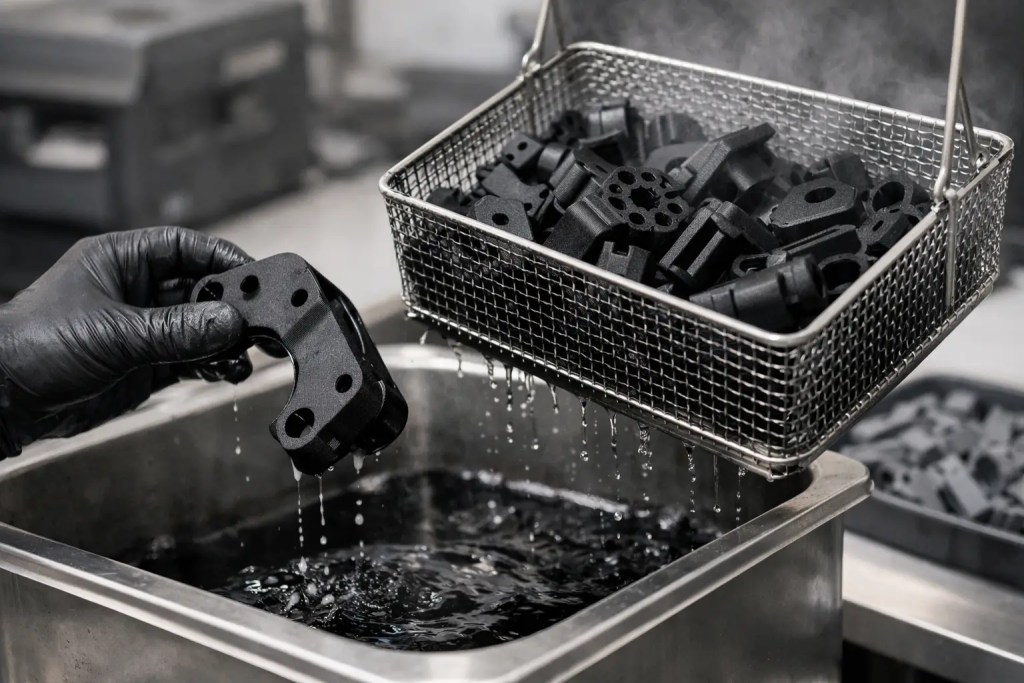
The dyeing process itself typically uses heated dye baths formulated for polyamide materials. Time, temperature, part loading, and agitation all influence how deeply and evenly the dye penetrates. After the dye bath, the parts are rinsed and dried under controlled conditions.
This sounds straightforward, but repeatability depends on discipline. If the incoming parts vary too much in surface condition, or if the batch includes drastically different geometries, color consistency can shift. That is why black dyeing should be treated as a controlled post-processing step, not an afterthought added at the end of production.
What affects the final black finish
The most common misconception is that all MJF parts will dye to the same shade of black automatically. In practice, several variables influence the result.
Surface texture is one of the biggest. A rougher surface scatters light differently and can appear lighter or less saturated even when it has absorbed the same amount of dye. Smoother surfaces often read as deeper black. If visual uniformity is critical, the pre-dye finishing route matters as much as the dye itself.
Part geometry also plays a role. Deep pockets, lattice structures, narrow channels, and heavy wall transitions can dye less evenly than open, accessible forms. Very thick sections may retain heat differently during dyeing and drying, while fine features can present slightly different surface density. Assemblies with multiple mating parts are especially sensitive because small differences become obvious when components sit side by side.
Material selection matters too. PA12 and PA11 do not always take dye in exactly the same way, and recycled versus fresh powder balance can subtly influence raw part appearance. For production programs, maintaining the same material specification and print process controls across batches supports better finish repeatability.
Dyeing MJF parts black for prototypes vs production
The acceptable standard for a prototype is often different from the standard for a production part. In prototyping, dyeing may be used mainly to improve presentation and reduce the visual distraction of raw gray surfaces. Slight tone variation may be acceptable if the part is being reviewed for form, fit, or function.
Production is less forgiving. If the part is sold to an end customer, installed in visible equipment, or used in a branded assembly, consistency becomes a purchasing requirement rather than a preference. That changes the process discussion. Teams should define whether they need a cosmetic black, a batch-matched black, or a finish suitable for customer-visible end use.
This is where a manufacturing partner with controlled workflows adds value. ISO 9001:2015-style process discipline is relevant because repeatable post-processing relies on standard work instructions, incoming inspection, batch handling, and clear finish criteria. A black finish can look simple from the outside, but consistency comes from process control.
Design considerations before you specify black dye
If dyeing MJF parts black is part of the requirement from the beginning, design decisions can help. Uniform wall sections tend to produce more consistent surfaces than abrupt mass changes. Accessible geometry is easier to clean and dye evenly than enclosed or highly intricate features. If a face is highly cosmetic, it may be worth orienting and designing the part so that critical surfaces have the most favorable as-printed condition before finishing.
Tolerance strategy matters as well. Dyeing is generally a low-build process compared with painting, but finishing and handling still interact with edges, mating surfaces, and snap fits. If your assembly depends on tight friction fits, test the full print-and-finish route rather than validating on raw parts alone.
It also helps to call out visual priorities on the drawing or quote request. Not every surface needs the same cosmetic standard. When engineering and procurement teams identify customer-facing surfaces, hidden surfaces, and functional datums early, the manufacturing process can be tuned around what actually matters.
When black dye is the right finish, and when it is not
Black dye is often the best choice when you want a clean, production-like finish while preserving the dimensional character of MJF nylon. It is well suited for enclosures, covers, clips, brackets, tooling aids, and many end-use polymer parts. It also scales better than hand-applied cosmetic finishing for repeat orders.
But it is not the answer to every requirement. If you need a glossy decorative surface, UV-stable outdoor appearance, or a perfectly uniform coating across highly variable geometry, another post-process may be more appropriate. Dye can fade over time in harsh exposure conditions, and dyed nylon will still retain some of the underlying MJF surface character unless additional smoothing steps are used.
There is also a cost and lead time trade-off. Adding black dyeing improves appearance, but it adds handling, processing time, and quality checks. For hidden internal components, that may not be justified. For customer-visible assemblies, it often is.
Specifying dyeing MJF parts black the right way
A good RFQ for black-dyed MJF parts should include more than just the word black. It should state the base material, the intended application, whether the finish is cosmetic or functional, and whether parts must match across multiple builds. If certain surfaces are visually critical, identify them. If your part will be assembled next to injection-molded black components, say so early because the acceptable appearance threshold changes.
It is also worth asking for guidance if the part has deep channels, thin ribs, enclosed cavities, or mixed cosmetic and precision surfaces. These details affect whether dyeing alone is enough or whether a different finishing sequence is needed.
At Additive3D Asia, these decisions are usually easiest to make before production starts, when print process, material choice, and post-processing can be aligned with the end-use requirement rather than corrected after the fact.
A black MJF part should not just look better in a photo. It should arrive with the level of finish, consistency, and production readiness your application actually demands.