
Aerospace programs rarely fail because a part could not be printed. They fail because the part could not be qualified, repeated, inspected, or delivered on schedule. That is why the real trends in metal additive manufacturing for aerospace parts are less about novelty and more about control – control of geometry, material behavior, process stability, and downstream production.
For engineering teams, the question is no longer whether metal additive manufacturing belongs in aerospace. It does. The more useful question is where it creates measurable value compared with machining, casting, or fabrication, and where it still needs a supporting process chain to meet flight, test, or production requirements. The current direction of the market makes that answer much clearer than it was even a few years ago.
Trends in metal additive manufacturing for aerospace parts that matter now
The strongest shift is from one-off demonstrators to application-specific production. Aerospace companies are targeting parts where additive manufacturing solves a real constraint: weight reduction, part consolidation, long lead times, obsolete spares, or thermal management. That sounds straightforward, but it changes how projects are evaluated.
A bracket that combines six machined components into one printed assembly is not valuable only because it looks optimized. It becomes valuable when it reduces fasteners, shortens assembly time, improves reliability, and avoids expensive tooling. The same applies to ducts, housings, heat exchangers, and satellite structures. Design freedom matters, but only when it improves the full manufacturing and operating picture.
A second trend is tighter process discipline. Aerospace customers increasingly expect additive suppliers to work within documented workflows, stable machine parameters, controlled powder handling, and traceable inspection plans. This is one reason certified quality systems matter. As metal additive moves closer to production intent, buyers are selecting manufacturing partners based on repeatability, not just machine access.
Qualification is becoming the center of the workflow
For many aerospace teams, qualification has become the pacing item. Printing the part is often faster than proving it performs consistently. That is pushing the industry toward better-defined build strategies, witness coupons, statistical process monitoring, and application-specific validation.
This trend affects design decisions early. Engineers are learning to avoid geometries that create unnecessary support removal risk, trapped powder issues, or inspection blind spots. In practice, the best aerospace additive parts are not simply topology-optimized. They are designed for printability, post-processing, inspection, and certification from the start.
There is also a growing distinction between parts intended for flight-critical use and parts intended for ground support, tooling, test rigs, UAV systems, or cabin and satellite applications. Qualification paths differ, and so should manufacturing strategy. In some cases, the fastest route is additive production in metal. In others, additive is best used to validate design intent before transitioning to casting or machining for higher-volume demand.
Material development is getting more application-driven
Early conversations around metal additive often focused on what could be printed. Current aerospace programs are more focused on what can be specified with confidence. That is a healthier direction.
Aluminum alloys remain highly relevant for aerospace because weight is still a primary driver. AlSi10Mg continues to be a practical option for lightweight structures, housings, and brackets where good strength-to-weight ratio and manufacturability are required. Stainless steels such as SS316L hold value for corrosion resistance, prototyping, and certain non-flight-critical applications, though they are not a universal answer for aerospace loads or temperature ranges.
What is changing is the level of scrutiny around material-property consistency after printing and heat treatment. Teams want to understand anisotropy, fatigue behavior, porosity control, and how surface condition affects performance. That is especially true for parts with cyclic loading or tight thermal requirements.
This material trend also reflects a broader reality: the best alloy on paper is not always the best production choice. Availability, qualification history, machinability after printing, and post-processing cost all matter. Aerospace procurement teams are increasingly weighing total route-to-part performance instead of selecting materials in isolation.
Hybrid manufacturing is replacing the all-additive mindset
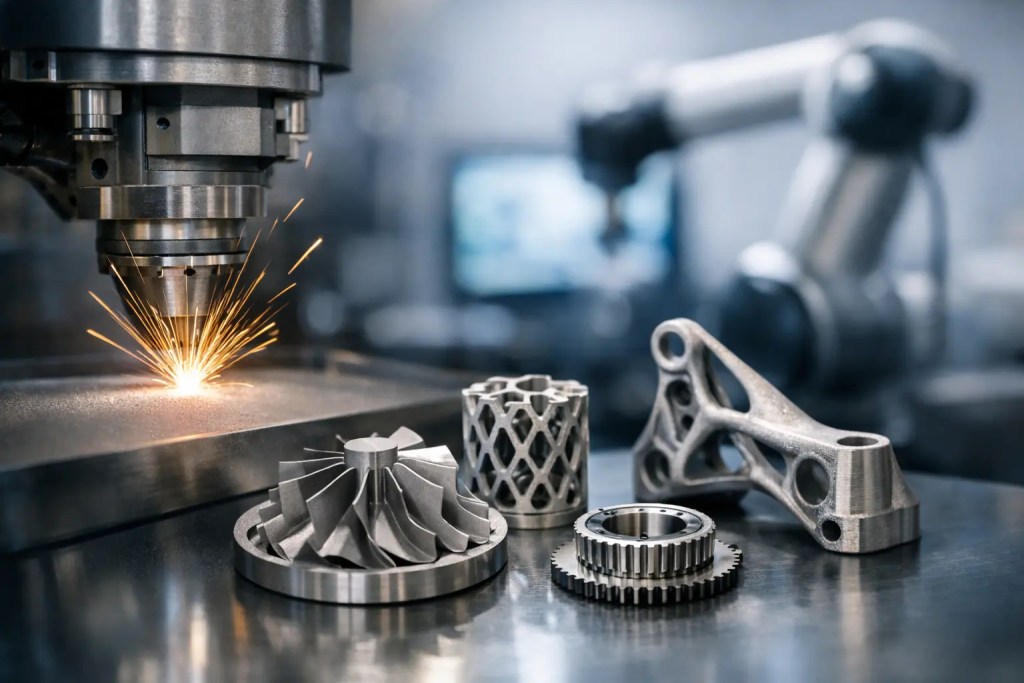
One of the most practical trends in metal additive manufacturing for aerospace parts is the rise of hybrid workflows. Mature aerospace production rarely depends on a single process from start to finish. Instead, additive is being used where it adds value, while machining, surface finishing, heat treatment, and inspection complete the part.
This hybrid approach is not a compromise. It is usually the most efficient way to meet tolerance, surface finish, and performance targets. A metal SLM part may deliver internal channels, consolidated geometry, and weight savings, but critical sealing faces, threaded features, and datum surfaces often still require CNC machining. Likewise, bead blasting, polishing, passivation, or coating may be necessary to achieve the final surface condition.
For buyers, this means supplier capability matters beyond the printer itself. A vendor that can manage both additive and complementary post-processing reduces handoff risk and shortens procurement cycles. It also improves accountability when tolerances, finish, and inspection criteria must be met on the same schedule.
Supply chain resilience is now a real adoption driver
Aerospace interest in metal additive has accelerated for a simple operational reason: conventional supply chains are still vulnerable to long lead times, tooling delays, and minimum-order constraints. Additive manufacturing does not solve every supply problem, but it does give teams a way to produce low-volume, high-complexity parts without waiting for hard tooling or overseas casting schedules.
This is especially relevant for spares, bridge production, and legacy components with limited documentation or declining supplier support. When a replacement part can be rebuilt from CAD, validated, and produced on demand, inventory strategy changes. The value is not only speed. It is the ability to reduce dependence on infrequent or unstable sourcing channels.
That said, aerospace teams should be realistic. Additive is not automatically cheaper than machining for simple parts, and it is not always the right route for large production quantities. The strongest business case usually appears where complexity is high, volume is moderate to low, and time matters.
Design rules are getting sharper, not looser
There was a period when additive manufacturing was marketed as freedom from conventional design limits. Aerospace engineers now know that is only half true. Additive removes some constraints and introduces others.
The current trend is better design literacy around metal AM. Engineers are paying closer attention to build orientation, support strategy, wall thickness, overhang behavior, residual stress, and achievable tolerances by feature type. This improves outcomes because redesign happens before production, not after a failed build.
It also changes how teams evaluate part candidates. The best candidates are not always the most complex parts in the assembly. They are the parts where additive improves function and remains manufacturable within controlled process windows. In many cases, modest redesign creates a stronger production result than aggressive optimization.
Data, inspection, and traceability are becoming buying criteria
As aerospace programs mature, machine capability alone is no longer a strong differentiator. Customers increasingly want documented process traceability, inspection reporting, and clear communication on what will happen after the build comes off the platform.
This is where an engineering-first manufacturing partner has an advantage. Quoting should not stop at price and lead time. It should include manufacturability feedback, realistic tolerance guidance, material suitability, and post-processing requirements. That reduces change orders later and improves confidence that the delivered part will match the application.
For service bureaus supporting aerospace work, reliability now means more than shipping quickly. It means controlled production, consistent documentation, and a process chain that can support prototypes, qualification builds, and short-run end-use parts without restarting the conversation each time. That is the operating model more aerospace buyers are looking for, and it is where providers such as Additive3D Asia fit best.
The next phase of adoption will not be driven by louder claims about design freedom. It will be driven by better decisions about where metal additive belongs, how it should be integrated with conventional manufacturing, and which suppliers can deliver repeatable results under real program pressure. For aerospace teams, that is good news. It means the technology is becoming less experimental and more useful where it counts most – on schedule, on spec, and with fewer surprises.