
A housing can look perfect on screen and still fail the moment a fastener bites too hard, a snap fit is flexed twice, or internal bosses drift out of tolerance. That is why ABS like resin 3D printing for functional housings needs to be evaluated as an engineering decision, not just a cosmetic one. For teams building enclosures for electronics, sensors, handheld devices, or test rigs, the material-process match determines whether a part is only presentation-ready or genuinely useful on the bench.
Where ABS-like resin fits for functional housings
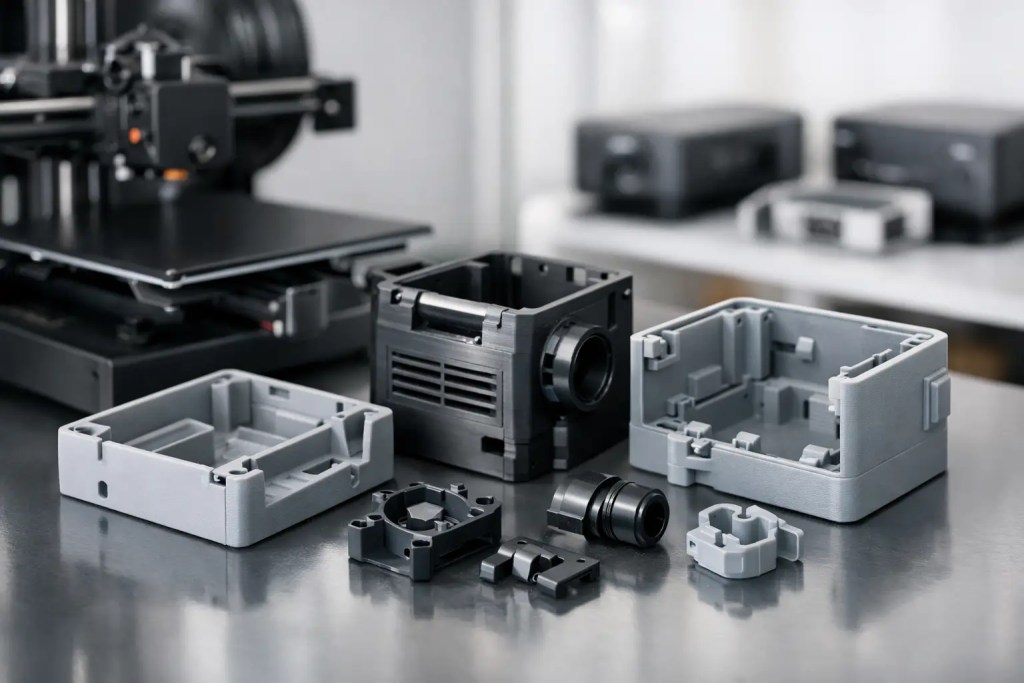
ABS-like resin is typically associated with SLA-style printing, where liquid photopolymer is cured layer by layer to produce high detail and smooth surfaces. For housings, that matters because enclosure parts often include thin walls, embossed text, recessed features, cable channels, and mating geometries that need to align cleanly. Compared with many extrusion-based prints, ABS-like resin can deliver sharper edges and more consistent small features.
The name can be misleading, though. ABS-like does not mean it behaves exactly like injection molded ABS. It usually refers to a resin formulated to mimic some of ABS plastic’s balance of stiffness and impact resistance, while retaining the print quality associated with resin processes. In practice, that makes it suitable for appearance-critical functional prototypes, assembly verification, and certain low- to moderate-load housings where dimensional accuracy and surface quality are priorities.
This is the key distinction. If your team needs a housing that must survive repeated field abuse, elevated temperatures, or aggressive fastening cycles, ABS-like resin may not be the final answer. If you need a housing that accurately represents production geometry and performs credibly in engineering validation, it can be a very efficient option.
ABS like resin 3D printing for functional housings in real use
Most housing programs are not decided by one property alone. Engineers typically need an acceptable combination of stiffness, detail resolution, appearance, and lead time. ABS-like resin performs well when the part must be assembled, inspected, and tested quickly without waiting for tooling or more complex production setup.
A common example is an electronics enclosure in early validation. The PCB, connectors, and mounting points must fit correctly. Exterior surfaces may need to be customer-facing. Screw bosses, vent patterns, and label recesses must be readable and dimensionally stable. In this phase, resin printing often gives a better representation of the final part than a rougher process would.
Another strong use case is low-volume pilot hardware, where the housing may be used for bench testing, internal demos, installation checks, or limited deployment in controlled environments. Here, the value is speed with usable function. Teams can review part ergonomics, mating interfaces, assembly sequence, and cosmetic finish in one build rather than splitting those checks across multiple prototypes.
That said, housing performance depends heavily on design details. Thin unsupported bosses, sharp internal corners, and over-constrained snap features can create failures that are blamed on the material when the geometry is equally responsible. Resin rewards disciplined design.
The main advantages and where they matter
The first advantage is feature fidelity. ABS-like resin can reproduce fine text, narrow slots, and precise sealing grooves better than many lower-resolution methods. That matters when a housing includes alignment features, small latches, or cosmetic surfaces that will be reviewed by stakeholders before production release.
The second advantage is surface finish. For customer-facing housings, a smoother as-printed surface reduces the gap between prototype and production intent. This is useful for industrial design reviews, investor samples, and products where tactile impression matters.
The third advantage is speed in the development cycle. A resin housing can move from CAD to part quickly, allowing design teams to validate fit and function early. In an engineering workflow, this shortens iteration loops and reduces the risk of carrying incorrect geometry into tooling.
The trade-off is durability under real mechanical stress. ABS-like resin may have decent stiffness, but its long-term response to impact, repeated flexing, heat, and UV exposure is application-dependent. It is usually less forgiving than true thermoplastics used in production processes.
Design rules that improve housing performance
For ABS like resin 3D printing for functional housings, geometry has a direct effect on survivability. Wall thickness should be kept consistent wherever possible. Very thin sections may print cleanly but still crack during assembly or handling. On the other hand, abrupt thick-to-thin transitions can create stress concentrations and cure-related distortion.
Bosses deserve special attention. Screw bosses should be supported with ribs where space allows, and the base transition should be filleted rather than sharp. If a housing will be opened and closed multiple times, self-tapping screws directly into brittle or undersized features are risky. Threaded inserts or alternative fastening strategies may be more reliable, depending on part size and service requirements.
Snap fits are possible, but they need caution. Resin materials generally do not tolerate repeated elastic deformation as well as molded ABS. A snap that works once for an assembly check may fail in repeated use. If your design requires regular opening, consider using screws, clips in another material, or a hybrid assembly.
Large flat panels also need planning. Resin can produce excellent visual quality, but thin wide surfaces may warp slightly if not designed with enough structure. Internal ribs, edge returns, and careful orientation during printing help maintain flatness.
When to choose another process instead
If the housing must withstand rough handling, repeated drops, or long service in a warm environment, nylon powder-bed processes such as MJF or SLS are often stronger candidates. These materials generally provide better toughness and more forgiving mechanical behavior for enclosures used in the field.
If the geometry is straightforward and the priority is a low-cost shop-floor part, FDM with a suitable thermoplastic may be acceptable, especially for larger housings where surface finish is secondary. If the part is moving toward volume production, injection molding becomes the logical next step once the design is stable enough to justify tooling.
This is where process breadth matters. A prototype housing may start in resin to validate geometry and appearance, move to nylon for more aggressive functional testing, and later transition to molding for production. A manufacturing partner with multiple in-house processes can guide that sequence without forcing the project into one technology.
Quality control matters more than the material name
Two ABS-like resin housings can perform very differently depending on print setup, post-curing, orientation, support strategy, and finishing control. For engineering teams, that is not a minor detail. Repeatability matters when you are evaluating fit against a PCB assembly, checking gasket compression, or comparing revisions across a validation program.
A controlled workflow reduces variation between builds. That includes file review, manufacturability checks, machine calibration, standardized post-processing, and inspection against defined requirements. ISO 9001:2015 systems are relevant here because they support process discipline rather than leaving outcomes to operator preference.
At Additive3D Asia, this kind of work is most effective when customers provide clear functional intent along with the CAD file. If a housing needs cosmetic surfaces protected, bosses held closely, or mating faces checked, that information should be specified up front. It leads to better process selection and fewer surprises after assembly.
How to decide if ABS-like resin is the right call
Start with the real job of the housing. Is it mainly for fit, appearance, and early functional review? ABS-like resin is often a strong choice. Does it need to survive repeated service loads, outdoor exposure, or abusive handling? You may be better served by another polymer process.
Then look at the assembly method. Housings with modest fastening loads, clean mating geometry, and limited service cycles are generally safer candidates than designs relying on aggressive snap fits or repeated screw insertion. Finally, consider where you are in the product lifecycle. Early-stage enclosures benefit from the speed and detail of resin. Late-stage validation may require a material closer to final-use behavior.
Good housing development is rarely about finding a single perfect process. It is about selecting the right process for the question you need answered now. If ABS-like resin can answer that question quickly and accurately, it earns its place in the workflow.
The most useful prototype is not the one that looks closest to production. It is the one that reveals the next design decision with the least delay and the fewest assumptions.