
A part that looks fine in CAD can still fail in MJF for simple reasons – a thin wall warps, a snap-fit is too stiff, a mating hole closes up, or trapped powder turns an assembly into a sealed box. If you are working out how to design parts for MJF, the real goal is not just printability. It is repeatable performance, predictable fit, and fewer revision cycles.
MJF is often chosen because it can produce strong nylon parts quickly, without the support structures required by many other additive processes. That does not mean every geometry behaves the same way. The best results come from designing around the process from the start, especially if the part may move from prototype to short-run production.
How to design parts for MJF with production in mind
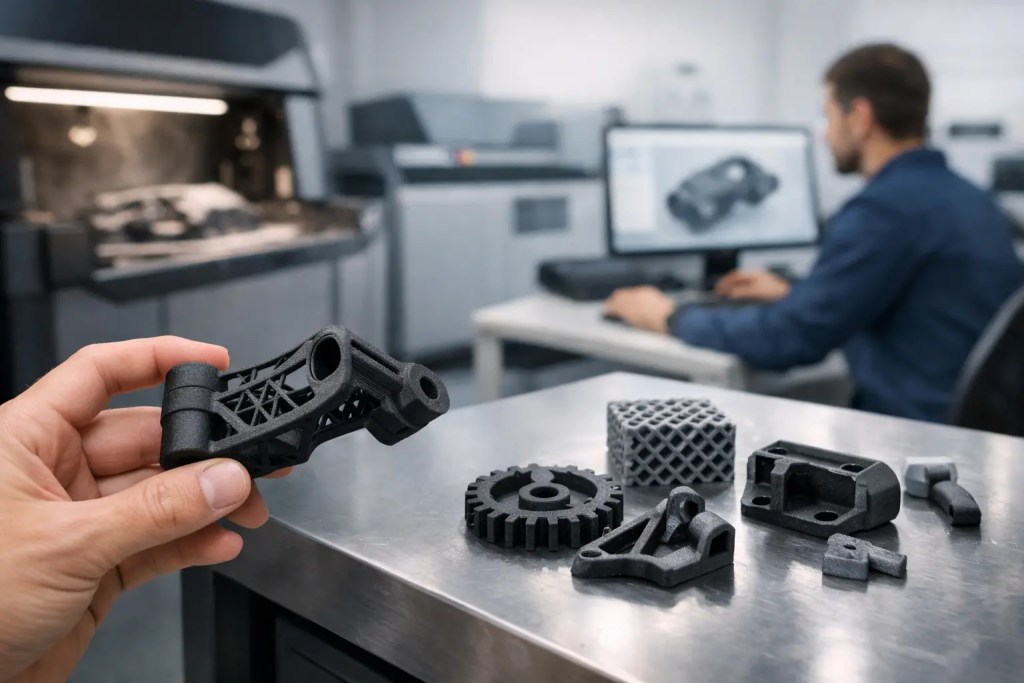
MJF builds parts in powdered polymer, typically PA12 or PA11, by selectively fusing each layer with heat and agents. Because the surrounding powder supports the part during printing, MJF handles complex geometries well. Internal channels, lattices, snap features, and nested assemblies are all possible. The trade-off is that thermal behavior, powder removal, and dimensional variation still need to be managed.
For most engineering teams, the design question is less about whether MJF can print a shape and more about whether the part will meet the functional requirement after printing, cooling, depowdering, and finishing. A cosmetic cover, a fixture, and an end-use duct may all be made in the same material, but they should not be designed by the same rules.
The first decision is always application-based. If the part needs stiffness and dimensional stability, PA12 is often a practical baseline. If you need higher ductility or better impact behavior, PA11 may be a better fit. Material choice affects how you size clips, hinges, and loaded sections, so it should be set before fine-tuning geometry.
Start with wall thickness and mass distribution
Wall thickness is one of the most common failure points in early MJF designs. Very thin walls can print, but that does not mean they will remain flat or durable after handling. As a general rule, keep unsupported walls thicker than the absolute minimum and avoid large thin panels when flatness matters.
Uniformity matters just as much as absolute thickness. If one region of the part is heavy and another is very thin, cooling behavior becomes uneven. That can introduce distortion or dimensional drift, especially across larger surfaces. A better approach is to keep section changes gradual and use ribs to add stiffness instead of building solid mass where it is not needed.
For larger housings or covers, hollowing the design can reduce cost and cooling stress, but the hollow volume must still be practical to depowder. If powder cannot be removed reliably, the model is not production-ready even if it prints.
Design holes, pins, and text with post-print reality in mind
Small holes tend to print undersized, and slender pins are more vulnerable than they appear on screen. That is normal for powder-bed polymer printing. If a hole has a strict fit requirement for a fastener, shaft, or insert, it is often better to design in machining allowance or expect a secondary operation rather than relying on as-printed dimensions alone.
The same principle applies to slots and mating pockets. Critical interfaces should be designed with realistic clearance, not nominal CAD contact. If the assembly must slide, rotate, or snap together, build that function into the geometry instead of assuming the process will hold zero-clearance intent.
Raised and recessed text generally works well in MJF, but it needs enough depth or height to remain legible after finishing. Fine decorative detail may soften, particularly if the part is bead blasted, dyed, or tumbled. Functional marking should be designed for readability, not just appearance in the model.
Tolerances in MJF depend on feature type and part size
One reason engineers ask how to design parts for MJF is that they want to know whether it can replace machined or molded parts for functional use. The honest answer is: sometimes. It depends on the tolerance scheme and where precision matters.
MJF is well suited for many functional components, but tolerance expectations should be tied to geometry, orientation, and scale. A small clip feature and a large enclosure panel do not behave the same way. Global dimensions may be acceptable while local fit features still need tuning. This is why tolerance planning should happen at the feature level.
If a dimension is critical, identify whether it truly needs to be held as printed. Many parts perform better when the printed body is optimized for strength and lead time, while a few key surfaces are adjusted through reaming, tapping, or machining after print. That hybrid approach is often more reliable than forcing every dimension into a single as-printed requirement.
Moving assemblies need clearance for powder and motion
MJF can produce multipart assemblies in one build, but only if you leave enough space between moving elements. Designers sometimes focus on whether two parts will fuse together and forget the second issue: whether powder can be removed from the interface afterward.
If you are designing hinges, captive joints, compliant mechanisms, or nested parts, clearance needs to support both separation during printing and practical depowdering. Deep, narrow gaps can trap powder even when the geometry is technically printable. The result is an assembly that arrives locked or partially seized.
Escape holes should be sized and placed based on how the part will actually be cleaned. Two small holes hidden in thick geometry may not be enough for a large internal cavity. In many cases, a slightly larger and better-positioned opening is the difference between a clever design and a manufacturable one.
Use fillets, ribs, and transitions to control stress
MJF parts are strong, but stress still concentrates at sharp internal corners and abrupt section changes. If the part will see repeated loading, impact, or snap deflection, generous radii usually improve durability. This is especially important in clips, living features, and mounts where bending is expected.
Ribs are often more efficient than adding bulk. They increase stiffness without the material cost and thermal mass of thick solid sections. The key is proportion. Overbuilt ribs can create local sink-like distortion behavior in polymer parts and make the section harder to cool evenly.
Where a rib meets a wall, smooth transitions matter. If the geometry looks mechanically abrupt, it usually behaves that way too.
Think about surface finish before release, not after
MJF typically produces a matte, slightly textured surface. For many jigs, fixtures, brackets, and internal components, that is acceptable as printed. For customer-facing parts, enclosures, or parts with sealing interfaces, finish requirements should influence design from the start.
A textured surface can change perceived fit on snap joints, lids, and hand-contact areas. Dyed black parts may look more uniform, but cosmetic quality still depends on the underlying geometry. Large flat faces, visible stair-stepping on shallow angles, or soft embossed details will not be fixed by color alone.
If the part requires machining, vapor smoothing, coating, or another secondary process, leave enough stock or feature tolerance to accommodate that step. Finish is not just aesthetic. It can affect friction, cleanability, and interface behavior.
Design for orientation flexibility, not a single perfect setup
Unlike some processes, MJF does not rely on support structures attached to the part. That gives more freedom in build orientation, but orientation still affects accuracy, surface appearance, and thermal response. A design that only works in one exact orientation is harder to schedule and scale.
It is usually better to create geometry that is tolerant of reasonable orientation changes. Symmetry helps. Balanced mass helps. Avoiding long unsupported-like spans, even in powder, also helps. If a critical face must have the best possible finish or dimensional control, call that out early so the manufacturing plan can be built around it.
This matters even more when moving from prototype quantities to repeat orders. Production-ready design is not just about one successful print. It is about maintaining results across builds.
Common design mistakes that slow MJF projects
Most avoidable delays come from a small set of issues: walls that are too thin for the part size, trapped powder in sealed cavities, unrealistic fit on mating features, oversized solid sections, and cosmetic expectations that do not match the process. None of these are unusual. They simply need to be addressed before release instead of after the first build review.
Another common mistake is treating MJF as either a prototype-only process or a drop-in replacement for injection molding. It can support both development and end-use production, but the design logic is different in each case. Prototype parts may prioritize speed and directional learning. Production parts need repeatability, inspection logic, and clear acceptance criteria.
That is where an engineering-led manufacturing review adds value. A reliable service bureau should not only quote the geometry, but also flag risk areas such as enclosed voids, fragile features, tolerance conflicts, and post-processing constraints. At Additive3D Asia, that review mindset is part of producing parts that move cleanly from CAD to shipment with fewer surprises.
The best MJF parts are rarely the most complex-looking ones. They are the parts designed with enough restraint to respect material behavior, enough clearance to assemble and function, and enough process awareness to scale beyond a single print. If you build those decisions into the model early, MJF becomes a faster and more dependable path to usable parts.