
A metal 3d printing review is only useful if it answers the question engineering teams actually have: will this process deliver the part you need, at the quality level you expect, within the lead time and cost your project can support? That is the real decision point. Metal additive manufacturing can produce complex, high-value parts that are difficult or wasteful to machine, but it is not automatically the best option for every bracket, housing, or tooling component.
For product teams evaluating metal parts, the conversation should move past novelty quickly. The better framework is performance, repeatability, post-processing load, and procurement risk. If the part must fit into a validated assembly, survive thermal cycling, and arrive on schedule with traceable production controls, then the review has to focus on manufacturing outcomes rather than marketing claims.
Metal 3D printing review: what matters most
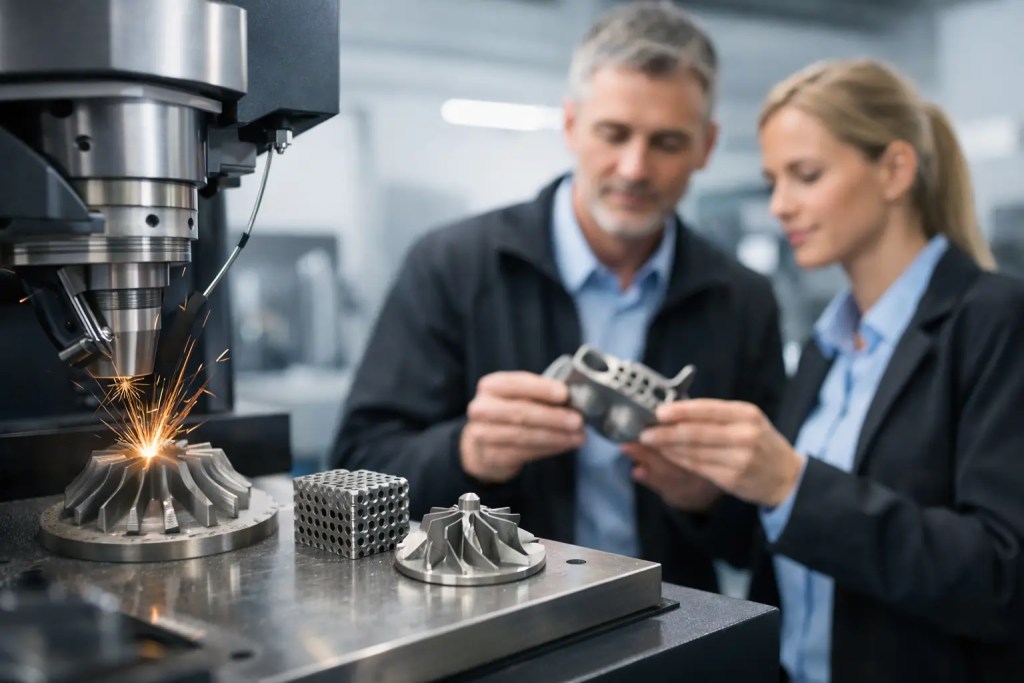
Most industrial metal 3D printing work today centers on powder bed fusion, particularly selective laser melting. The process builds parts layer by layer from metal powder, fusing geometry directly from CAD data. For engineers, the appeal is clear: internal channels, weight reduction, part consolidation, and rapid iteration without hard tooling.
The strength of the process is not just geometric freedom. It is the ability to compress development cycles for parts that would otherwise require multiple machining setups, welded assemblies, or expensive fixtures. This is especially valuable in R&D, low-volume production, and custom industrial applications where design changes are still likely.
The limits are just as important. Metal additive manufacturing introduces support strategy constraints, thermal distortion risk, surface roughness considerations, and finishing requirements that can materially affect cost and lead time. A part may print successfully but still need machining on sealing faces, tapped holes, or tight-tolerance interfaces. That is not a failure of the process. It is normal process planning.
Where metal additive performs well
Metal 3D printing is strongest when complexity has value. Lightweight structures, lattice-supported components, conformal cooling channels, and consolidated assemblies are all good examples. If one printed part replaces three machined components plus fastening hardware, the business case can become much stronger than a simple cost-per-part comparison suggests.
Tooling is another strong category. Jigs, fixtures, and inserts with internal cooling paths can improve cycle times or operator ergonomics without requiring high production volumes. Medical, aerospace, electronics, and industrial automation applications often benefit for the same reason: the geometry is doing real work, not just looking sophisticated.
Short-run end-use production can also make sense, particularly when demand is uncertain or product variants are frequent. In these cases, avoiding tooling investment has direct value. The economics depend on the part size, material, finishing requirements, and quantity, but for many low-volume programs, additive can be the more practical route.
Where the trade-offs show up
Surface finish is one of the first realities teams notice. As-printed metal parts usually do not match a fine machined finish, especially on visible or mating surfaces. If cosmetic quality or low-friction contact is important, plan for secondary finishing from the start.
Tolerance capability also needs a disciplined review. Metal additive can achieve strong dimensional performance, but not every feature should be printed to final specification. Critical bores, threads, datum surfaces, and bearing fits are often better machined after printing. Engineers who design with this hybrid workflow in mind usually get more predictable results.
Then there is support removal and orientation. A geometry that looks ideal in CAD may become expensive once support structures, heat flow, and distortion control are considered. Build orientation affects surface quality, strength behavior, lead time, and final cost. This is why manufacturability review matters before release, not after a purchase order is placed.
Materials in a practical metal 3D printing review
Material selection is where many projects are won or lost. Aluminum alloys such as AlSi10Mg are often chosen for lightweight components, housings, and heat-sensitive applications where low mass matters. Stainless steels such as SS316L are common when corrosion resistance and balanced mechanical performance are required. Other alloys may be selected for hardness, heat resistance, or application-specific certification requirements.
The key is to evaluate the material in its actual printed and post-processed condition, not by assuming it will behave exactly like wrought stock in every direction and every finish state. Mechanical properties can be excellent, but they are still linked to process parameters, orientation, heat treatment, and finishing workflow. For functional parts, those variables should be part of the quote-stage discussion.
This is also where a manufacturing partner with both additive and conventional capabilities becomes useful. Some parts start as strong candidates for metal printing, then shift to CNC machining after cost and tolerance review. Others benefit from a combined route: print the near-net geometry, then machine the critical interfaces. That kind of process selection usually leads to better outcomes than forcing a part into a single manufacturing method.
Cost, lead time, and what buyers should compare
A fair metal 3d printing review cannot stop at unit price. Buyers should compare total project cost, including support removal, heat treatment, machining, inspection, surface finishing, and any validation work required for the application. A printed part may appear expensive next to a simple machined block, but if it removes assembly steps, shortens development time, or avoids tooling, the total value picture changes.
Lead time is similar. Printing itself is only one stage of production. Build preparation, machine scheduling, depowdering, stress relief, support removal, finishing, and inspection all affect delivery. Reliable suppliers are transparent about this because compressed schedules only work when the full workflow is controlled.
For procurement teams, consistency matters as much as speed. Standardized quoting, documented process controls, and quality systems reduce the risk of surprises late in the program. That is particularly important when the printed part is moving from prototype to pilot production or end-use deployment.
How to evaluate a supplier during a metal 3D printing review
The most useful question is not whether a supplier owns a metal machine. It is whether they can repeatedly deliver production-ready parts. That includes design feedback, material guidance, process planning, post-processing capability, inspection discipline, and clear communication on tolerances and lead times.
An ISO 9001:2015-certified workflow is one strong signal because it points to documented quality management rather than ad hoc execution. Engineers should also look for evidence of material familiarity, realistic design-for-additive guidance, and the ability to support secondary operations in-house or through controlled workflows.
Instant quoting can also be more than a convenience feature. When done well, it shortens the path from design upload to manufacturability review and purchasing approval. For busy engineering and sourcing teams, that reduction in procurement friction is not minor. It directly affects project velocity.
Additive3D Asia fits this model well because the value is not limited to metal SLM alone. The broader manufacturing coverage matters when a project needs polymer prototypes, metal functional parts, CNC-finished interfaces, or a transition from development to short-run production under one operational framework.
The bottom line on metal additive manufacturing
Metal 3D printing is at its best when geometry, speed, and low-volume flexibility create measurable engineering value. It is less compelling when the part is simple, heavily tolerance-driven across every face, or better suited to conventional machining at the target volume. The right answer depends on the function of the part, the quantity required, and how much post-processing the application can absorb.
For engineers and manufacturing teams, the smartest review starts with the application rather than the technology. Ask what the part must do, which features are truly critical, and where additive removes cost or time from the broader program. When that analysis is done properly, metal 3D printing stops being a trend and becomes what it should be: a reliable production tool used where it delivers a clear operational advantage.
If you are evaluating a metal part now, treat the print process and the finishing plan as one manufacturing decision. That single shift usually leads to better parts, better quotes, and fewer surprises after release.