
A part can meet dimensional targets and still fail in the field because the surface is too rough, the support marks interfere with assembly, or the appearance is not production-ready. That is why the best post processing methods for 3D printed parts are not cosmetic add-ons. They are manufacturing steps that directly affect fit, function, durability, and customer acceptance.
For engineering teams, the right finishing plan starts with a simple question: what does the part need to do after printing? A cosmetic concept model, a PA12 jig, a clear SLA cover, and an AlSi10Mg bracket all need different treatment. Good post-processing improves the part. Poor post-processing adds cost, variability, or dimensional drift. The goal is repeatable outcomes, not just a smoother surface.
How to choose the best post processing methods for 3D printed parts
The correct method depends on the print technology, material, tolerance requirement, and final application. An FDM prototype may only need support removal and light sanding. An SLS housing may benefit from media blasting and dyeing. A metal SLM component may require support removal, machining on critical interfaces, and heat treatment before it is ready for use.
Surface finish is only one variable. Engineers should also consider whether the finishing step changes dimensions, affects mechanical properties, improves chemical resistance, or supports downstream operations such as painting, sealing, or assembly. In production environments, repeatability matters as much as visual quality. A finish that looks good on one sample but varies across a batch is not the best choice.
Start with the process and material
Different additive processes leave different surface conditions, and that dictates the finishing path.
FDM typically shows visible layer lines and may have support scars on overhangs. It is often the most labor-intensive process to finish to a cosmetic standard, especially on complex geometries.
SLA produces high detail and relatively smooth surfaces, but parts require resin removal, UV post-curing, and careful handling to avoid damaging fine features. Clear SLA parts also need more intensive finishing if optical clarity matters.
SLS and MJF parts usually have a matte, slightly granular surface. They often respond well to bead blasting, dyeing, sealing, and vapor or chemical smoothing depending on the material and performance target. For functional polymer parts, this combination often offers one of the best balances of finish quality, throughput, and consistency.
Metal additive parts such as AlSi10Mg or SS316L introduce another layer of complexity. Support removal, stress relief, machining, and surface refinement are often necessary to meet production requirements. In many metal applications, post-processing is not optional. It is part of the manufacturing route.
Mechanical finishing methods
Mechanical finishing remains one of the most common options because it is flexible and works across many materials.
Support removal and depowdering
This is the first step, but it should not be treated as routine cleanup. Improper support removal can gouge contact points, distort thin walls, or create stress concentrations. For powder-bed parts, thorough depowdering is critical for internal channels, threaded regions, and assemblies with moving interfaces.
On production programs, this step benefits from standardized work instructions. The difference between acceptable and inconsistent output often starts here.
Sanding and polishing
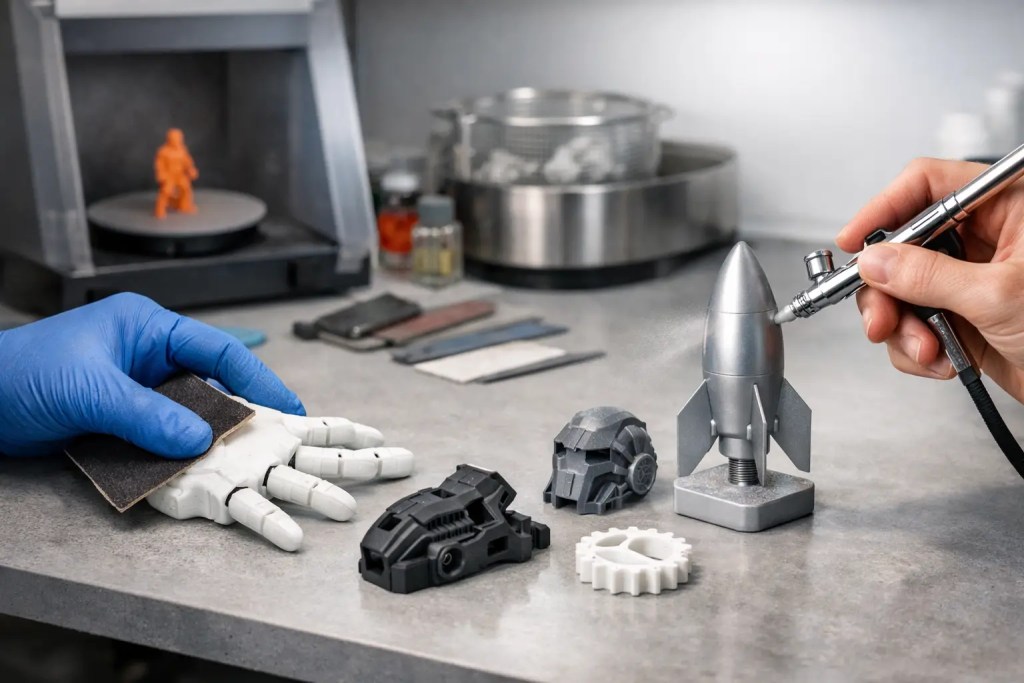
Sanding is widely used on FDM and SLA parts to reduce layer lines and prepare the surface for coating. It can produce excellent results, but it is labor-dependent and can quickly alter geometry on edges, corners, and thin features. For concept models and display parts, that trade-off may be acceptable. For precision features, it usually is not.
Polishing is common for clear resins and some metal applications. The challenge is that a polished appearance does not guarantee uniform optical or dimensional quality. On transparent SLA parts, several controlled polishing stages are typically needed to approach useful clarity.
Media blasting
Bead blasting or similar media finishing is often one of the best post processing methods for 3D printed parts made with SLS, MJF, and metal processes. It cleans the surface, removes residual powder, and creates a more uniform visual finish without the labor burden of hand sanding every surface.
That said, blasting is not dimensionally neutral. Aggressive parameters can soften edge definition or affect fine text and small features. It works best when the process is matched to the material, feature size, and desired texture.
Chemical and thermal finishing methods
These methods are valuable when consistency and throughput matter, but they require tight process control.
Vapor or chemical smoothing
Chemical smoothing can significantly reduce surface roughness on compatible polymers and improve the look and feel of end-use parts. It is especially useful when the target is a more sealed surface for housings, covers, or consumer-facing components.
The main advantage is uniformity over complex shapes that are difficult to sand manually. The main risk is feature rounding, dimensional change, or material compatibility issues. If a part has tight mating features, threads, or snap fits, the smoothing process must be validated before release.
Heat treatment and stress relief
For metal printed parts, thermal post-processing is often essential. Stress relief reduces residual stresses introduced during the build, while other heat treatment routes can improve microstructure and mechanical performance depending on the alloy and application.
Polymer parts can also be thermally treated in some cases, but the benefits vary. The critical point is that heat affects both properties and geometry. If flatness, hole position, or tolerance stack-up matters, thermal cycles need to be accounted for in the manufacturing plan.
Coatings and appearance-focused finishes
A coating can do more than improve appearance. It can also provide sealing, wear resistance, chemical protection, or a cleaner tactile finish.
Priming and painting
Painting is common for presentation models, branded enclosures, and production-like prototypes. The best results come when painting is treated as a full process, not just a final spray step. Surface preparation, filling, primer selection, and cure conditions all influence adhesion and finish quality.
For rougher processes such as FDM, painting can hide surface artifacts, but only after substantial prep work. For SLA, SLS, or MJF parts, the prep path is often more efficient. If cosmetic quality is a release requirement, the print process and the finishing process should be chosen together.
Dyeing and sealing
Dyeing is particularly effective for nylon parts from SLS and MJF. It offers a cleaner, more production-ready appearance than raw white or gray parts and generally maintains geometry better than heavy paint buildup. Sealing can further improve stain resistance and make surfaces easier to clean.
This combination works well for functional housings, brackets, and low-volume end-use polymer parts where appearance matters but dimensional reliability still comes first.
Plating and specialty coatings
For some applications, conductive, wear-resistant, or decorative coatings are justified. These are more specialized routes and usually make sense when the printed component has a defined performance need, such as EMI shielding or higher surface hardness.
The trade-off is process complexity. Coating thickness, adhesion, and substrate preparation need to be controlled carefully, especially on polymer parts.
Machining after printing
One of the most effective ways to finish a printed part is not to force every feature out of the printer. Print the overall geometry, then machine the critical surfaces.
This hybrid approach is common on metal parts and increasingly useful on high-value polymer components. Datums, sealing faces, bores, and threaded features often perform better when they are finish-machined. It adds a secondary operation, but it can be the fastest route to production-ready accuracy.
For engineering teams, this is often the difference between a part that looks complete and a part that installs correctly every time.
Matching method to application
If the part is a visual prototype, prioritize appearance and speed. If it is a jig or fixture, surface perfection matters less than edge integrity, grip, and dimensional stability. If it is an end-use part, the finishing method should be selected based on actual service conditions, including wear, cleaning exposure, UV, and handling.
There is no universal best finish across all 3D printed parts. The best choice is the one that meets function, quality, and cost targets with repeatable output. That is why experienced manufacturers build post-processing into the part strategy from the quoting stage onward, instead of treating it as rework after printing.
At Additive3D Asia, that process-led approach matters because a PA11 functional assembly, an SLA appearance model, and a machined AlSi10Mg production part should not move through the same finishing logic. The finishing route has to match the part’s job.
When post-processing is selected correctly, the part does not just look better on arrival. It performs more predictably in testing, assembly, and use. That is the standard worth targeting.