
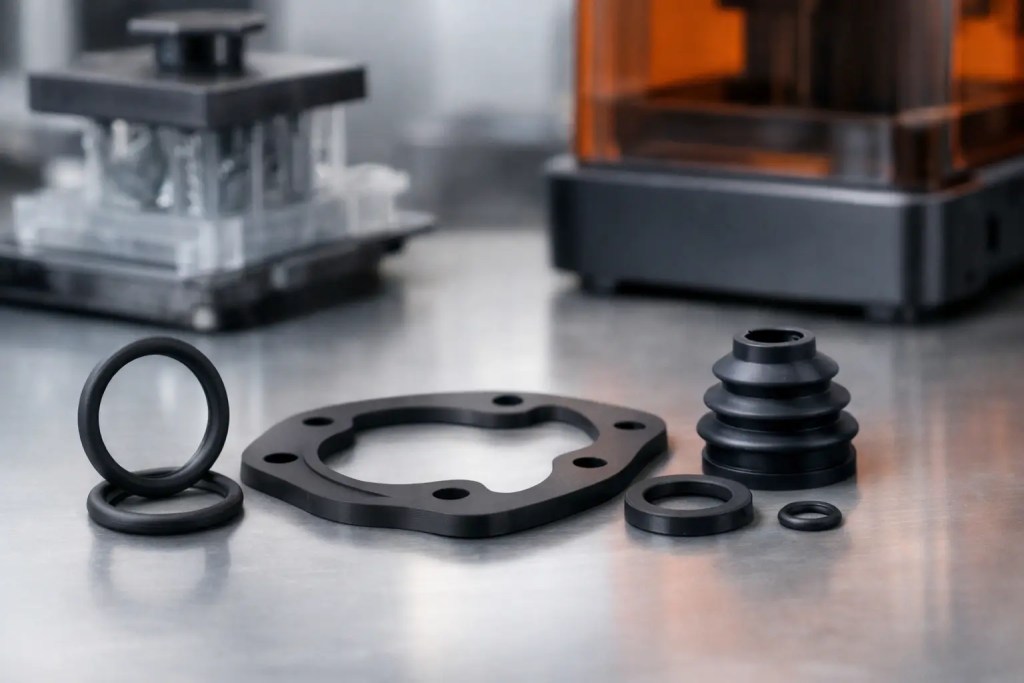
A gasket that looks right on screen can still fail the moment you clamp it between two mating parts. Compression set, flange flatness, bolt load, groove fill, and surface contact all show up fast in physical testing. That is where rubber like SLA resin for gaskets and seals becomes useful – not as a universal substitute for molded elastomers, but as a fast, precise way to validate geometry, assembly behavior, and early-stage sealing performance.
For engineers working under schedule pressure, the question is rarely whether a flexible resin can replace every production rubber. The real question is whether it can shorten the path to a working design with fewer tooling revisions. In many cases, the answer is yes, provided the material is chosen for the right job and the limitations are understood upfront.
Where rubber-like SLA resin fits
SLA is attractive for gasket and seal development because it combines fine feature resolution with smooth surfaces and consistent dimensional control. Those traits matter when you are printing thin lips, narrow grooves, bellows-like features, or custom sealing geometries that would be slow to machine and too early to tool.
Rubber-like SLA resin for gaskets and seals is typically selected when teams need to check form, fit, and functional compression in a prototype or pre-production phase. It is especially effective for custom enclosure gaskets, sensor housings, fluid covers, dust seals, cable pass-throughs, and low-pressure static sealing concepts. If the design includes complex cross-sections or integrated features that would complicate conventional prototype methods, SLA can remove a lot of friction from the iteration cycle.
There is also a practical procurement advantage. Instead of splitting prototype work across multiple vendors, teams can move from CAD upload to manufacturability review, printed parts, and post-processing under one controlled workflow. That reduces delay and makes it easier to compare revisions against a stable process baseline.
What SLA does well for gasket and seal prototypes
The biggest strength of SLA in this application is precision. Gaskets often fail for very ordinary reasons – a corner radius is too sharp, a groove is undersized, a flange is not contacting evenly, or the part compresses in the wrong region. High-resolution printing makes those problems visible earlier.
Surface finish is another advantage. Compared with rougher additive processes, SLA can produce smoother sealing faces, which helps when evaluating contact behavior against rigid mating parts. That does not automatically guarantee leak-free performance, but it gives engineers a cleaner baseline for testing than many other prototype routes.
Material behavior can also be directionally useful. A rubber-like resin will deform under load and recover enough to let teams assess compression, insertion force, latch interference, and assembly tolerance stack-up. For housings and covers where the seal geometry must be tuned before tooling, that feedback is valuable.
SLA is also well suited to low-volume custom parts. If you need five design variants with different bead heights or wall thicknesses, printing is much faster than creating soft tooling for each option. That speed matters in R&D and pilot builds, where design freezes rarely happen on the first pass.
Where the trade-offs start
The phrase rubber-like can be misleading if it is treated as equal to production-grade rubber. It is not. Most SLA elastomeric resins are best viewed as engineering prototype materials with useful flexibility, not direct replacements for silicone, EPDM, nitrile, or fluorocarbon in demanding service conditions.
Compression set is one area to watch closely. A printed seal may perform acceptably in short-cycle bench testing but lose recovery over longer dwell times or repeated compression. If the application depends on maintaining clamp force for extended periods, prototype success with SLA should be treated as directional rather than final proof.
Chemical resistance is another variable. Some resins tolerate incidental exposure well, while others degrade with oils, fuels, solvents, or aggressive cleaners. Temperature performance also varies. A seal near motors, outdoor enclosures, hot fluid paths, or sterilization cycles may quickly exceed what a rubber-like resin can handle reliably.
Tear strength and fatigue life matter too. Thin membranes, snap-in seals, and dynamic applications with sliding contact or repeated flexing can expose the limits of the material. If the part sees rotational motion, pressure cycling, or abrasion, SLA may help validate geometry but not long-term durability.
How to evaluate rubber-like SLA resin for gaskets and seals
The right way to use this material is as part of a staged engineering decision, not a shortcut around qualification. Start with the sealing function itself. Is the part static or dynamic? Is it sealing dust, splash, air, or liquid? What is the pressure range, temperature exposure, chemical environment, and expected service life?
If the answer points to a static, low-pressure seal with moderate environmental exposure, SLA is often a strong prototyping option. If the part is a dynamic shaft seal, a high-temperature manifold gasket, or a chemically exposed industrial seal, the printed resin is less likely to reflect production behavior closely enough.
Geometry is the next checkpoint. SLA performs well when fine details matter – custom ribs, lips, integrated compression stops, or unusual cross-sections. It is also useful when the mating hardware is already fixed and the gasket must adapt to that constraint. In those cases, dimensional accuracy and fast revision cycles are more important than matching every property of the final elastomer.
Testing should be structured around what the material can prove. Good prototype tests include assembly fit, closure force, compression behavior, leak checks at modest pressure, tolerance studies, and design comparisons between revisions. Less reliable indicators include long-duration creep resistance, chemical aging, and final field life.
Design considerations that improve results
Printed flexible parts benefit from design discipline. Very thin unsupported features may distort, while overly thick sections can create uneven compression behavior. In many gasket designs, a controlled bead, rib, or hollowed section performs better than simply scaling the entire cross-section thicker.
Part orientation and post-processing also affect outcomes. Engineers should expect that print direction, support placement, cure conditions, and finishing can influence both dimensions and local surface quality. For sealing faces and critical grooves, that process control matters. An ISO 9001:2015-certified workflow is relevant here because repeatability is not just about the printer – it depends on the full chain from file preparation through finishing and inspection.
Tolerance strategy should be realistic. SLA can achieve fine detail, but mating part variation still drives seal behavior. If you are validating an enclosure gasket, test against real production-intent hardware, not only nominal CAD. That is often where clamp load imbalance and local gaps become visible.
It is also worth designing with the next manufacturing step in mind. If the printed prototype is helping validate a future molded rubber part, keep geometry transferable where possible. A design that works only because SLA allowed an impractical feature may create avoidable redesign later.
When to move beyond SLA
Rubber-like SLA resin for gaskets and seals is usually most effective in early validation, pre-tooling review, and limited functional testing. Once the design is stable and the application requires real environmental confidence, teams should transition to a process and material that better represent production conditions.
That next step may be molded elastomers, urethane casting, or another manufacturing route depending on volume, hardness target, and service environment. The key is timing. Moving too early into tooling locks in uncertainty. Moving too late keeps the program dependent on prototype data that may not translate.
A practical manufacturing partner can help bridge that gap by comparing additive and conventional options within the same project. That matters when procurement teams want one source for printed validation parts, secondary finishing, and the eventual move to short-run or production-grade components. Additive3D Asia supports that decision path by combining industrial 3D printing with complementary production processes under a controlled manufacturing workflow.
The most useful way to think about it
For gasket and seal work, rubber-like SLA resin is best treated as a decision-acceleration material. It helps answer whether the geometry seals, whether the assembly closes correctly, and whether the design is ready for the next investment. Used that way, it can remove weeks from development and reduce tooling risk.
The strongest results come from matching the material to the question you need to answer. If the question is about fit, compression, and design intent, SLA is often a very efficient path. If the question is about years of chemical exposure and field life, it is time to test in a production-representative elastomer. That distinction saves time, budget, and avoidable rework – which is exactly what good engineering process should do.