
When a production line is waiting on a simple checking gauge or assembly nest, the real cost is rarely the tool itself. It is the missed output, the delayed validation, and the engineering time spent chasing a workaround. That is why example jig fixture production with nylon 3D printing has become a practical manufacturing decision, not a novelty. For many low-volume and fast-changeover environments, nylon tooling closes the gap between prototype support and fully machined hard tooling.
Where nylon 3D printed jigs and fixtures make sense
Jigs and fixtures are not all doing the same job, so they should not all be built the same way. A drill guide that sees repeated localized loads has different demands than a pick-and-place tray, inspection fixture, soldering mask, or assembly locator. Nylon 3D printing is well suited to tooling that needs good mechanical performance, low weight, fast turnaround, and geometry that would be inefficient to machine.
In practice, that means engineers often choose nylon for operator aids, positioning nests, soft-touch workholding, go-no-go checking fixtures, cable routing tools, and end-of-arm tooling components. The value is strongest when the part geometry changes often, the production quantity is moderate, or the fixture needs to be deployed quickly across multiple stations.
This is also where additive changes the design conversation. Instead of starting from stock material and asking what can be removed, the team can design around the process itself. Integrated handles, datum labels, part identification, cable channels, vacuum paths, and weight-reduction lattices can be built directly into the fixture body. That reduces assembly steps and removes secondary operations that add time without adding function.
Why nylon is often the right material choice
For fixture applications, nylon offers a useful balance of strength, toughness, dimensional stability, and wear resistance. Materials such as PA12 are widely used because they handle repeated handling better than brittle photopolymers and provide more design freedom than many basic filament options. For jigs and fixtures that need some impact resistance and daily operator use, that balance matters.
The other advantage is process consistency. Industrial powder-bed technologies such as HP Multi Jet Fusion and SLS can produce nylon parts with reliable mechanical properties and without the support structures associated with some other methods. That matters for fixtures because flatness, hole quality, and repeatability are often more important than cosmetic appearance.
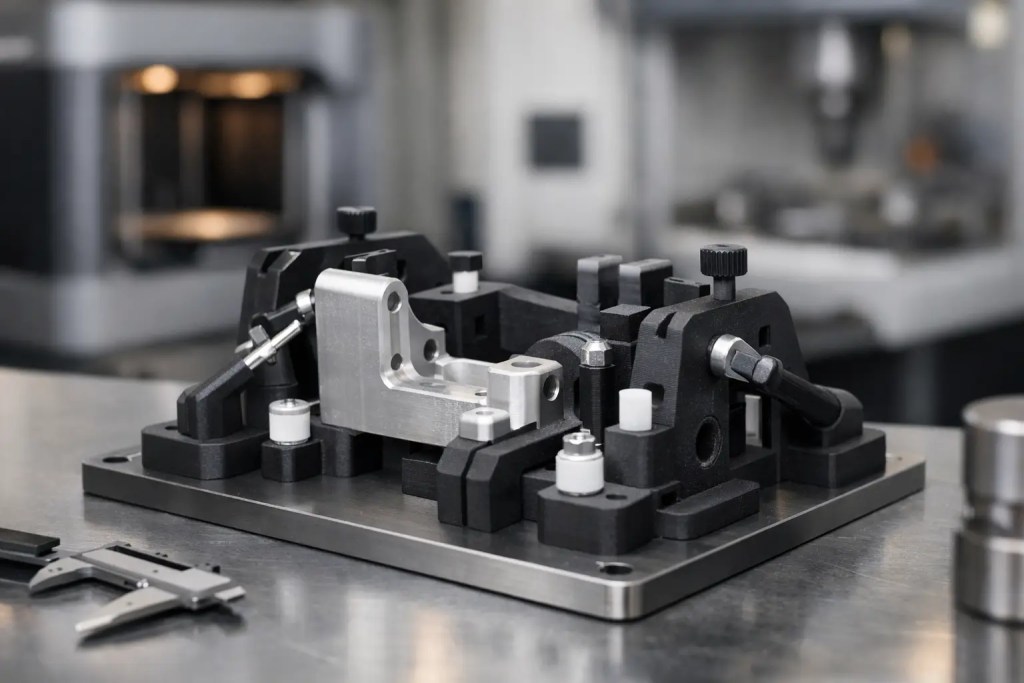
That said, nylon is not a universal replacement for aluminum or steel tooling. If the fixture sees high clamping loads, aggressive abrasion, elevated temperatures, or tight tolerance stacks over large spans, a machined tool may still be the better decision. In many real production environments, the answer is hybrid tooling – a nylon body with metal bushings, threaded inserts, dowel pins, or wear plates where needed.
An example jig fixture production with nylon 3D printing
Consider a contract manufacturer assembling a plastic enclosure with an internal PCB, gasket, and fasteners. The line needs a fixture that locates the lower housing, holds the board at a defined angle during cable insertion, and guides the operator during screw installation. The product is already in pilot build, but enclosure revisions are still likely over the next six weeks.
If this fixture is machined from aluminum immediately, the team gets durability but pays for lead time and revision risk. Any geometry change to the housing may require rework or a full remake. If the team uses nylon 3D printing instead, the fixture can be produced quickly, deployed to the line, and adjusted as the assembly sequence matures.
The fixture body can include contoured contact surfaces matched to the housing, integrated datum references, embossed part numbers, and dedicated pockets for captive magnets or elastomer pads. Screw guide towers can be printed into the fixture, while high-wear drill or fastening points can use press-fit metal inserts. The result is a production-ready tool that supports real operator use without waiting for hard tooling release.
This is the kind of application where speed has direct operational value. Engineers can test ergonomics, verify clearance for drivers and hands, confirm whether cable routing is practical, and refine the fixture after only a short production run. Once the product stabilizes, the same design can remain in nylon if performance is sufficient, or it can become the basis for a machined version.
Design details that improve fixture performance
Successful fixture design with nylon depends less on copying a machined tool and more on designing for additive from the start. Wall thickness should be consistent where possible to control distortion. Large flat sections benefit from ribs rather than solid mass. Contact faces should be defined around functional datums instead of trying to constrain every surface.
Tolerance strategy also matters. Printed nylon can deliver strong repeatability, but fixture designers should still assign tight tolerances only where they affect function. Critical interfaces such as bushing bores, dowel locations, and alignment pins may need post-machining or secondary hardware. Non-critical surfaces should retain realistic allowances so the fixture remains cost-effective.
Ergonomics are often overlooked, yet they are one of the strongest reasons to print fixtures. Curved grips, finger clearances, lightweight structures, and visual orientation features are easy to add and can reduce operator error. On a high-mix line, that can be as valuable as raw dimensional accuracy.
Production benefits beyond part cost
The strongest business case for nylon jigs and fixtures is usually not the invoice price. It is the effect on manufacturing speed and change control. A fixture delivered in days instead of weeks allows pilot builds to start earlier, process issues to surface sooner, and engineering changes to be validated without disrupting the line.
Procurement teams also benefit from lower commitment at the uncertain stage of a program. Instead of freezing a design too early to justify machined tooling, they can release a printed fixture that is good enough for pre-production and early ramp. This reduces the cost of learning.
There is also an inventory advantage. When fixtures are digital-first, replacements do not need to sit on a shelf for long periods. A validated CAD file, process specification, and controlled production workflow can support on-demand reorders when a tool is damaged or a second line is added. For organizations focused on traceability and repeatability, that is far cleaner than relying on undocumented shop-floor modifications.
What to watch for before you release the job
Nylon fixture projects succeed when the performance requirements are defined clearly. Load case, temperature, contact wear, tolerance needs, and expected cycle count should be known before process selection. Without that, teams often overbuild the fixture or choose a material based on habit rather than use case.
Surface finish is another practical consideration. Powder-bed nylon parts typically have a slightly textured finish. That is acceptable for many assembly and inspection tools, but if the fixture interfaces with delicate cosmetic parts, contact areas may need finishing or protective pads. The same applies to ESD-sensitive assemblies, where the material and post-processing approach should be reviewed early.
Environmental exposure can also change the answer. Nylon can absorb moisture over time, which may affect dimensions and mechanical behavior depending on the application. In many shop-floor use cases, this is manageable and well understood. But if the fixture supports precision inspection in tightly controlled conditions, the design and material choice should account for it.
Choosing the right manufacturing partner
Jig and fixture work moves fastest when the supplier can do more than simply print the file. Design feedback, material guidance, insert installation, secondary machining, and finishing all affect whether the delivered tool performs on the line. A manufacturing partner with both additive and conventional processes can recommend where nylon is enough and where metal reinforcement or machining should be added.
This is especially relevant for engineering teams that do not want to manage multiple vendors just to release one production aid. An ISO 9001:2015-certified workflow, documented inspection practices, and repeatable process control matter because fixtures are functional manufacturing tools, not display parts. At Additive3D Asia, this is the practical advantage of combining industrial nylon printing with CNC machining, finishing, and production support under one operational workflow.
For engineers evaluating fixture options, the best question is not whether nylon 3D printing can replace every traditional tool. It cannot, and it should not. The better question is whether the fixture needs to exist quickly, iterate easily, and perform reliably enough to improve production now. In many cases, that answer is yes – and that is where nylon earns its place on the factory floor.