
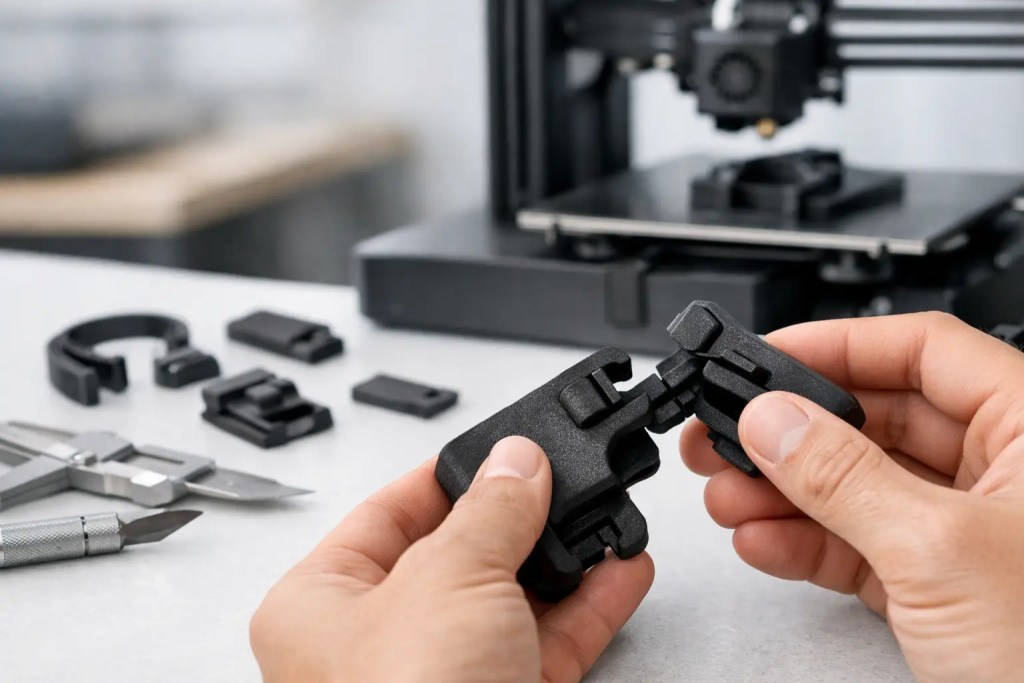
A snap fit that works once is a prototype. A snap fit that works through repeated assembly cycles, holds tolerance, and survives handling is a manufacturable part. That is why nylon 3D printing for snap fit parts gets specified so often in functional development and low-volume production. Nylon combines toughness, fatigue resistance, and controlled flexibility in a way many rigid photopolymers and commodity filaments do not.
For engineers, the appeal is straightforward. Snap fits depend on elastic deflection. The feature needs to bend far enough to assemble, then recover without cracking, whitening, or taking a permanent set too quickly. Nylon, especially PA12 and PA11 in powder bed processes, is well suited to that behavior. But the material alone does not guarantee success. Geometry, print orientation, process selection, wall thickness, and tolerance strategy all matter.
Why nylon 3D printing for snap fit parts is often the right choice
A snap fit is a stress-managed spring. During assembly, the cantilever, annular ring, or torsional feature stores energy and releases it into retention force. That makes material selection less about headline tensile strength and more about ductility, elongation, fatigue behavior, and environmental stability.
Nylon performs well because it can absorb strain without failing as abruptly as more brittle polymers. In practical terms, that means a hook or latch can flex repeatedly with lower risk of fracture. PA12 is commonly chosen when dimensional stability, balanced strength, and moisture resistance are priorities. PA11 is often favored when higher ductility and impact resistance are needed. If the part will be opened and closed often, that extra flexibility can be valuable.
The other advantage is manufacturing freedom. Powder bed technologies such as SLS and HP Multi Jet Fusion build parts without dedicated support structures, which allows more freedom around undercuts, enclosed latch geometries, and nested components. For snap features that need quick iteration, that can reduce both redesign time and tooling cost.
Process selection matters more than many teams expect
Not all nylon printing processes produce the same snap fit performance. The phrase nylon 3D printing for snap fit parts covers several routes, and the differences are meaningful.
SLS and MJF for functional snap features
Selective Laser Sintering and HP Multi Jet Fusion are usually the strongest candidates for functional snap fits in nylon. Both process nylon powders into parts with good mechanical performance and no support-contact scars on critical latch surfaces. They are commonly used for housings, clips, covers, retainers, and light-duty end-use assemblies.
MJF often delivers more consistent surface quality and tighter process control across builds, which can help when retention features rely on predictable dimensions. SLS remains a proven option for durable nylon parts and is widely used for prototypes through short production runs. The best choice depends on geometry, required finish, tolerance sensitivity, and production volume.
FDM nylon has a narrower window
FDM with nylon filament can work for larger snap features, fixtures, and internal validation parts, but it requires more caution. Layer adhesion, anisotropy, and warpage can all affect how a snap arm behaves under repeated deflection. A design that performs well in powder bed nylon may fail early in FDM if the bending load crosses weak interlayer planes.
That does not make FDM unsuitable. It makes orientation and design more critical. For simple clips or early concept checks, it can be cost-effective. For production-ready snap mechanisms, powder bed nylon is usually the safer path.
Designing snap fits in nylon without overbuilding them
The most common design mistake is making the snap arm too thick. Teams often add material to make the part feel safer, but a thicker section increases stiffness and raises assembly force. That drives stress higher at the root and can shorten life.
A better approach is to control strain through length, root radius, and gradual section changes. Longer arms reduce strain for the same deflection. Generous fillets at the base reduce stress concentration. Tapered arms can help balance stiffness and make load distribution more uniform.
Hook geometry also deserves attention. A steep assembly face increases insertion force. A lead-in angle lowers force and reduces the risk of gouging the mating part. The retention face can remain steeper if pull-out resistance matters, but there is always a trade-off between ease of assembly and holding strength.
Clearance should be intentional, not guessed. Nylon parts from SLS or MJF are accurate enough for repeatable snap fits, but they are not injection-molded parts coming off polished steel tools. Allowance for surface texture, feature size, and expected process variation should be built into the latch and mating channel. Small test coupons are often the fastest way to validate fit before committing to a full assembly build.
Orientation, anisotropy, and fatigue life
Even with good material choice, print direction changes results. Snap arms loaded across their weakest direction will show lower life and less predictable failure behavior. This is especially relevant in FDM, but it also matters in powder bed printing where mechanical properties can still vary by axis.
If the snap arm is the functional heart of the part, orient the build to support the best possible strength in the direction of bending. That may not align with the orientation that gives the best cosmetic finish. This is where engineering priorities need to be clear. For an internal latch, mechanical performance usually matters more than a smoother visible face. For a consumer-facing enclosure, the decision may require compromise or post-processing.
Repeated-use snap fits should be evaluated for fatigue, not just single-cycle assembly. A latch that survives one installation can still fail after twenty or fifty cycles if strain is too high. Nylon is forgiving, but it is not immune. If the use case involves frequent access panels, battery doors, service covers, or wearable closures, prototype testing should reflect actual cycle count and environment.
Environmental exposure changes performance
Nylon is hygroscopic, which means it absorbs moisture from the environment. That can make the material tougher and slightly more flexible, but it can also affect dimensions and stiffness. In some snap fit designs, that is helpful. In others, especially tight-tolerance enclosures, it can shift insertion force or retention feel.
Temperature also matters. A snap fit designed for room temperature use may behave differently in a hot vehicle cabin, near electronics, or in a cold storage application. If the part must perform across a wide temperature range, design margins should reflect the full operating condition, not just a bench test done after printing.
Chemical exposure is another variable. Oils, cleaners, and UV exposure can change long-term performance depending on nylon grade and finishing route. When the part is moving toward end use rather than prototyping, those conditions should be part of process selection from the start.
When nylon is not the best answer
Nylon is strong for snap fits, but not every snap fit should be printed in nylon. Very small living hinges may perform better in other materials or may need a different mechanism entirely. Cosmetic consumer products with strict Class A surface expectations may still be better suited to injection molding after geometry is proven. If a snap feature must hold extremely tight tolerances over large production volumes, molded parts can offer more consistency once tooling is justified.
There are also cases where the part should not be a snap fit at all. If the assembly sees high static loads, tamper resistance requirements, or repeated service under heat and chemicals, a screw boss, insert, or secondary fastening method may be the more reliable engineering choice.
A practical validation path
The fastest route to a production-ready snap fit is usually iterative, but controlled. Start with the functional feature, not the full product complexity. Print coupon geometries that isolate arm thickness, undercut depth, root radius, and insertion force. Test assembly by hand and, where possible, with measured force. Then move into the complete housing or mechanism once the snap behavior is understood.
This is where a qualified manufacturing partner adds value beyond part production. Process guidance on minimum feature size, orientation, tolerance expectation, and material choice can eliminate one or two design loops immediately. For teams managing development schedules, that reduction in iteration is often more valuable than small differences in piece price. Additive3D Asia approaches this as a production decision, not just a print job, which is the right lens for parts that need to function repeatedly in the field.
A good snap fit feels simple to the end user. Behind that simplicity is careful control of strain, process, and tolerance. Nylon gives engineers a strong starting point because it flexes without behaving like a brittle prototype material, and it supports quick iteration on real functional geometry. If the design is treated like a spring instead of just a clip, nylon 3D printing can take a snap fit from first concept to dependable use much faster.