
A bracket that takes two weeks longer than expected can hold up an entire build. A heat exchanger that machines poorly can push costs out of range before testing even starts. That is why metal printing vs machining is not an abstract process comparison. For engineers and sourcing teams, it is a practical decision that affects lead time, part performance, cost control, and how quickly a design can move from CAD to qualified hardware.
The right answer depends on what the part needs to do, how many you need, and which constraints matter most. Geometry, tolerance, surface finish, material availability, and post-processing all change the equation. In many projects, the best choice is not ideological. It is simply the process that produces a reliable part with the least friction.
Metal printing vs machining at a glance
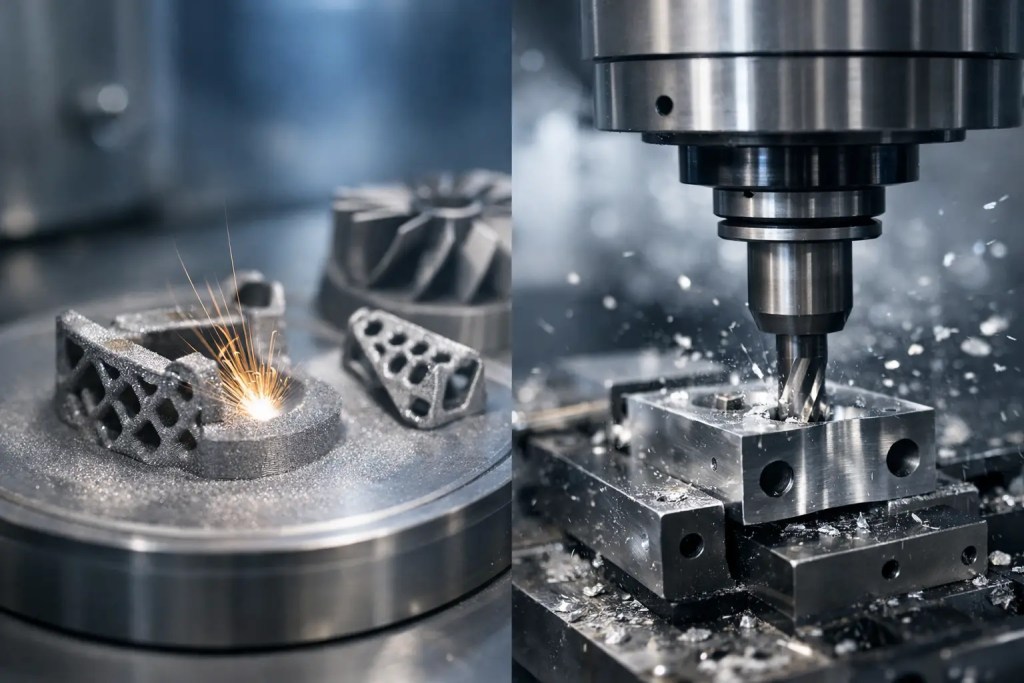
Metal printing and CNC machining solve different manufacturing problems. Metal printing, usually through powder bed fusion processes such as SLM, builds parts layer by layer from metal powder. Machining removes material from solid stock using controlled cutting tools. Both can deliver functional metal parts, but they reach that outcome in very different ways.
Metal printing performs best when geometry is difficult, internal features matter, or part consolidation can remove assembly steps. It can produce lattice structures, conformal channels, and complex organic forms that would be expensive or impossible to machine from billet. It is especially useful in prototyping and low-volume production where design freedom has high value.
Machining performs best when tight tolerances, predictable surface finish, and standard material forms are the priority. It remains the baseline process for many production parts because it is well understood, broadly available, and efficient for components with accessible features and conventional geometry.
When metal printing wins
If the part geometry is driving cost or manufacturability problems, metal printing deserves a hard look. Internal cooling channels, lightweighted brackets, integrated manifolds, and one-piece replacements for multi-part assemblies are common examples. When a design can eliminate welds, fasteners, or secondary joining steps, the total manufacturing picture can improve even if the printed part costs more at the raw process level.
This is where additive manufacturing changes the design brief rather than just the fabrication method. Instead of asking how to cut a shape from stock, engineers can ask how to place material only where it carries load, transfers heat, or supports flow. That often leads to lower weight, fewer components, and shorter assembly time.
Lead time can also favor printing, especially early in development. A team validating fit, function, or thermal behavior may not want to wait for multiple machining setups or custom fixturing. With the right file preparation and build strategy, metal printing can compress the path from model revision to physical part.
There are trade-offs. Printed metal parts usually require support removal, stress relief, and finish machining on critical surfaces. Surface roughness is generally higher than machined surfaces straight off the machine. Tolerances are not as tight across all features, and design rules such as minimum wall thickness, support strategy, and build orientation matter.
When machining wins
Machining is still the right answer for a large share of metal components because it is direct, repeatable, and efficient when the geometry is straightforward. If a part is prismatic, rotationally symmetric, or easy to access with standard cutting tools, CNC machining is often the fastest path to a production-ready result.
It is also the stronger choice when dimensional control is critical across multiple features. If your drawing calls for tight positional tolerances, flatness requirements, precision bores, or fine threaded features, machining typically reaches those targets with less process variability. Surface finish requirements also favor machining, particularly for sealing faces, bearing interfaces, and cosmetic exterior surfaces.
Material selection can be another deciding factor. Machining has broad access to common engineering metals in plate, bar, and billet form, including aluminum, stainless steel, tool steels, brass, copper alloys, and titanium grades. Metal printing material options continue to improve, but they remain more limited and process-specific. If your application depends on a particular alloy temper or stock certification pathway, machining may fit procurement and compliance needs better.
Volume matters too. For very low quantities, either process can make sense depending on geometry. But once parts become simpler and quantities rise, machining often becomes more cost-effective. The cycle time is easier to model, and there is less need for build preparation, support management, and thermal distortion control.
Cost is not just the part price
The most common mistake in metal printing vs machining decisions is comparing only the quoted unit price. That can produce the wrong answer.
A machined part may look cheaper until you account for multiple setups, custom fixtures, assembly labor, and scrap risk from complex operations. A printed part may look expensive until you factor in part consolidation, weight reduction, or reduced lead time in a development program where every week matters.
The reverse is also true. Printing a simple block with drilled holes is usually a poor use of additive manufacturing. You pay for design freedom you do not need. Machining that same part from standard stock is typically faster, cheaper, and easier to control.
Good cost analysis should include the full manufacturing route: raw process, post-processing, inspection, finishing, assembly effects, and downstream operational impact. In regulated or quality-sensitive environments, process traceability and repeatability should also be part of the decision, not an afterthought.
Tolerances, finish, and secondary operations
This is where many projects become hybrid whether they planned to or not.
Metal printing can create the near-net geometry, but critical features often still need machining. Datums, bores, threads, sealing surfaces, and interfaces that mate with other precision parts are commonly finish machined after printing. That combination is not a compromise. It is often the correct engineering route.
A printed AlSi10Mg housing, for example, may use additive manufacturing for internal channels and weight reduction while machining is reserved for gasket faces and mounting points. A stainless steel fixture may be printed to capture complex geometry, then machined where clamping accuracy matters. The process route follows the function of each feature.
This is also why supplier capability matters. If the vendor can manage both additive and conventional finishing under a controlled workflow, the handoff is cleaner and the quality plan is easier to maintain. For teams that need dependable results without building internal capacity, a process partner with metal printing, machining, and post-processing in one system reduces quoting delays and production risk.
Design rules should decide the process
A practical way to choose is to review the part against five engineering questions.
First, does the geometry require internal features, topology optimization, or part consolidation? If yes, printing moves up the list. Second, are there critical tolerances or finishes that dominate performance? If yes, machining likely carries more of the route. Third, what is the actual quantity and revision frequency? Frequent design changes tend to favor additive early on. Stable, repeatable designs often shift toward machining or hybrid production.
Fourth, what material properties are required in service? Not every alloy is available in every metal printing process, and not every printed microstructure behaves the same as wrought stock. Mechanical requirements, corrosion environment, heat exposure, and certification needs must be checked against the chosen process, not assumed. Fifth, what is the real delivery target? If lead time includes machining fixtures, external finishing, and multiple vendors, the cheapest quote may not be the fastest path to installed hardware.
Where hybrid manufacturing makes the most sense
In real production, the choice is often not metal printing or machining. It is metal printing plus machining.
That approach works well for complex low-volume components, tooling, custom fixtures, and end-use parts that need both geometric freedom and precision interfaces. Print the complexity. Machine the critical surfaces. Inspect the features that matter. This route aligns well with short-run production and advanced prototyping because it preserves design intent while controlling quality where it counts.
An ISO 9001:2015-certified workflow becomes especially relevant here. Hybrid parts need disciplined file control, process planning, traceable post-processing, and consistent inspection criteria. Without that structure, the benefits of additive geometry can be lost in secondary operations.
Choosing the right process for the job
If your part is simple, tolerance-driven, and made from a standard alloy, machining is usually the more efficient answer. If your part gains measurable value from complexity, reduced assembly, or internal functionality, metal printing can outperform conventional methods despite a higher process cost. And if the part combines both needs, hybrid manufacturing is often the best route.
The decision should start with function, not technology preference. Geometry, tolerance, material, quantity, and lead time tell you which process is doing real work and which one is adding avoidable cost. For engineering teams moving quickly, the most useful manufacturing partner is the one that can assess the CAD, flag the trade-offs early, and produce the part through the right process path the first time.
The smartest process choice is usually the one that removes risk before it shows up on the shop floor.