
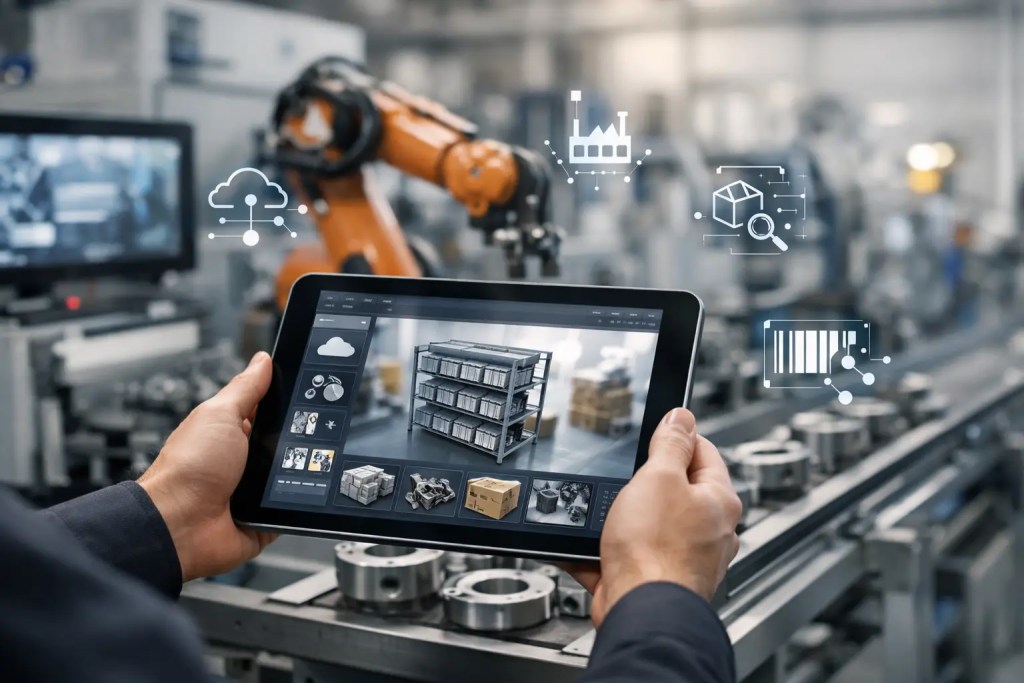
A production line stops for a component that costs only a few dollars. The physical stock is gone, the original supplier has changed, and the drawing on file is several revisions behind the part installed on the machine. This is the operational problem behind the question, what is a digital inventory and why every manufacturer needs one? It is not simply a folder of CAD files. It is a controlled system for producing the right part, at the right revision, when demand requires it.
For manufacturers managing service parts, jigs, fixtures, low-volume assemblies, and legacy components, digital inventory changes the relationship between engineering data and supply. Instead of holding every item as physical stock, qualified designs, process requirements, material specifications, and inspection criteria are retained as production-ready digital records. Parts can then be manufactured on demand through an approved process and supplier workflow.
What Is a Digital Inventory?
A digital inventory is a verified library of part data that can be manufactured when needed. At a minimum, each record should include the current CAD model or controlled drawing, revision level, material requirement, manufacturing process, finishing specification, tolerance requirements, and relevant quality documentation.
The key word is verified. A collection of STL files on a shared drive is not a digital inventory if no one can confirm which file is current, whether it meets functional requirements, or how it should be produced. A useful digital inventory connects the design definition to the production definition.
For example, a maintenance fixture may be stored with a STEP file, a defined build orientation for HP Multi Jet Fusion, PA12 material requirements, threaded insert details, a bead-blasted finish requirement, and a record of the approved dimensional checks. A replacement metal bracket may specify AlSi10Mg produced by selective laser melting, followed by CNC-machining of critical interfaces. When an order is released, the manufacturer is not starting from an ambiguous model. The manufacturing route has already been established.
This approach is particularly effective for parts with intermittent demand. Rather than forecasting years of requirements and paying to store physical units, teams maintain the approved digital definition and produce only the quantity required.
Why Physical Inventory Alone Creates Risk
Physical inventory remains necessary for high-volume, safety-critical, or immediate-use components. A digital inventory is not a universal replacement for stocked parts. It is a better control method for items where demand is uncertain, storage is expensive, obsolescence is likely, or lead times are difficult to predict.
Traditional inventory systems create several operational pressures. Capital is tied up in parts that may never be used. Warehouses carry stock across multiple locations. Components can become obsolete after an engineering change. In some cases, the inventory exists but is no longer traceable to the latest approved revision.
The risk becomes more severe with legacy equipment. Original tooling may have been retired, a supplier may no longer support the part, or a drawing may describe an outdated manufacturing method. Recreating the part under pressure can introduce delays and quality variation. Engineering then spends time reconstructing requirements instead of resolving the root production issue.
A digital inventory reduces this exposure by preserving the information needed to make a part again. It also supports a more disciplined make-versus-stock decision. If a fixture is needed twice a year, storing a qualified design may be more practical than storing multiple finished units for years.
How Digital Inventory Improves Manufacturing Operations
Shorter response time for low-volume demand
On-demand production removes several steps between identifying a need and releasing an order. When the file, revision, material, and process are already defined, procurement does not need to restart the sourcing cycle for every requirement.
This matters for replacement parts, custom assembly aids, inspection gauges, and engineering changes. A team can order one unit for validation, then release a short run when demand is confirmed. The result is not always same-day production, but it is a more predictable path than searching for old stock or reopening an unqualified supplier relationship.
Better revision and traceability control
Manufacturing errors often begin with uncontrolled information. A CAD file might be updated while an older PDF drawing remains in circulation. A supplier may continue making a previous revision because the change was not clearly communicated.
A controlled digital inventory establishes one approved production record. Each release should identify the revision, the approved material and process, and any required certificates or inspection records. When a design changes, the prior revision can be retained for service support while new orders are directed to the updated record.
For regulated industries or controlled internal quality systems, traceability requirements may be more demanding. The digital inventory should then include approval status, lot traceability expectations, inspection plans, and document retention rules. The level of control depends on the part’s function and risk profile.
Reduced inventory carrying cost and obsolescence
The financial case is straightforward but should not be oversimplified. Producing a single on-demand part can cost more than a high-volume unit made with dedicated tooling. However, the true comparison includes warehouse space, inventory handling, insurance, write-offs, expiration, and the cost of capital tied up in unused stock.
Digital inventory is often strongest for the long tail of a parts catalog: low-demand SKUs, spare parts, custom tools, and parts with frequent revisions. It can also reduce the need to place minimum-order-quantity purchases simply to satisfy a supplier’s production economics.
For high-volume, stable components, conventional methods such as injection molding, stamping, or CNC production may remain the correct choice. The objective is not to force every part into additive manufacturing. It is to match the inventory strategy and manufacturing process to the demand profile.
Which Parts Are Good Candidates?
The best candidates are generally parts that are expensive to store, difficult to source, frequently revised, or needed in unpredictable quantities. Tooling and production aids are common examples because their value is tied to a specific operation rather than a large recurring sales volume.
Polymer additive manufacturing can be effective for ergonomic jigs, drill guides, assembly fixtures, protective caps, enclosures, and functional test components. PA12 and PA11 are often selected where durability and functional performance are required, while SLA may suit detailed parts that prioritize surface finish and feature resolution.
Metal additive manufacturing may be appropriate for complex low-volume parts, lightweight brackets, conformal cooling applications, or components where geometry makes conventional machining inefficient. Yet it is not automatically the best route for every metal part. A simple prismatic component with tight tolerances may be faster and more economical to CNC machine. Some digital inventory programs therefore use multiple approved manufacturing routes for the same part family.
Building a Production-Ready Digital Inventory
The first step is to identify parts that create recurring supply friction. Review slow-moving physical inventory, obsolete items, emergency purchases, legacy service parts, and fixtures that engineering repeatedly remakes. Prioritize components with clear functional requirements and manageable validation needs.
Next, consolidate the technical definition. The CAD model must match the approved revision. Critical dimensions, tolerance zones, threads, inserts, surface requirements, and material properties should be stated clearly. If the part will be additively manufactured, design-for-additive considerations such as wall thickness, support strategy, orientation, and post-processing must be evaluated before it is added to the library.
Then qualify the production route. This may include a first article, dimensional inspection, functional testing, and review of material documentation. A part produced in PA12 through Multi Jet Fusion should not be treated as interchangeable with a similar-looking FDM print if mechanical performance, accuracy, or finish is relevant. Process selection is part of the part definition.
Finally, establish release controls. Define who can approve a new record, who can revise it, what documentation must accompany an order, and how long records will be retained. For distributed teams, clear ownership is essential. A digital inventory without governance can create the same confusion as a disorganized physical warehouse.
Digital Inventory Works Best With a Qualified Manufacturing Partner
A useful digital inventory needs more than storage software. It needs a repeatable route from file release to finished part. That includes manufacturability review, material selection, production planning, post-processing, inspection, and shipment.
An ISO 9001:2015-certified partner such as Additive3D Asia can support this model across polymer and metal additive manufacturing, CNC machining, casting, sheet metal fabrication, and finishing. The advantage of multi-process capability is practical: engineering teams can preserve one controlled part record while selecting the manufacturing method that best fits geometry, volume, tolerance, and lead-time requirements.
The most valuable digital inventories are built before a supply problem occurs. Start with the parts that cause delays, consume warehouse space, or depend on fragile supplier arrangements. Once their designs and production requirements are qualified, a future urgent request becomes a controlled manufacturing release rather than an engineering recovery project.