
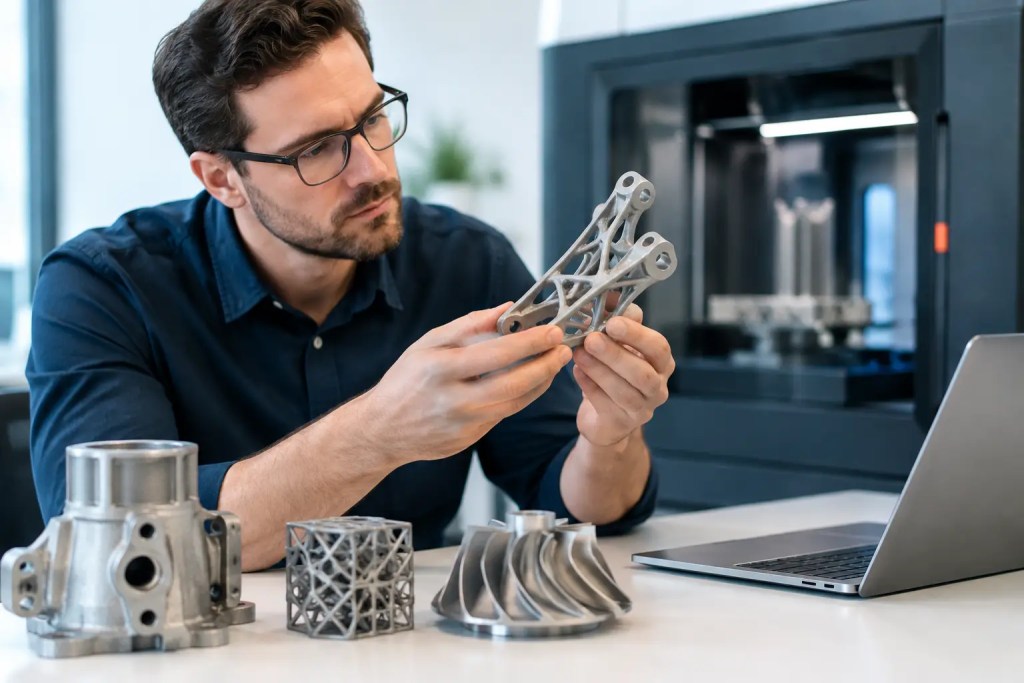
A metal 3d printing service is not simply a faster way to obtain a complex metal part. It is a manufacturing decision that affects mechanical performance, dimensional accuracy, certification requirements, cost, and delivery risk. For engineers moving from CAD to functional hardware, the right supplier should provide more than machine access. It should provide a controlled process for selecting the alloy, preparing the build, validating the part, and finishing it for its intended use.
Metal additive manufacturing is especially effective when conventional machining or fabrication introduces excessive setup, material waste, assembly work, or design compromise. Internal channels, lattice structures, lightweight brackets, conformal cooling features, and consolidated assemblies are common examples. But not every metal component is a suitable candidate. A disciplined evaluation prevents costly redesigns after the order is placed.
Start With the Part’s Operating Requirements
The first question is not which printer to use. It is what the finished part must do. Define the load case, operating temperature, corrosion exposure, pressure requirements, fatigue expectations, and cosmetic needs before selecting a process or material.
For example, an AlSi10Mg bracket may be appropriate where low mass and good thermal performance matter. SS316L is often selected for corrosion resistance and strength in demanding industrial environments. These materials have different behavior during printing, heat treatment, machining, and service. A part that performs well as a lightweight prototype may not be the correct solution for a high-cycle production application.
Be specific about whether the component is a fit-check model, a functional test part, a jig or fixture, or an end-use part. The required level of documentation and post-processing changes with each use case. A production-facing fixture may need repeatable critical dimensions and threaded inserts, while a proof-of-concept part may prioritize speed over surface finish.
Evaluate the Metal 3D Printing Service Process
For industrial metal parts, selective laser melting, often called SLM or laser powder bed fusion, is a common process. A laser selectively fuses thin layers of metal powder to build a part directly from a digital file. This makes it possible to manufacture geometries that cannot be reached by cutting tools or assembled efficiently from multiple components.
SLM does involve process constraints. Parts require support structures in certain areas to manage heat and prevent distortion. Downward-facing surfaces can show a rougher finish, and thin features may need adjustment to print reliably. Build orientation also affects support placement, surface quality, lead time, and the direction of mechanical properties.
An experienced manufacturing partner should review these conditions before production. Design-for-additive feedback is not an optional extra when tolerances, internal passages, or highly loaded features are involved. It is how potential issues are identified while a design change is still inexpensive.
Design for the Process, Not Just the CAD Model
A visually correct CAD model can still be difficult to print. Sharp internal corners can concentrate stress. Long, flat sections may distort from residual thermal stress. Enclosed channels may trap powder if they lack suitable escape paths. Unsupported overhangs can require extensive support removal and finishing.
Design modifications are often straightforward: add radii, revise wall thickness, change the part orientation, split a component into practical sections, or provide machining stock on critical surfaces. The best approach depends on the part geometry and its inspection requirements. For a sealing face or bearing bore, printing near-net shape and CNC machining the final feature is often more dependable than expecting an as-printed surface to meet the final specification.
Specify Material and Post-Processing Together
Material selection should never be separated from the finishing plan. The same printed alloy can deliver very different results depending on whether it is stress relieved, heat treated, machined, bead blasted, polished, coated, or left as printed.
Stress relief is commonly used to reduce residual stresses created during the layer-by-layer build. Heat treatment can be specified when it supports the desired mechanical properties. Support removal and powder removal are essential production steps, particularly for complex internal geometries. Machining may be required for threads, precision bores, flat mounting faces, and interfaces with mating components.
Surface finishing is equally application-specific. An as-printed surface can be suitable for concealed structural features or where texture is acceptable. Bead blasting can create a more consistent matte appearance. Polishing may be needed for fluid-facing channels, visible surfaces, or areas where lower roughness supports function. Each additional operation improves a specific outcome, but it also adds cost and lead time.
Set Realistic Tolerances and Inspection Criteria
Metal additive manufacturing is highly capable, but it is not a substitute for every conventional precision process. Tolerance expectations should be linked to feature size, geometry, build orientation, and planned finishing. General dimensions may be achievable directly from the print, while precision features are better completed by machining.
Provide a clear drawing when dimensions, thread specifications, geometric tolerances, or inspection points are critical. A STEP file is valuable for manufacturing geometry, while a PDF drawing communicates the requirements that cannot be inferred from the model alone. Mark critical-to-function features rather than applying unnecessarily tight tolerances across the entire part.
Inspection planning should match risk. A simple prototype may only require visual and dimensional checks. A functional production part may require documented inspection records, material traceability, or defined acceptance criteria. ISO 9001:2015-certified workflows are valuable because they establish consistent controls for quoting, production, verification, and nonconformance handling.
Compare Lead Time Beyond the Printer Build
A quoted lead time includes more than the printing cycle. File review, build preparation, printing, cooling, depowdering, support removal, heat treatment, machining, finishing, inspection, and packing all affect delivery. A supplier that quotes only the machine time may not be accounting for the full manufacturing route.
This is particularly relevant for short-run production. A single part may be optimized for fast delivery, while a batch can be planned around build capacity, post-processing flow, and repeatable orientation. If your project has a hard test date or assembly milestone, communicate it during quotation. The supplier can then identify which finishing steps are essential and which can be deferred.
At Additive3D Asia, this process starts with CAD upload and manufacturability review, allowing teams to resolve production questions before committing to the build. That reduces the back-and-forth that commonly delays prototype orders and procurement approvals.
Know When Metal Additive Is Not the Best Choice
The right manufacturing recommendation is sometimes not metal 3D printing. High-volume, simple geometries may be more economical with machining, sheet metal fabrication, casting, or molding. Large flat parts with broad tolerances may be faster to fabricate conventionally. A component with straightforward geometry and tight tolerances on every surface can also be a better CNC machining candidate.
The strongest case for additive manufacturing is usually a combination of geometric complexity, part consolidation, reduced assembly work, short-run demand, and performance-driven design. It is not complexity for its own sake. If additive manufacturing removes multiple operations, improves thermal or flow performance, or shortens an iteration cycle, it can create meaningful value even when the unit price is higher than a simple machined part.
Prepare a Better Request for Quote
A complete request helps the manufacturing team make an accurate recommendation quickly. Include the 3D model, a drawing for controlled dimensions, quantity, desired material, required finish, and target delivery date. Explain the application if material choice or post-processing is uncertain.
Also identify whether the part has safety, pressure, electrical, medical, or regulatory implications. These requirements influence the appropriate inspection level and may affect whether additional documentation is needed. Early clarity is more efficient than attempting to add controls after the build is complete.
The most useful metal additive manufacturing partner is one that can challenge an assumption when needed: recommending machining for a critical bore, a different alloy for corrosion exposure, or a conventional process when it better fits the production volume. Start with the performance requirement, provide the complete design intent, and use the manufacturing review to turn a printable model into a dependable part.