
A production requirement for 50, 500, or 5,000 parts creates a different engineering decision than a one-off prototype or a high-volume program. Tooling cost, lead time, material performance, and repeatability must be balanced against the expected demand. This guide to low volume molding explains how to make that decision with production readiness in mind.
Low-volume molding is not a single process. It is a manufacturing strategy for producing limited quantities without committing prematurely to the capital cost and long lead times of hardened, high-cavitation steel tooling. Depending on the part, material, and annual demand, the right route may be rapid injection molding, urethane casting, or a combination of additive manufacturing and conventional tooling.
What Low Volume Molding Means in Practice
Low-volume molding generally covers production runs from a few dozen to several thousand parts. The range is intentionally broad because part geometry, resin selection, finishing requirements, and the cost of failure matter more than a universal quantity threshold.
For a simple enclosure in a commodity polymer, injection molding may be economical at a few hundred units. For a complex medical housing, an overmolded assembly, or a component requiring a specialized resin, urethane casting or additive manufacturing can remain more practical at substantially higher quantities. The key question is not simply, “How many parts do we need?” It is, “What production risk are we willing to accept at this stage?”
Low-volume molding is commonly used for pilot production, validation builds, bridge manufacturing before mass production tooling is complete, service parts, market trials, and low-demand end-use products. It gives engineering teams parts that are closer to final production intent than typical prototypes, while preserving the ability to revise the design.
Guide to Low Volume Molding Process Selection
The correct process starts with the part’s functional requirements. Mechanical loading, heat exposure, chemical contact, cosmetic expectations, dimensional tolerances, and regulatory needs should be defined before comparing unit prices.
Rapid injection molding
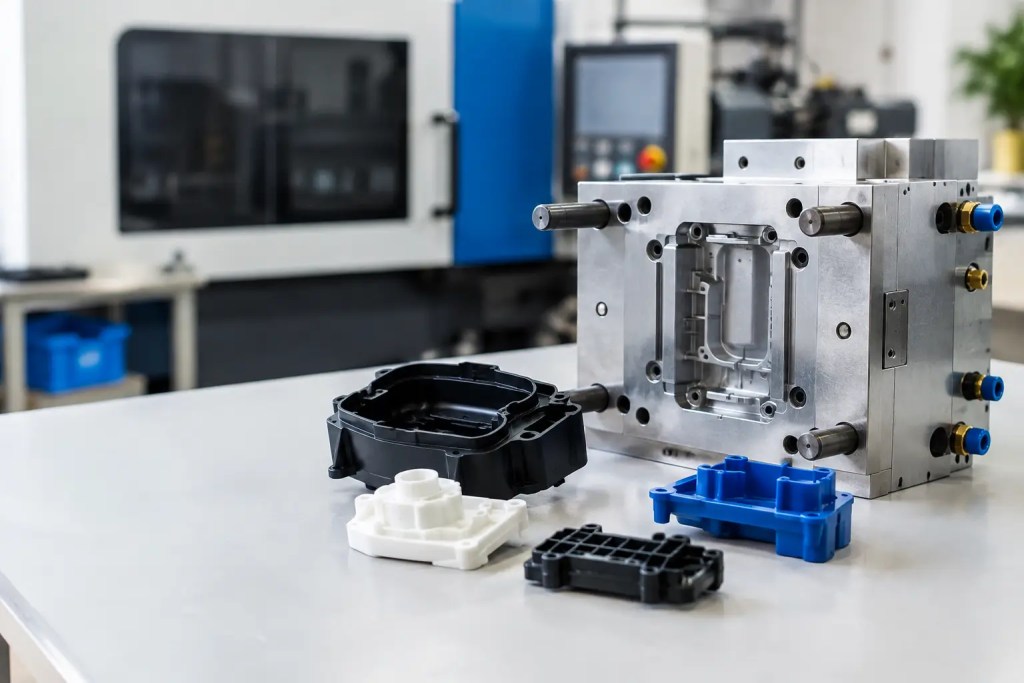
Injection molding remains the preferred option when the end-use material must be a production-grade thermoplastic and the geometry is stable. Aluminum or softer steel tooling can reduce initial investment and shorten toolmaking lead time compared with hardened production molds. It is well suited to repeatable parts in materials such as ABS, polypropylene, nylon, polycarbonate, or glass-filled engineering resins.
Its advantage is material authenticity. A part molded in the intended resin will provide more meaningful results for snap-fit testing, chemical compatibility, heat performance, and long-term mechanical evaluation than a visual substitute. It also delivers consistent cycle-to-cycle output once the tool has been optimized.
The trade-off is that mold design still governs success. Draft, wall thickness, gate location, rib geometry, shrinkage, and ejection all require disciplined design-for-manufacturing review. A tool change after machining has started can affect both cost and schedule.
Urethane casting
Urethane casting uses silicone molds, typically created from a master pattern, to produce small batches of polyurethane parts. It is an effective choice when speed, lower tooling cost, and high cosmetic quality are priorities. Cast urethanes can be selected to approximate rigid plastics, elastomers, transparent materials, and flame-retardant formulations.
For a short pilot run, this approach can produce production-like housings and seals without investing in an injection mold. It is particularly useful when the design may still change after customer testing or field evaluation.
However, cast urethane is not identical to an injection-molded thermoplastic. Material data should be reviewed carefully where fatigue life, exact chemical resistance, UV stability, or certification requirements are critical. Silicone molds also have finite lives, so this process is best evaluated against the expected quantity rather than assumed to scale indefinitely.
Additive manufacturing as a production alternative
Industrial additive manufacturing can remove tooling from the equation entirely. Processes such as HP Multi Jet Fusion and selective laser sintering can produce functional polymer parts in PA12 or PA11, while stereolithography supports fine features and high-detail masters. Metal laser powder bed fusion can produce low-volume AlSi10Mg or SS316L components where machining from billet is inefficient or geometry is highly complex.
Additive manufacturing is often the strongest option for jigs, fixtures, ducts, brackets, customized components, and low-volume assemblies with internal features. It also provides a fast route to verifying fit and function before tooling is released. For visible consumer-facing surfaces or parts requiring standard molded resin behavior, molding may still be the better final process.
Design Inputs That Control Cost and Quality
A low-volume program performs best when the CAD model is supplied with more than nominal geometry. Critical dimensions, material requirements, cosmetic surfaces, expected quantities, and assembly interfaces should be identified at quoting stage. This allows manufacturability feedback before cost becomes committed.
Wall thickness is one of the first items to review. Uniform walls help material fill and cool predictably in injection molding, reducing sink, warp, and cosmetic variation. Where thickness changes are unavoidable, transitions should be gradual. Ribs can add stiffness efficiently, but overly thick ribs may create sink marks on external surfaces.
Draft is equally important. Vertical faces need draft to release from a mold without scuffing or excessive ejection force. The required amount depends on material, surface texture, and feature depth. Textured surfaces generally need more draft than polished ones.
Undercuts deserve early attention because they can introduce slides, lifters, hand-loaded inserts, or secondary operations. These features are not automatically unacceptable, but they affect tool complexity and part cost. For a limited run, a secondary operation may be more economical than a complex mold action. For repeated production, investing in the correct tooling feature may improve consistency.
Tolerances should be assigned according to function, not by default across every dimension. Tight tolerances increase inspection requirements and can raise rejection risk, particularly on larger parts subject to material shrinkage or thermal movement. Reserve the tightest controls for sealing faces, bearing locations, snap features, and other interfaces that directly affect performance.
Material Selection Should Follow the Failure Mode
Material selection is often reduced to matching a familiar plastic name. A better approach is to identify how the part could fail. Will it crack under impact, creep under a sustained load, soften near a heat source, degrade in cleaning chemicals, or require electrical insulation?
For structural polymer components, PA12 and PA11 offer different balances of stiffness, toughness, and environmental resistance in additive production. For molded parts, unfilled and glass-filled nylons, polycarbonate blends, ABS, polypropylene, and thermoplastic elastomers each solve different problems. Do not specify glass-filled material solely for strength without considering anisotropy, surface finish, wear on tooling, and the impact on mating parts.
Where metal is required, AlSi10Mg can suit lightweight structures and complex internal geometries, while SS316L is commonly considered for corrosion resistance and demanding environments. The production route may include additive manufacturing, CNC machining, or a hybrid approach. The best choice depends on geometry, post-processing needs, and required material certification.
Plan Quality Controls Before Parts Are Made
Low-volume production should not mean informal production. A smaller run may have a higher cost per failed part because there are fewer units over which to absorb rework, schedule delays, or field returns.
Define the inspection plan before the first article is produced. This may include visual criteria, dimensional inspection points, functional gauges, fit checks with mating components, and material or finish verification. For cosmetic parts, establish acceptable standards for color, gloss, gate vestige, parting lines, and surface marks using approved samples where possible.
First-article approval is especially valuable when a part transitions from additive prototypes to molded production. The two processes can reveal different behavior in shrinkage, assembly force, texture, and flatness. A controlled first-article review gives the team a point to confirm whether the tool, material, and inspection criteria match the original intent.
An ISO 9001:2015 quality system adds discipline to this workflow through documented process controls, traceability, and consistent handling of nonconforming parts. For procurement teams, this reduces uncertainty when production is outsourced across multiple technologies.
Build a Low-Risk Path From Prototype to Production
The most reliable programs do not treat prototyping and production as separate handoffs. They use prototypes to retire specific risks, then select the next process based on what remains unknown. A 3D-printed PA12 part may verify packaging and assembly. A urethane cast batch may validate appearance and user handling. A rapid injection mold can then confirm production material behavior before a high-volume tool is approved.
This staged approach also protects schedules. Rather than waiting for a final tooling decision while every engineering question is resolved, teams can manufacture the parts needed for each decision point. A supplier with additive, molding, machining, and finishing capability can maintain continuity across those stages, reducing the errors that occur when files, specifications, and responsibility move between vendors.
At Additive3D Asia, this process begins with a CAD review and a clear understanding of quantity, material, tolerance, and application requirements. The objective is not to force every part into molding. It is to select the process that produces reliable parts at the right cost and timeframe.
The most useful next step is to review your expected demand alongside the consequences of a design change. If the geometry or material specification is still moving, preserve flexibility. If performance is proven and demand is repeatable, invest in the tooling and controls that make every subsequent part predictable.