
A build that fails after 18 hours, a support strategy that leaves inaccessible surfaces unfinished, or a batch of parts that misses a critical tolerance can erase the speed advantage of 3D printing. How AI is transforming additive manufacturing in 2026 is therefore becoming a production question, not a software trend. The value lies in reducing variation before, during, and after a build while giving engineering teams clearer evidence for process decisions.
For industrial users, AI does not replace design engineers, process engineers, or quality systems. It improves the speed at which they can evaluate geometry, select build parameters, identify risk, and learn from production data. The result can be shorter iteration cycles, fewer failed builds, and more predictable paths from prototype to low-volume production.
How AI Is Transforming Additive Manufacturing in 2026
AI is affecting the full additive workflow, from CAD preparation through inspection and post-processing. Its practical role is to analyze data that would otherwise take an engineer significant time to review: geometry features, previous build records, machine sensor signals, material behavior, and dimensional inspection results.
The strongest applications are focused on repeatability. A recommendation is useful only when it is tied to a validated machine, material, parameter set, and inspection method. For a PA12 Multi Jet Fusion part, that may mean predicting distortion around thick-to-thin transitions. For an AlSi10Mg metal SLM component, it may mean identifying areas prone to residual stress or recommending an orientation that improves support access and heat flow.
This distinction matters. Generative outputs and automated recommendations can accelerate engineering work, but they are not production approval. Qualified manufacturing still requires documented requirements, material traceability where needed, and inspection criteria matched to the part’s function.
Faster Design for Additive Without Skipping Engineering Review
Design-for-additive-manufacturing analysis is one of the most immediate AI applications. Software can review an uploaded STL or STEP file and flag unsupported overhangs, enclosed powder traps, thin walls, sharp stress concentrators, or holes likely to print below specification. It can also compare multiple orientations against priorities such as surface finish, build time, support volume, and dimensional risk.
That makes early manufacturability feedback more actionable. Rather than discovering after production that a channel cannot be depowdered or a cosmetic surface is covered in support marks, the team can revise the model when changes are inexpensive.
Generative design is also becoming more production-aware. Earlier tools often optimized primarily for mass reduction or theoretical stiffness. Current workflows can apply constraints for additive processes, including minimum wall thickness, allowable overhang angles, machining allowance, load direction, and designated datum surfaces. The output can be a lighter bracket or a consolidated assembly, but it still needs engineering judgment. A highly optimized shape may increase inspection complexity, require extensive finishing, or be poorly suited to the economics of a short production run.
Build Preparation Moves From Manual Setup to Guided Decisions
Build preparation has traditionally depended on experienced operators making choices about orientation, nesting, supports, scan strategy, and packing density. AI-assisted planning can evaluate many more combinations than a manual review, then rank them against defined objectives.
For polymer powder-bed systems, the objective may be improving packing efficiency while maintaining spacing that supports consistent thermal behavior. For SLS and MJF production, better nesting can increase machine utilization and lower cost per part, particularly when several compatible jobs share a build. The trade-off is lead time: waiting to consolidate a fuller build is not always appropriate for an urgent engineering prototype.
For metal additive manufacturing, orientation and support strategy have larger technical consequences. They affect thermal gradients, recoater risk, surface quality, distortion, and post-processing access. AI models trained on machine and build data can identify combinations associated with failures or unfavorable deformation. They can guide an engineer toward a better starting point, but simulation and process validation remain necessary for safety-critical or tightly toleranced parts.
In-Process Monitoring Finds Problems Earlier
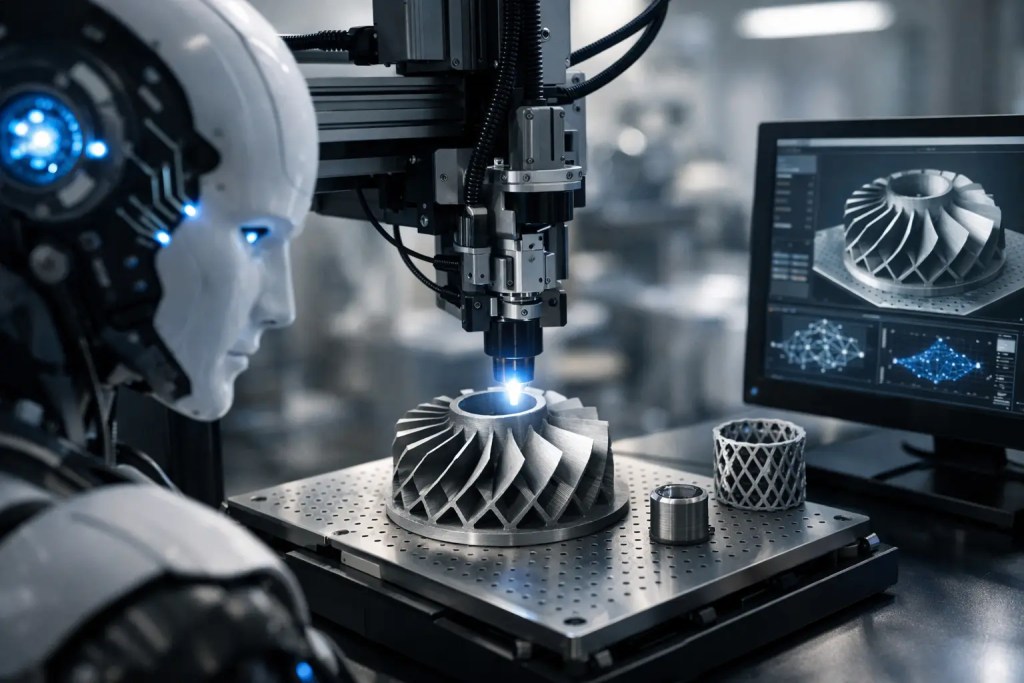
The most consequential change in metal additive manufacturing is the use of machine data during production. Melt-pool sensors, cameras, thermal imaging, recoater signals, and chamber data generate far more information than an operator can assess in real time. AI can classify patterns associated with anomalies, such as a powder spreading issue, a potential lack-of-fusion region, excessive spatter, or a layer disruption.
Early detection gives manufacturers options. Depending on the process and quality plan, they may pause the build, investigate the machine condition, segregate affected components, or increase inspection on a specific region. This is more valuable than simply collecting data after a failed job because it limits wasted material, machine time, and downstream finishing effort.
However, anomaly detection is not the same as part certification. A model can flag an unusual signal without proving that a component is defective. It can also miss a condition outside its training data. Production teams need defined response procedures, calibrated sensors, controlled data retention, and correlation between sensor findings and destructive or nondestructive inspection results.
Quality Control Becomes More Predictive
AI is also changing how inspection data is used. Instead of treating each coordinate measurement, scan result, or visual inspection as an isolated pass-or-fail event, manufacturers can compare results across builds, machines, operators, materials, and post-processing routes. Patterns begin to emerge: a feature consistently trends high in one orientation, a finishing process changes a thin wall more than expected, or a specific geometry needs additional machining allowance.
This supports closed-loop manufacturing. Inspection results inform future build preparation, and future build preparation reduces the likelihood of repeat nonconformities. The benefit is especially clear for parts that move from prototype to repeat short-run production, where the same geometry is produced across multiple orders.
A quality system remains essential. AI can help prioritize inspection and identify drift, but controlled work instructions, calibrated equipment, revision control, and documented acceptance criteria are what make results auditable. ISO 9001:2015-aligned workflows provide the operational structure needed to turn data into consistent action.
Material Selection Gains More Context
Material choice is rarely a simple strength comparison. Engineers selecting PA11, PA12, SLA resins, or FDM thermoplastics must consider impact performance, heat exposure, chemical resistance, surface requirements, wall thickness, and production volume. Metal choices such as AlSi10Mg and SS316L add corrosion, weight, thermal, and post-processing considerations.
AI can narrow the field by matching application requirements to historical part outcomes, material data, and process constraints. It can identify that a high-detail SLA prototype is appropriate for form and fit review but unsuitable for a snap-fit endurance test, or that a nylon powder-bed part offers a more representative functional result. These recommendations are useful when the input requirements are accurate. If a load case, temperature range, or regulatory requirement is missing, the recommendation will be incomplete.
The best workflow combines automated screening with an engineering review of the part’s actual service conditions. Material data sheets describe tested properties under defined conditions; they do not guarantee the performance of every geometry, orientation, or environment.
Procurement Becomes Less Fragmented
AI-supported quoting and job routing can reduce delays that occur between engineering, purchasing, and production. When a CAD file is submitted, automated analysis can identify likely process options, estimate material consumption and production time, and surface design issues before an order reaches the shop floor.
For teams working under compressed development schedules, this reduces the back-and-forth that often slows procurement. It is particularly effective when one manufacturing partner can assess additive and conventional alternatives. A component may be best produced by MJF for a functional prototype, then by CNC machining for a tighter tolerance requirement, or by injection molding once volume justifies tooling.
At Additive3D Asia, this decision should remain process-led rather than automation-led. The fastest quoted route is not automatically the right route if it creates unnecessary finishing work, misses a cosmetic requirement, or does not meet the intended mechanical performance.
What Manufacturing Teams Should Ask Before Using AI Tools
Before adopting an AI-enabled additive workflow, teams should define what decision the system is expected to improve. Is the goal fewer support-related defects, higher nesting efficiency, faster design review, earlier anomaly detection, or better dimensional predictability? A clear target makes it possible to measure whether the tool improves throughput, scrap rate, lead time, or inspection outcomes.
They should also ask how recommendations are validated, what data the model uses, and who owns the final production decision. The most useful systems are connected to real manufacturing records and are operated within controlled procedures. A generic model may offer helpful ideas, but it cannot substitute for process-specific evidence.
AI will make additive manufacturing more predictable when it is applied to the decisions that create the most cost and risk: geometry readiness, build planning, machine monitoring, and quality feedback. Start with a defined part requirement, select the process around performance and production needs, and use the resulting data to make the next build more reliable than the last.