
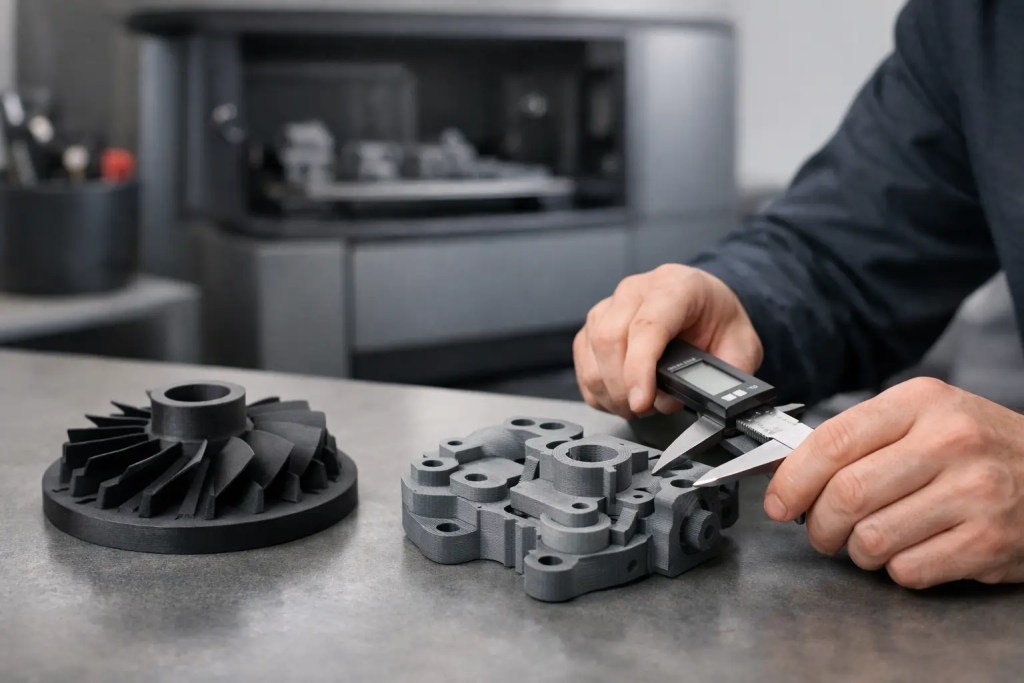
If you are evaluating a part for HP Multi Jet Fusion, the real question behind how accurate is MJF printing is usually this: will the printed part assemble, fit, and perform without adding risk to production? Accuracy in MJF is strong by polymer additive standards, but it is not a single number. It depends on part size, geometry, orientation, wall thickness, thermal behavior, and any post-processing applied after printing.
For engineers and procurement teams, that distinction matters. A process can be highly repeatable and still produce different results on a small clip than on a large enclosure. MJF is best understood as a stable industrial process with predictable tolerance behavior when the design is matched to the process window.
How accurate is MJF printing in practice?
For standard PA12 MJF parts, a common baseline is around +/-0.3 mm for dimensions under 100 mm, with additional deviation often estimated as a percentage of length on larger features. Exact capability varies by machine condition, packing strategy, material batch, cooling profile, and the supplier’s quality controls, but that range is a realistic planning number for most functional components.
That level of accuracy is often sufficient for housings, covers, brackets, ducting, jigs, fixtures, and many end-use polymer parts. It is also one reason MJF is popular for short-run production. Compared with filament-based printing, MJF generally delivers better dimensional consistency and less visible layer-related distortion. Compared with injection molding, it offers more design freedom but wider tolerances.
The practical takeaway is simple. If your part needs a slip fit, light press fit, or reliable alignment between printed features, MJF can often do the job directly. If you need tight bearing bores, precision sealing faces, or highly controlled mating dimensions, it is better to design in machining stock or use a secondary finishing operation.
What drives MJF accuracy?
MJF builds parts by selectively applying fusing and detailing agents onto a powder bed, then using heat to fuse each layer. Because the part is surrounded by powder during the build, support structures are not required in the same way they are for some other additive methods. That helps reduce support-related defects and improves production efficiency, but dimensional behavior is still governed by heat.
Thermal effects are the main reason accuracy changes from one geometry to another. Thick sections cool differently than thin sections. Long flat areas may warp more readily than compact shapes. Internal stresses can shift circularity, flatness, and straightness even when the overall linear dimensions remain within tolerance.
Feature size also matters. Small embossed text, thin pins, snap features, and narrow slots are more sensitive to process limitations than larger structural walls. A dimension that looks simple on a CAD model can become less predictable if it sits next to a heavy mass of material or a broad unsupported surface.
This is why engineering review remains important even with instant quoting workflows. Machine capability sets the baseline, but design for additive manufacturing determines whether that baseline is achieved consistently.
Tolerances are not the same as fit
When customers ask how accurate is MJF printing, they often mean dimensional tolerance. What they actually need is assembly performance. Those are related, but not identical.
A nominally accurate part can still create issues if the fit condition was not designed with additive manufacturing in mind. For example, an enclosure with multiple mating tabs may need more clearance than a single tab-and-slot pair. A printed hinge pin may measure close to target but still feel tight if the surrounding bore has slight ovality. A lid with a long sealing edge may sit proud because flatness, not linear dimension, is the controlling factor.
That is why tolerance allocation should be tied to function. Ask which dimensions truly matter. Usually only a small number of features are critical: datum surfaces, hole locations, connector interfaces, sealing edges, or hardware seats. Once those are identified, you can decide whether they should be printed as-is, oversized for post-machining, or adjusted with standard fit clearances.
Part size changes the answer
Small to medium components usually show the strongest dimensional control in MJF. As parts grow larger, the chance of shrink variation and warp increases. A 30 mm latch and a 300 mm panel should not be tolerance-planned the same way, even if both are made from PA12 on the same machine.
Large flat geometries are especially worth reviewing. They may print successfully and still require design compensation to improve flatness or edge stability. Ribs, blended transitions, and more balanced wall distribution often help. In many cases, splitting one large part into two joined components produces better overall dimensional control than printing a single oversized body.
If your application depends on a large reference surface, call that out at the quoting stage. A capable manufacturing partner can recommend whether MJF is appropriate as printed, whether secondary machining is advisable, or whether another process should be used.
Hole size, threads, and mating features
Internal features deserve extra attention because they are where assembly problems usually appear first. Printed holes often need design offsets if a specific final diameter matters. Small holes may print undersized, and deep holes can behave differently than shallow ones due to local heat accumulation and powder removal constraints.
Threads are similar. Coarse printed threads can work well for covers, access panels, and moderate-duty closures, especially in larger diameters. For repeated assembly, high clamp loads, or small thread sizes, threaded inserts or post-machined threads are usually the safer choice.
Pins, clips, and snap fits are also common MJF applications, but they should be tuned for the material and process. MJF PA12 offers a good balance of stiffness and toughness, yet repeatable snap performance depends on radius, thickness, and strain distribution, not just nominal dimension.
Surface finish and post-processing affect final dimensions
Raw MJF parts typically have a fine matte texture from the powder bed process. That surface is suitable for many industrial uses, but finishing steps can change final dimensions. Bead blasting, dyeing, vapor smoothing, machining, tapping, coating, or media finishing each alter the part to some degree.
Vapor smoothing, for example, can improve surface feel and help on some cosmetic surfaces, but it may slightly soften edge definition or shift small features. Machining improves local precision but adds setup considerations and datum planning. Dyeing usually has minimal dimensional impact, while coating thickness may matter on tight fits.
This is one reason process control matters beyond the printer itself. A supplier with standardized workflows, inspection checkpoints, and documented post-processing methods will generally deliver more predictable outcomes than one treating every job as a one-off build.
How MJF compares with other 3D printing processes
MJF sits in a useful middle ground for polymer production. It generally provides better consistency and mechanical performance than basic FDM for functional parts, especially when batch repeatability matters. Compared with SLA, MJF usually offers better toughness for engineering use, though SLA can achieve finer visual detail and smoother surfaces in some applications. Compared with SLS, MJF often stands out for surface uniformity, throughput, and repeatability, though actual results depend on machine platform, material, and supplier controls.
If your priority is industrial throughput, isotropic-like mechanical behavior, and dependable polymer part production, MJF is often one of the strongest choices. If your priority is ultra-fine cosmetic detail or highly transparent parts, another process may be a better fit.
Designing for dependable MJF accuracy
The best MJF results come from designing to the process rather than forcing the process to imitate molding or machining. Uniform wall thickness helps reduce thermal imbalance. Generous radii lower stress concentration and improve build stability. Sensible clearances between moving or mating printed features reduce assembly risk. Critical bores, faces, and interfaces should be identified early so they can be offset, machined, or tolerance-checked.
It also helps to classify your features by importance. Cosmetic dimensions can usually accept standard process variation. Functional interfaces need reviewed clearances. Truly critical dimensions should either be validated through first-article inspection or moved to a secondary precision operation.
For teams moving from prototype to production, consistency matters as much as one-time accuracy. The right supplier should be able to discuss material choice, nesting strategy, expected tolerance window, and post-processing impact in operational terms. That is where an ISO 9001:2015 quality framework becomes relevant. It supports repeatability, traceability, and controlled execution across quoting, build preparation, production, and inspection.
So, how accurate is MJF printing for your part?
Accurate enough for many functional prototypes, manufacturing aids, and end-use polymer components – provided the design reflects the process and the tolerance strategy matches the application. MJF is not a substitute for tight-tolerance machining on every feature, but it is far more than a concept-model process. It is a production-capable manufacturing method with predictable dimensional behavior when managed correctly.
For most engineering teams, the right question is not whether MJF is accurate in general. It is whether your critical features can be held reliably in MJF as printed, or whether they should be finished afterward. That decision is what turns a printed part into a dependable production outcome.
When speed matters, the smartest path is usually to validate one controlled iteration, measure the few dimensions that actually govern performance, and then lock the process from there.