
A nylon bracket can meet its dimensional requirements and still fail a customer review because the surface looks unfinished, traps dirt, or varies from batch to batch. Selecting the top surface finishes for nylon parts is therefore not a cosmetic afterthought. It is a production decision that affects function, inspection, assembly, durability, and the perceived quality of the final product.
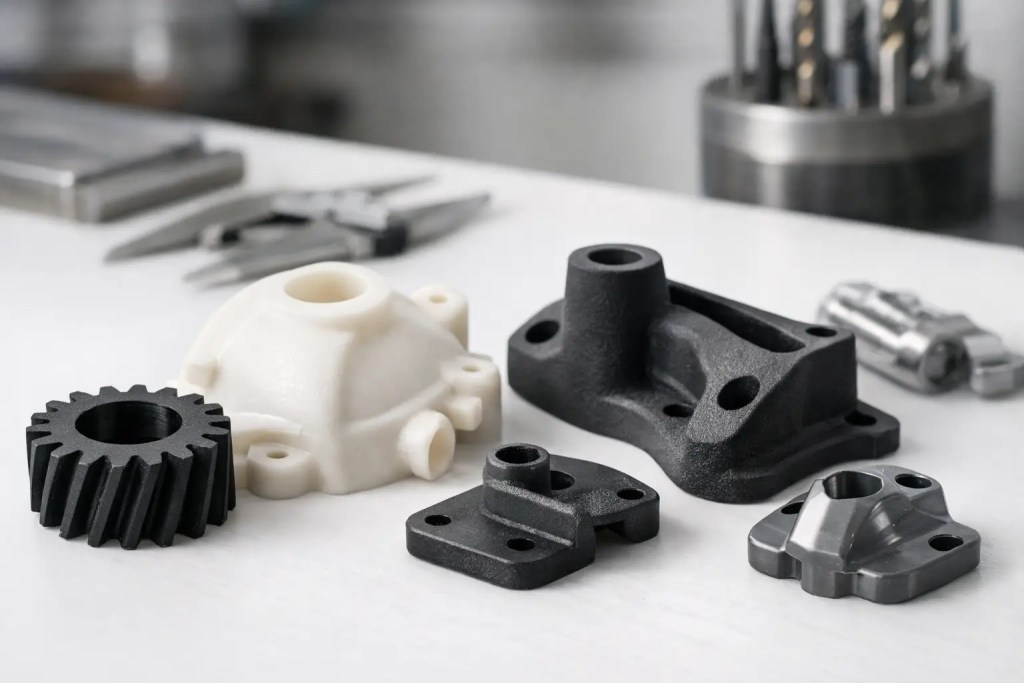
For additive nylon parts, the starting texture is determined by the manufacturing process, material grade, build orientation, and part geometry. MJF and SLS parts made from PA12 or PA11 typically have a fine, matte, slightly granular surface. That texture is often suitable for jigs, fixtures, housings, and functional prototypes without additional finishing. Where a part must be customer-facing, easy to clean, color-controlled, or exposed to repeated handling, post-processing should be specified early in the design and sourcing process.
Start With the Surface Requirement, Not the Finish Name
The right finish depends on what the part must do after production. A black cosmetic enclosure, a fluid-handling manifold, and a low-volume assembly fixture may all use nylon, but they require different surface outcomes.
Engineers should first define the required appearance, roughness, cleanability, dimensional sensitivity, color, and environmental exposure. This prevents a common procurement problem: requesting a finish based on a reference photo without accounting for its effect on tolerances, wall thickness, or mechanical use.
For example, a media-blasted PA12 part may be ideal when a consistent matte appearance is sufficient. A vapor-smoothed part may be more appropriate where reduced surface porosity and easier cleaning are essential. A painted part can deliver a controlled cosmetic color, but it adds process steps and requires attention to coating adhesion and edge coverage.
Top Surface Finishes for Nylon Parts
Media Blasting for a Uniform Matte Surface
Media blasting is one of the most widely specified finishes for MJF and SLS nylon components. The process removes loose powder and lightly conditions the exterior using controlled blasting media. It produces an even matte surface while retaining the dimensional character of the printed part.
This is a practical choice for production fixtures, brackets, covers, housings, and functional prototypes where visual consistency matters but a polished cosmetic finish is unnecessary. It is also commonly used as a preparation step before dyeing or coating.
The trade-off is that media blasting does not eliminate the underlying layer-related texture or fully seal the surface. Fine details, thin ribs, sharp edges, and tight-fit interfaces require controlled exposure. Finishing allowances should be considered when the design includes critical contact surfaces.
Dyeing for Integrated Color
Dyeing provides color penetration into the outer region of nylon rather than creating a separate paint film. Black is the most common production option, although other colors may be available depending on material and process controls. Dyed nylon maintains the familiar matte character of MJF or SLS while offering a more finished, consistent appearance.
For customer-facing enclosures, handles, wearable components, and low-volume end-use parts, black dyeing is often an efficient balance of cost, appearance, and durability. Minor surface scuffs are generally less visible than on painted parts because there is no thin topcoat to chip away.
Color control still requires realistic expectations. Nylon is porous, and color results can vary with material batch, surface condition, geometry, and prior post-processing. A defined color standard, approved sample, and controlled production workflow are appropriate for repeat orders or assemblies that must match other components.
Tumbling for Edge Break and Surface Refinement
Mechanical tumbling uses media to soften sharp edges and reduce surface irregularities. It can improve the hand feel of nylon parts and is useful when components will be frequently handled, inserted into assemblies, or used near cables and soft goods.
Tumbling is particularly valuable for designs with accessible external edges, but it is not equally effective across every feature. Internal channels, deep recesses, fine text, narrow slots, and complex lattices may receive limited media contact. It can also round small details and alter fragile features.
Use tumbling when the requirement is practical edge conditioning rather than a highly cosmetic finish. If a mating snap feature, bearing seat, or precision datum is present, isolate that area from the process or verify it through first-article inspection.
Vapor Smoothing for Reduced Porosity and Better Cleanability
Vapor smoothing uses a controlled chemical vapor process to reflow the outermost surface of compatible polymer parts. For nylon applications, the objective is usually a smoother, more closed surface that is easier to wipe down and less likely to retain powder, moisture, or contaminants.
This finish can be appropriate for consumer products, medical-adjacent equipment covers, fluid-contact components, and parts that need a visibly refined molded-like appearance. It may also improve surface behavior in applications where reduced friction or improved washability is beneficial.
However, vapor smoothing is not a universal upgrade. The process can soften edges, affect fine embossed features, and change small dimensions. Results depend on the nylon grade, wall thickness, geometry, and validated finishing parameters. Critical tolerances should be measured after finishing, not assumed from the original CAD model. When a part includes sealing surfaces or close-tolerance mechanical interfaces, prototype and test the finished condition before releasing production.
Painting and Coating for Cosmetic Control or Added Protection
Painting creates the greatest freedom in color, gloss level, and visual presentation. It can be specified for branded housings, display models, industrial equipment panels, and assemblies that must match established product colors. Coatings may also be selected to support particular needs such as UV exposure, chemical resistance, or improved cleanability.
The limitation is that nylon requires proper surface preparation. Its low-energy, textured surface can challenge adhesion if cleaning, blasting, priming, and curing are not controlled. Sharp corners and recessed features can also receive uneven coverage.
Painted nylon should be treated as a coating system, not simply as a color choice. Specify the target color, gloss, coating type, masking requirements, and acceptance criteria. For parts subject to impact, abrasion, frequent assembly, or flexing, test adhesion and wear under actual use conditions. A coating that looks excellent on a sample panel may behave differently on a flexible nylon snap cover.
Hand Sanding and Polishing for Localized Cosmetic Work
Hand sanding can remove support marks, blend transition areas, and improve selected visible surfaces. It is often used on prototype parts, presentation models, or low-volume components that need local attention before painting.
For production nylon parts, hand finishing is best reserved for defined areas rather than used as the primary process. It is labor-intensive and introduces operator variation. It can also create inconsistent gloss or expose porosity that becomes more visible after dyeing or coating.
Where a highly polished appearance is required across a large part, nylon powder-bed printing may not be the most efficient starting process. A different manufacturing route, such as CNC machining, SLA for selected prototype requirements, or injection molding for scaled production, may deliver a more suitable baseline surface.
How MJF and SLS Starting Surfaces Affect Results
MJF and SLS both produce functional nylon parts, but the initial surface condition and post-processing response can differ by system, material, build orientation, and thermal history. PA12 is often selected for dimensional stability and balanced mechanical performance. PA11 can be preferred where higher ductility and impact performance are needed. The finish should be qualified with the specific material, not assumed to transfer directly between nylon grades.
Orientation also matters. Down-facing surfaces, recessed areas, and features exposed to different powder evacuation conditions may have a different appearance before finishing. If the visual side of a housing is known, orienting that face appropriately and defining the finish zone in the manufacturing drawing can reduce variation.
For repeat production, establish a reference part or approved finish sample. Written requirements should identify cosmetic surfaces, non-cosmetic surfaces, masking zones, critical dimensions, and acceptable texture variation. This gives manufacturing and quality teams an objective basis for inspection rather than relying on subjective terms such as “smooth” or “premium.”
Specify Finishes Alongside Critical Tolerances
A finish callout should never be separated from the part’s functional requirements. If a bore must accept a press-fit insert, if a snap latch must retain its edge definition, or if a gasket groove has a controlled depth, identify whether it will be masked, machined after printing, or verified after finishing.
The same applies to threads, text, barcodes, and small logos. Dyeing may preserve readable text well, while heavy coating or aggressive mechanical finishing can reduce contrast and soften fine features. For engraved labels that must remain legible through service, test the complete post-processing sequence.
At Additive3D Asia, production planning can combine nylon additive manufacturing with secondary operations such as CNC machining and controlled surface post-processing. This is useful when a part needs the geometric freedom of MJF or SLS but also requires precision interfaces or a defined cosmetic standard.
A Practical Selection Rule
Choose media blasting when you need a clean, uniform matte part. Choose dyeing when durable integrated color is the priority. Use tumbling when edge condition and hand feel matter most. Specify vapor smoothing when reduced porosity and cleanability justify dimensional validation. Select painting or coating when exact appearance, gloss, or specialized surface behavior is required.
The best result comes from qualifying the finished part in its real assembly, not from selecting the most visually appealing sample. When finish requirements are defined with the same discipline as material, tolerance, and load case, nylon parts move from acceptable prototypes to repeatable production components.