
A useful SS316L metal printing review starts with the part, not the alloy datasheet. Stainless steel 316L produced by selective laser melting (SLM) can deliver corrosion-resistant, complex metal components on short lead times. It is not, however, a direct replacement for every machined or wrought stainless part. Build orientation, support strategy, heat treatment, and finishing determine whether the printed result meets the functional requirement.
For engineers evaluating metal additive manufacturing, SS316L is often the practical starting point. It is widely specified, well understood, and suitable for applications that need corrosion resistance, strength, and geometries that conventional manufacturing cannot produce efficiently.
Where SS316L Metal Printing Performs Well
SS316L is a low-carbon austenitic stainless steel. Its chemistry supports good corrosion resistance in many industrial, marine-adjacent, chemical-processing, and general engineering environments. In metal 3D printing, it is commonly processed through SLM, where a laser selectively fuses thin layers of metal powder into a near-net-shape component.
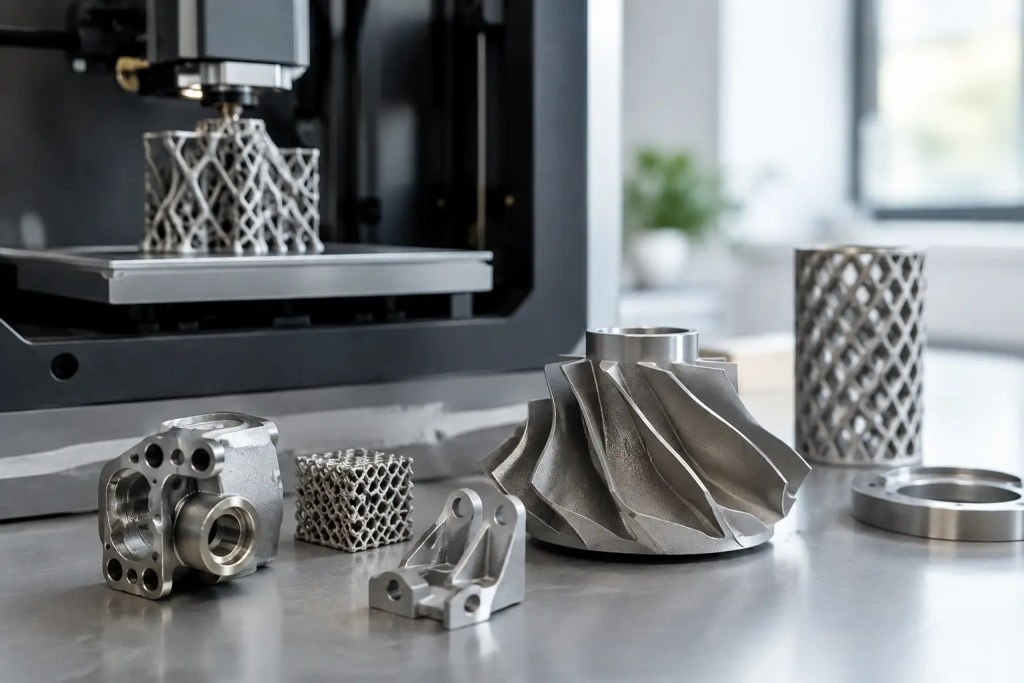
The process is especially effective when design complexity creates cost or lead-time pressure in CNC machining. Internal channels, lightweight lattices, consolidated assemblies, conformal passages, and custom gripping surfaces are all strong candidates. A component that would require several machined parts, welding, and inspection steps may be redesigned as one printed part with fewer interfaces and lower assembly risk.
SS316L is also a sound option for functional prototypes that need to behave like metal rather than simply represent metal. Jigs, fixtures, brackets, test hardware, fluid-handling components, and low-volume end-use assemblies can benefit from its combination of mechanical performance and environmental resistance.
The commercial advantage is not that printing makes every stainless part cheaper. It is that it can make difficult parts more direct to manufacture. For low-volume production, where tooling investment is hard to justify and machining time rises with geometric complexity, that distinction matters.
The Trade-Offs Behind an SS316L Metal Printing Review
Printed SS316L parts should be evaluated as manufactured components, not as ideal CAD geometry. SLM produces high-density parts, but the process also introduces considerations that designers must address early.
Surface finish is the first. As-built surfaces are typically rougher than CNC-machined surfaces, particularly on downward-facing areas and internal channels. Powder particle size, layer thickness, contour settings, orientation, and support removal all affect the final texture. If a sealing face, bearing fit, or cosmetic exterior requires a controlled finish, machining, polishing, bead blasting, or other post-processing should be included in the production plan.
Dimensional accuracy is similarly dependent on feature type and post-processing. Metal printing can produce complex forms accurately, but tight tolerances should not be assigned uniformly across a part. Holes may need to be printed undersize and machined to final dimension. Threads are often better tapped or machined after printing. Critical flatness, concentricity, and datum surfaces should be identified for secondary machining rather than left to an as-built condition.
Mechanical properties can be very good, but they are affected by orientation and thermal history. Layer-based manufacturing can create directional behavior, while residual stress may cause distortion in thin walls, long spans, or large flat geometries. Stress relief is therefore a standard consideration, and some applications may require additional heat treatment or hot isostatic pressing based on fatigue, density, or certification requirements.
Corrosion performance also depends on finishing and service conditions. SS316L provides strong general corrosion resistance, but it is not immune to chloride-driven pitting, crevice corrosion, or damage from poor surface condition. For parts exposed to aggressive chemicals, salt-rich environments, or sanitary service, specify the medium, temperature, cleaning process, and surface-finish target. Material selection should follow the actual duty cycle, not the assumption that all stainless steels perform the same way.
Design Features That Need Early Review
Support structures are necessary for many overhangs and heat-sensitive features. They anchor the part to the build plate, manage heat, and reduce deformation. But supports leave contact marks and must be removed, which may be difficult inside enclosed passages or in narrow gaps.
This creates a clear design rule: avoid inaccessible supported surfaces wherever possible. Orient channels for powder evacuation, provide escape holes for enclosed cavities, and consider whether an internal feature can be produced without supports. A hidden feature that cannot be depowdered or inspected is rarely production-ready.
Wall thickness and local mass transitions also deserve attention. Very thin walls may distort, while abrupt changes from thin sections to heavy blocks can concentrate heat and residual stress. Smooth transitions, fillets, and a build orientation selected around the most critical surfaces will usually improve repeatability more effectively than trying to correct distortion after the build.
SLM SS316L Versus CNC Machining
CNC machining remains the better choice for many SS316L parts. If the geometry is simple, tolerances are tight across most features, surface finish is critical, and production volume is high enough, machining is often faster and more economical. Wrought bar or plate stock may also be preferred where a specific material standard, documented grain structure, or established certification route is mandatory.
Metal printing becomes more compelling when geometric complexity changes the comparison. A machined manifold may require multiple setups, deep drilling, plugs, and welded joints. A printed manifold can integrate curved flow paths and reduce assembly count. The printed part may still need machined ports and sealing faces, but the overall process can be simpler.
The strongest manufacturing route is frequently hybrid. Print the geometry that adds value, then machine the interfaces that control fit and function. This approach is particularly effective for production fixtures, custom tooling, low-volume equipment components, and parts with internal features that cannot be drilled economically.
Production Readiness Depends on Post-Processing
An SLM build is only one step in the production route. Reliable SS316L parts require a defined sequence from file review through final inspection. A practical workflow begins by reviewing the CAD model for wall thickness, trapped powder, unsupported spans, tolerances, and surfaces that require machining.
After printing, the part is removed from the build plate and supports are removed. Stress relief may be performed before or after removal according to the component geometry and process plan. Secondary operations can then establish critical dimensions, improve surface finish, or prepare the part for assembly. Depending on the application, the route may include machining, blasting, polishing, passivation, heat treatment, and inspection.
Inspection requirements should match the risk of the part. A prototype bracket may require dimensional verification at critical interfaces. A pressure-bearing component may need a more rigorous plan covering material traceability, density-related requirements, surface condition, and non-destructive testing. The correct level is application-specific, but it should be agreed before production rather than added after a failed qualification.
For teams moving from prototype to repeat production, process control matters as much as material selection. Stable machine parameters, documented build orientation, qualified powder handling, controlled post-processing, and consistent inspection methods help reduce variation between builds. An ISO 9001:2015 quality system provides structure for that control, but the part specification must still define what acceptable performance means.
When to Specify SS316L Instead of Another Metal
Choose SS316L when corrosion resistance, general-purpose strength, and stainless-steel compatibility are central requirements. It is a practical material for industrial hardware, custom fixtures, flow components, laboratory equipment, and low-volume parts that must tolerate wet or mildly corrosive service.
Consider aluminum alloys when weight and thermal conductivity matter more than corrosion resistance or elevated-temperature strength. Consider tool steels where wear resistance and hardness are the dominant requirements. Titanium may be appropriate when low weight, biocompatibility, or specific corrosion performance justifies its higher cost. For high-temperature applications, nickel alloys may be more suitable than SS316L.
The decision should begin with the operating environment, loading, tolerances, volume, and finishing requirement. Only then should the manufacturing team decide whether SS316L SLM, CNC machining, or a combined route is the most reliable path.
A well-designed SS316L printed part does not try to imitate a machined component feature for feature. It uses additive manufacturing where additive manufacturing is strongest, then applies controlled post-processing where precision surfaces and final function demand it.