
A functional prototype can prove geometry, but it may not prove how a part will perform in the hands of users, under load, or across a small pilot build. That is where the question, when should I use urethane casting, becomes a production decision rather than a prototyping question. Urethane casting is often the practical bridge between one-off additive parts and high-volume injection molding.
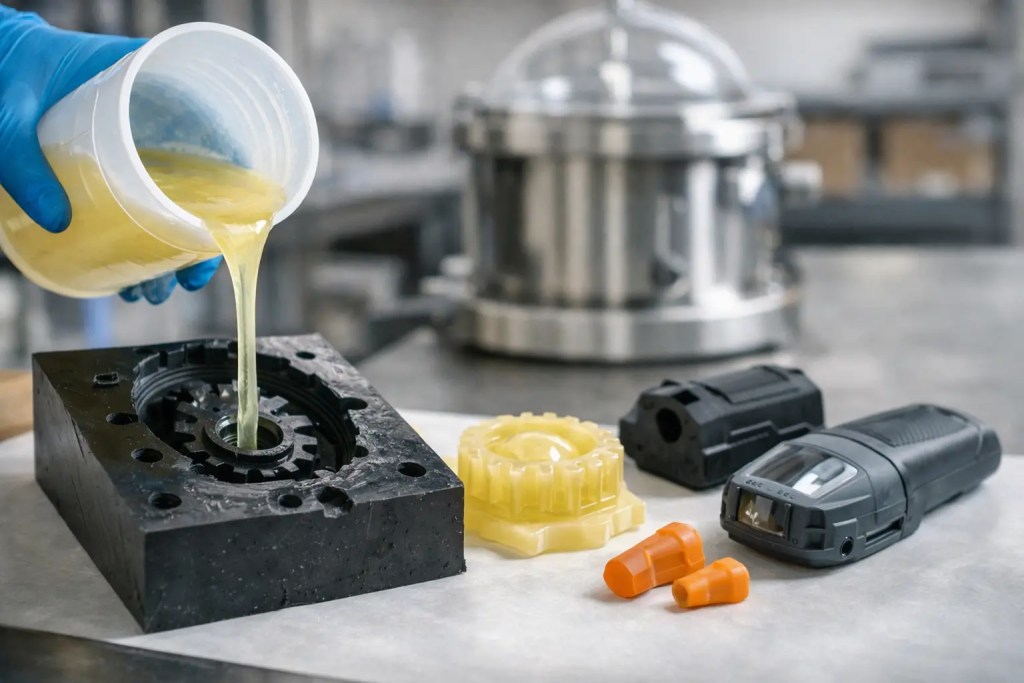
The process uses a master pattern, typically produced by SLA or CNC machining, to create a silicone mold. Liquid polyurethane resin is then poured or injected into the mold and cured, often under vacuum to reduce entrapped air. The result is a short-run part with properties and surface quality that can more closely resemble molded production components than many prototype methods.
For engineering teams, the value is not simply speed. It is the ability to validate design, material behavior, finish, and assembly before committing to hard tooling.
When should I use urethane casting?
Use urethane casting when you need approximately 10 to 100 production-like parts and injection molding tooling is not yet commercially justified. The exact break-even point depends on part size, geometry, resin selection, finishing requirements, and expected revisions. However, this range is a reliable starting point for most prototype, pilot, and low-volume production programs.
It is particularly well suited to housings, covers, grips, enclosures, cosmetic components, elastomeric seals, overmold-like features, and functional assemblies that need more than a visual mockup. A cast part can be color matched, painted, textured, clear, tinted, or molded with inserts, allowing teams to evaluate the details that affect customer acceptance and manufacturing readiness.
Choose urethane casting when the design is stable enough to invest in silicone tooling, but not stable enough, or not high enough in volume, to justify steel or aluminum injection molds. Silicone molds have a finite service life, commonly producing a limited number of high-quality copies before dimensional consistency and surface finish begin to decline. That makes the process efficient for controlled batches, not indefinite production.
The production gap urethane casting fills
A common development path starts with additive manufacturing. SLA can deliver high-detail master patterns and presentation models quickly. SLS and Multi Jet Fusion can produce durable functional prototypes. CNC machining can provide tight tolerances and engineering-grade material performance. Each process has a clear role.
The gap appears when a team needs dozens of parts that look, feel, and function consistently enough for field testing, pre-production evaluation, sales samples, or a limited release. Printing every part may be slow or costly at that quantity, and layer-based surfaces can require substantial finishing. Machining may be uneconomical for geometries with complex external forms or multiple cosmetic surfaces. Injection molding, meanwhile, carries the cost and lead time of production tooling.
Urethane casting addresses this gap with low-cost silicone tooling and a broad selection of polyurethane systems. It gives teams a repeatable way to produce short runs without treating every unit as a separate prototype.
Select it when material behavior matters
The strongest case for urethane casting is not always part quantity. It is often the need to test a specific type of material behavior.
Cast polyurethane resins are available in rigid, semi-rigid, rubber-like, clear, flame-retardant, and high-temperature formulations. They can be selected to approximate common production plastics such as ABS, polypropylene, polycarbonate, nylon, or TPU. These are analog materials, not exact chemical equivalents, so engineers should define the required performance criteria rather than rely solely on a material name.
For example, a handheld electronics enclosure may require impact resistance, screw-boss performance, a matte exterior, and a specific color. A rigid polyurethane formulation can support functional fit checks and user evaluation far better than a display-only model. A flexible boot or gasket may need a defined Shore hardness, compression behavior, and tear resistance. In this case, a rubber-like casting resin provides a more meaningful test article than a rigid printed substitute.
This distinction matters in qualification work. If the final component will be injection molded in PC-ABS, a cast equivalent can help assess assembly, ergonomics, appearance, and preliminary mechanical behavior. It should not automatically be used to certify long-term environmental performance, chemical resistance, or regulatory compliance for the final resin. Those requirements still need verification in the intended production material and process.
Use casting to validate appearance and user-facing surfaces
Urethane casting is a strong option for customer-facing components because silicone molds reproduce fine details from the master pattern. Text, logos, light textures, and controlled surface finishes can transfer well when the master is prepared correctly.
This makes the process useful for design validation builds where appearance is part of the engineering requirement. Product teams can review color consistency, gloss level, translucency, seam placement, button feel, and the visual relationship between assembled components. Parts can also be painted or finished after casting when a specific production appearance is required.
There are limits. A silicone mold will reproduce defects as faithfully as it reproduces intended details. Visible layer lines, sanding marks, and surface waviness in the master pattern can transfer to every cast copy. Master pattern quality should therefore be treated as a tooling input, not an afterthought. For cosmetic parts, SLA masters are often selected for their fine resolution and smooth finishing potential.
When urethane casting is not the right process
Urethane casting is not a universal replacement for injection molding, additive manufacturing, or CNC machining. Process selection should follow the part’s requirements, not a fixed volume rule.
Choose injection molding when annual demand is high, the design is locked, and the lowest per-part cost is needed over a long production run. Hard tooling supports thousands to millions of cycles, tighter process control at scale, and access to production-grade thermoplastics. It also enables manufacturing features and cycle-time economics that silicone tooling cannot match.
Choose CNC machining when the part requires tight tolerances, exact material properties, highly stable dimensions, or machined interfaces such as bearing bores, precision threads, and critical sealing faces. Cast parts can achieve good accuracy, but curing shrinkage, mold flexibility, and part geometry create more variation than precision machining.
Choose additive manufacturing when you need only one to several parts, expect frequent design changes, or need geometries that do not require production-like surfaces. Multi Jet Fusion and SLS are effective for durable functional parts, while SLA is well suited to detailed prototypes and casting masters. For complex internal channels or lightweight lattices, additive manufacturing may remain the better option even at modest quantities.
Urethane casting may also be a poor fit for parts exposed to sustained high heat, aggressive chemicals, UV exposure, or demanding fatigue loads unless the selected resin has been specifically validated for those conditions. It is essential to evaluate the actual service environment rather than selecting a resin based on hardness or appearance alone.
Design considerations before releasing a casting job
A casting-ready CAD model should account for the same fundamentals that affect any tooling process: wall thickness, draft, undercuts, split lines, and tolerance strategy. Silicone molds are flexible, so they can accommodate some undercuts that would complicate injection molding. That flexibility should not be mistaken for unlimited design freedom. Deep undercuts, fragile features, and difficult demolding paths can shorten mold life or affect part consistency.
Wall thickness should be reasonably uniform where possible. Large changes in section thickness can lead to uneven curing behavior, localized shrinkage, or cosmetic sink-like effects. Thick solid sections may also create excess heat during cure, depending on the resin system.
Tolerances deserve early discussion. A cast component may be suitable for an enclosure, cover, bracket, or gasket, but a precision assembly can require secondary machining or design allowances at critical interfaces. Threaded inserts, metal pins, magnets, and other hardware can often be integrated during casting or installed afterward. The best approach depends on pull-out requirements, alignment needs, and expected assembly loads.
Color and finish requirements should be defined at the quotation stage. State whether the part needs molded-in color, a paint finish, clear transparency, a specific texture, or cosmetic approval on a designated surface. These details determine master preparation, mold strategy, and post-processing steps.
A practical decision path for low-volume parts
Start with the quantity you need before the next design revision. If the answer is a few units, additive manufacturing may be the fastest route. If the answer is a controlled batch for functional, cosmetic, or market validation, urethane casting is often the more efficient choice. If the answer is sustained production at hundreds or thousands of units, evaluate injection molding early.
Then define what the part must prove. If it must demonstrate fit and form only, several methods may work. If it must demonstrate tactile feel, color, elastomer performance, user-facing finish, or production-like assembly, casting becomes more compelling. If it must meet exact production-material requirements or precision tolerances, use the relevant final process or plan a hybrid workflow.
An ISO 9001:2015-controlled manufacturing partner such as Additive3D Asia can assess the CAD model, identify mold and demolding risks, recommend a resin system, and align the process with the next production stage. That reduces the risk of producing a pilot batch that cannot support the engineering decision it was intended to inform.
The most useful cast parts are not simply lower-cost copies. They are deliberate test articles built to answer the last critical questions before production tooling becomes a commitment.