
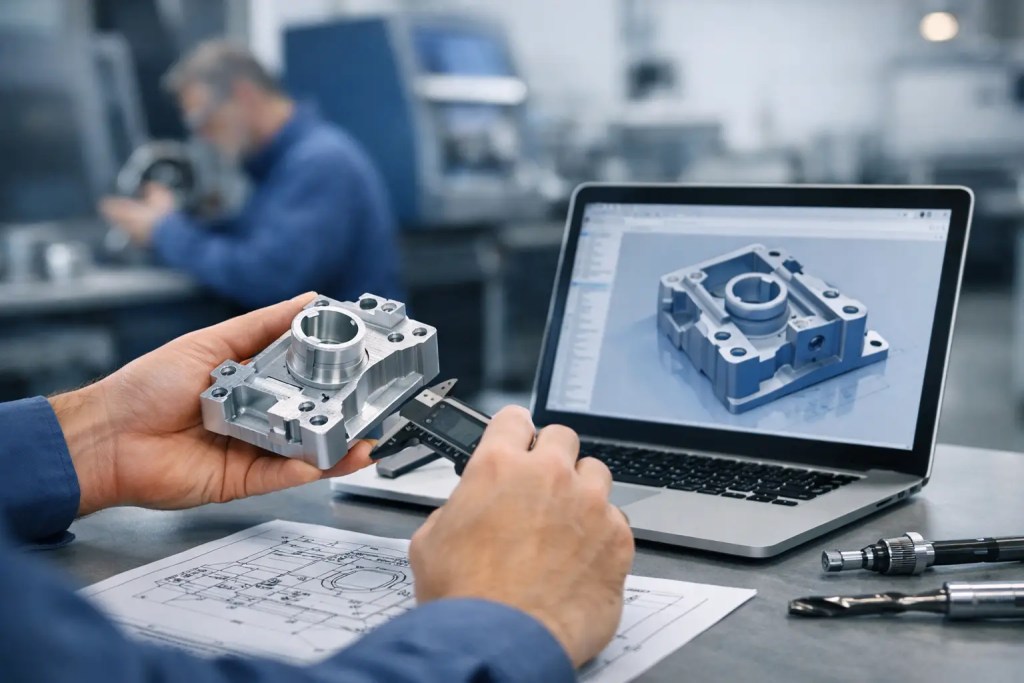
A CAD file can look production-ready on screen and still fail the moment it meets a real machine, real material, and real tolerance stack. That gap is exactly where what is manufacturability review for CAD uploads becomes relevant. It is the checkpoint between design intent and production reality, used to identify geometry, material, tolerance, and process risks before they turn into delays, scrap, or unnecessary cost.
For engineering teams working on compressed timelines, this review is not an administrative step. It is a technical filter. When a part is uploaded for quoting or production, the manufacturability review evaluates whether the model can be built as designed, whether it should be built that way, and whether another process or material would produce a better result.
What is manufacturability review for CAD uploads?
Manufacturability review for CAD uploads is the assessment of a 3D model against the limits and behavior of a selected manufacturing process. The goal is simple: confirm that the part can be produced reliably, at the expected quality level, within a practical lead time and cost.
That assessment usually starts with the uploaded geometry itself. File integrity matters first. A broken STL, non-watertight mesh, missing faces, or conflicting bodies can stop production before any process-specific judgment begins. From there, the review moves into engineering checks such as wall thickness, unsupported spans, trapped powder or resin, hole quality, minimum feature size, tolerance feasibility, orientation effects, and post-processing access.
The answer is rarely just pass or fail. In many cases, the outcome is conditional. The part may be manufacturable in PA12 with Multi Jet Fusion but not ideal in SLA. It may print in metal SLM, but with support structures that increase cost and leave witness marks in a cosmetic zone. It may machine well from aluminum, yet the requested internal corner geometry may require redesign or secondary operations.
Why this review matters before production starts
The most expensive design issue is the one found after the job is released. A good manufacturability review shifts that discovery earlier, when changes are still fast and relatively inexpensive.
For prototypes, that means fewer iteration loops caused by preventable print failures or dimensional surprises. For bridge production and end-use parts, it means more stable output and fewer quality escapes. Procurement teams benefit as well, because clearer manufacturability guidance reduces quote revisions and helps align cost with the actual production route.
This matters even more when teams are comparing additive and conventional methods. A part designed for 3D printing may need draft, split lines, or tooling changes before it is suitable for injection molding. A geometry that works in SLS may become inefficient at higher quantities, where CNC machining or molding offers better unit economics. The review helps determine not only whether the uploaded file can be made, but whether it fits the intended production stage.
What gets checked in a CAD upload review
The specifics depend on process and material, but the review usually centers on a few engineering fundamentals.
Geometry integrity
The model has to be usable. Typical issues include open shells, intersecting surfaces, zero-thickness regions, duplicate entities, and exported files with degraded detail. These problems are common when converting between native CAD, STEP, and STL formats.
A geometry issue is not always visible in the viewer. A part may appear complete yet still generate slicing errors or inconsistent toolpaths. Catching that at upload stage prevents wasted setup time and failed builds.
Feature size and wall thickness
Every process has minimums. Thin walls that look acceptable in CAD may warp, break during depowdering, or fail in post-processing. Small embossed text may disappear. Fine pins may distort. Deep narrow channels may trap material or be impossible to clean.
The acceptable range changes by technology. MJF and SLS can support complex polymer shapes differently than SLA. Metal SLM introduces additional thermal stress considerations. CNC machining, sheet metal, and molding each bring their own tool and access limitations.
Tolerances and critical dimensions
A manufacturability review also checks whether the requested tolerances match the process capability. This is where expectation management becomes valuable. If a design needs tight positional accuracy on mating features, the best answer may be secondary machining after printing, not printing alone.
This is one of the most common trade-offs in digital manufacturing. Additive processes offer design freedom, but not every feature should rely on as-printed accuracy. Critical bores, datum surfaces, and sealing interfaces often need a different finishing strategy.
Orientation, supports, and surface outcome
For additive manufacturing, build orientation affects much more than whether a part fits in the machine envelope. It influences support requirements, surface finish, dimensional behavior, anisotropic strength, and cycle time.
A review considers where support contact may leave marks, whether overhangs are acceptable, and whether orientation will compromise a load-bearing direction. In metal printing, support strategy can significantly affect both cost and distortion risk. In resin systems, orientation can influence drainage and surface quality. There is rarely a universal best orientation – only the best choice for the part’s priorities.
Material and process fit
A model can be manufacturable and still be wrong for the application. That is why the review should not stop at geometry.
If the part needs impact resistance and production-friendly economics, PA12 or PA11 may be a better fit than a brittle photopolymer. If it must operate at elevated temperature or resist corrosion, the conversation changes again. For metal parts, selecting AlSi10Mg versus SS316L depends on performance requirements, weight targets, environment, and finishing expectations.
This is where engineering review adds practical value. The uploaded file is only one part of the manufacturing decision. Functional requirement matters just as much.
What is manufacturability review for CAD uploads in an instant quote workflow?
In an instant quote environment, manufacturability review usually begins with automated analysis and then moves into engineering validation where needed. That combination matters because speed alone is not enough for production work.
Automated checks can quickly identify obvious geometry problems, estimate volume, flag wall thickness concerns, and map the part against process envelopes. That accelerates quoting and gives teams fast feedback. But automation has limits. It may not understand how a cosmetic face should be protected, whether a tolerance is mission-critical, or when a redesign could cut cost without affecting function.
Engineering review fills that gap. It interprets the file in context of manufacturing outcome, not just software rules. For a service bureau operating across polymer printing, metal printing, CNC machining, molding, and finishing, that broader view is especially valuable because the right answer may involve a different process than the one initially selected.
What a good review helps you avoid
The practical benefit is fewer surprises. A strong manufacturability review reduces the chance of failed prints, weak features, unnecessary support-heavy builds, inaccessible finishing zones, unrealistic tolerances, and process-material mismatches.
It also helps control cost in less obvious ways. Sometimes a small fillet adjustment improves machinability. Sometimes changing a blind cavity to a through-feature improves powder removal. Sometimes splitting one complex part into two simpler components lowers total production risk. None of these are dramatic redesigns, but they can materially improve turnaround and yield.
For teams managing multiple stakeholders, the review also creates alignment. Design, engineering, and procurement can make decisions from the same manufacturing constraints instead of discovering them one step at a time.
How engineers should prepare CAD files for review
The fastest review starts with a clean file and clear intent. Upload the correct format for the process, verify units, and make sure revision control is unambiguous. If certain dimensions are critical, say so. If a face is cosmetic, identify it. If the part is a prototype for form and fit only, that changes the recommendation versus an end-use load-bearing part.
It also helps to provide application context instead of only geometry. A bracket that carries static load indoors has a different solution than a bracket exposed to heat, chemicals, and repeated fatigue. The more clearly the requirement is defined, the more accurate the manufacturability guidance becomes.
At Additive3D Asia, this is where a multi-process workflow becomes useful. A CAD upload does not have to be treated as a request for one machine only. It can be reviewed against the broader production objective, whether that means rapid prototyping, short-run production, or transitioning to a conventional process later.
Manufacturability review is not there to slow down your CAD upload. It is there to protect schedule, cost, and part performance before the file becomes a purchase order. When the feedback is early and technically grounded, engineers spend less time correcting preventable issues and more time moving programs forward.