
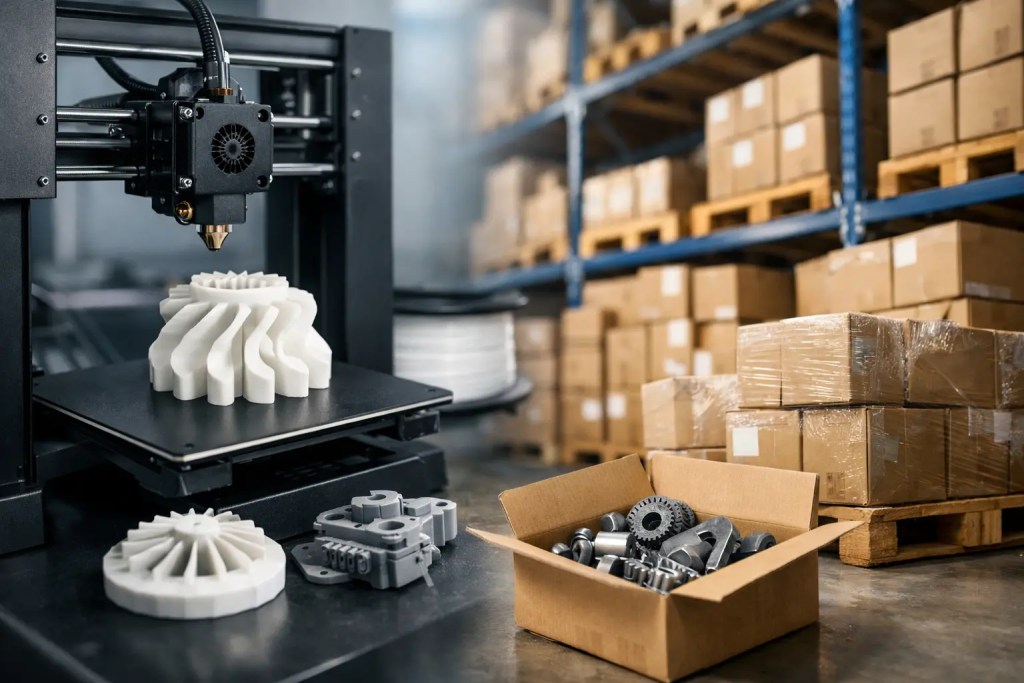
A spare part sitting on a shelf is not just a part. It represents cash tied up, warehouse space consumed, insurance and handling expense, and a growing risk that the part will become obsolete before it is ever used. How 3D printing eliminates inventory costs starts with a different operating model: manufacture qualified parts when demand is confirmed instead of forecasting, purchasing, and storing every possible requirement.
For engineering and procurement teams, the value is not simply that additive manufacturing can produce a component quickly. The value is that a validated digital part file can replace a portion of the physical stockroom. When the application, material, process controls, and post-processing requirements are properly defined, on-demand production reduces the financial burden of holding low-volume and long-tail parts.
Why physical inventory creates hidden cost
The purchase price of a component is only one part of its inventory cost. Businesses also pay to receive, inspect, label, store, count, protect, move, and eventually dispose of inventory. For parts with uncertain demand, these costs can exceed the economic benefit of buying in bulk.
Obsolescence is often the largest exposure. A design revision may make an existing stock batch unusable. A product may be discontinued while replacement parts remain in storage. Regulatory changes, supplier updates, or a material substitution can also leave purchased inventory stranded. This is common for service spares, legacy equipment components, production jigs, and custom fixtures that may be needed only occasionally.
Traditional sourcing compounds the problem because conventional manufacturing often requires minimum order quantities. Injection molding, for example, can be highly cost-effective at volume, but tooling investment and batch requirements can force a company to buy more parts than it can confidently consume. The result is a familiar trade-off: accept a high unit cost for a small order, or accept excess inventory to achieve a lower unit price.
Additive manufacturing changes that calculation for suitable parts. It does not eliminate every inventory-related expense, but it can substantially reduce the need to carry finished goods where demand is variable and production volumes are low to moderate.
How 3D printing eliminates inventory costs in practice
The core mechanism is digital inventory. Instead of stocking hundreds of physical units, a company maintains controlled CAD data, manufacturing specifications, approved material selections, and inspection requirements. The part is produced only when needed.
A validated digital inventory record should include more than an STL file. For repeatable production, the release package should identify the required process, material grade, critical tolerances, orientation-sensitive requirements, finishing instructions, color or marking requirements, and inspection criteria. A PA12 part produced by Multi Jet Fusion or SLS, for instance, should not be treated as interchangeable with an FDM part merely because both originated from the same geometry.
Once that definition is established, the physical inventory position can shift from finished parts to a smaller quantity of critical safety stock. A company may hold a limited number of mission-critical components for immediate response while using on-demand production for the remainder. This approach reduces carrying costs without leaving operations exposed to avoidable downtime.
The most effective candidates are typically parts with low annual usage, irregular demand, frequent design updates, expensive storage requirements, or short product lifecycles. Examples include maintenance spares, custom assembly aids, inspection gauges, enclosures, brackets, cable-management components, and replacement parts for equipment no longer supported by the original manufacturer.
From a warehouse model to a qualified digital catalog
A digital catalog works only when its data is governed. Engineering teams should control revision status, approval ownership, applicable material specifications, and the manufacturing route for each part. Without revision discipline, a digital inventory system can create a different problem: producing an outdated component quickly.
The process should be similar to any other controlled manufacturing release. Upload the approved STL or STEP file, confirm manufacturability and production technology, document the selected material and finish, then retain the approved quote and production configuration. When a repeat order is placed, the supplier can manufacture to the same defined requirements rather than reinterpreting the part each time.
For organizations managing multiple suppliers, this standardization also reduces vendor fragmentation. A single manufacturing partner that supports polymer additive processes, metal additive manufacturing, machining, casting, sheet metal, and finishing can recommend the process that best matches the part’s functional requirement instead of forcing every demand into one technology.
Where the savings are strongest
Inventory reduction is most compelling when the cost of holding stock is high relative to the annual part demand. Consider a maintenance department that uses a specialized fixture twice per year. Buying 50 units may lower the quoted unit price, but it also creates 48 units of unnecessary inventory, requires storage and tracking, and risks becoming obsolete after the next production-line modification.
Producing that fixture on demand may have a higher piece price, yet a lower total cost of ownership. The company buys only what it uses, preserves working capital, and can incorporate design improvements before the next order. For jigs, fixtures, and assembly aids, polymer processes such as HP Multi Jet Fusion, SLS, or FDM can often support rapid replacement and functional iteration when the load, temperature, and dimensional requirements are appropriate.
Service parts present a similar opportunity. A manufacturer may support equipment in the field for years after the initial production run has ended. Maintaining a physical spare-parts inventory for every configuration can be expensive and difficult to forecast. A qualified digital catalog allows the business to produce a replacement component against an approved file when a service request occurs.
Metal additive manufacturing can extend this model to selected high-performance parts. AlSi10Mg and SS316L may be appropriate where corrosion resistance, thermal performance, or mechanical strength is required, provided the geometry, loading conditions, surface requirements, and qualification needs support the process. In many cases, a hybrid route is more effective: print near-net geometry, machine critical interfaces, and apply the required finishing or inspection process.
The trade-offs engineering teams must manage
On-demand manufacturing is not a universal replacement for inventory. High-volume, stable parts with predictable demand may still be less expensive to produce through injection molding, stamping, or other conventional processes. When demand is consistent and the design is frozen, bulk production can provide a lower unit cost than additive manufacturing.
Lead time also matters. If a replacement part is needed within hours to prevent a production shutdown, a small physical buffer may remain necessary. Digital inventory reduces the total amount of stock required, but it cannot remove the need for strategic safety stock where operational consequences are severe.
Qualification is another critical consideration. Parts used in safety-critical, regulated, high-temperature, high-pressure, or heavily loaded environments require process-specific validation. Material data alone is not enough. Engineers must evaluate anisotropy, dimensional capability, surface finish, fatigue performance, chemical exposure, and post-processing effects. A printed part should be approved for its application based on the actual manufacturing route, not an assumption that printed material behaves identically to wrought or molded material.
There is also a data-security and continuity requirement. The digital inventory must be stored, revision-controlled, and accessible to authorized stakeholders. Clear ownership of design files and production specifications is essential, particularly when parts are manufactured across long product lifecycles or shipped to multiple regions.
Building an inventory-light production strategy
Start by reviewing inventory by demand pattern rather than by part number alone. Identify components with low turnover, uncertain forecasts, high obsolescence exposure, or frequent engineering changes. These are often the fastest opportunities for an on-demand model.
Next, classify each candidate by functional requirement. Determine whether the part requires impact resistance, heat resistance, electrical properties, fine detail, tight machining tolerances, or a specific cosmetic finish. Process selection should follow these requirements. PA12 may suit durable functional polymer parts, while PA11 can be considered where greater flexibility and impact performance are needed. SLA may be appropriate for high-detail prototypes, while CNC machining may remain the correct choice for certain precision surfaces and material requirements.
Then establish a repeatable release package. Define the approved file revision, process, material, finish, dimensional requirements, and acceptance criteria. An ISO 9001:2015-certified manufacturing workflow supports this discipline by applying consistent controls from quotation through production and final delivery.
Additive3D Asia supports this model by combining industrial additive manufacturing with conventional production processes, allowing teams to choose the most practical route for each part rather than treating 3D printing as the only answer. That flexibility is especially useful when a program moves from prototype to short-run production or when a part needs printed geometry with machined critical features.
The objective is not an empty storeroom. It is a smarter one: physical stock reserved for true operational urgency, and qualified digital part definitions ready to produce the rest when demand is real.