
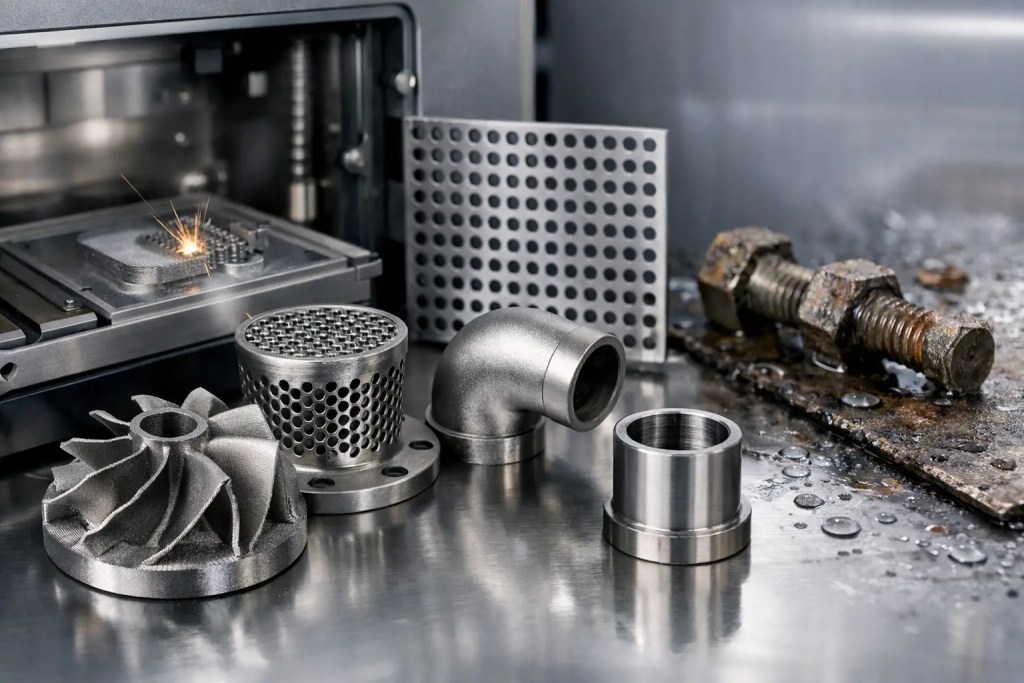
A valve body that survives chloride exposure on paper can still fail early if weld zones, trapped moisture, or rough internal passages become corrosion initiators in service. That is why SS316L metal printing for corrosion resistant components is not just a material choice. It is a manufacturing decision that affects geometry, surface condition, density, inspection strategy, and long-term reliability.
For engineering teams evaluating metal additive manufacturing, SS316L remains one of the most practical stainless steels for end-use parts. It combines established corrosion resistance with good printability, strong weldability, and broad acceptance across industrial environments. In selective laser melting, it also supports shapes that are difficult or expensive to machine conventionally, especially when the part includes internal channels, weight reduction features, or assembly consolidation.
Why SS316L fits corrosion-critical applications
SS316L is widely specified when a component must perform in humid, chemically exposed, or marine-adjacent environments. The addition of molybdenum improves resistance to pitting and crevice corrosion compared with 304-grade stainless steel, while the low carbon content helps reduce sensitization risk during thermal processing. For printed parts, that matters because thermal cycles are inherent to the build process and any downstream heat treatment.
This does not mean SS316L is immune to every corrosive condition. Chloride concentration, temperature, media chemistry, residual stress, and surface finish all influence performance. If the application involves aggressive acids, elevated temperatures, or severe crevice conditions, material selection should still be validated against the service environment. In many industrial cases, though, SS316L offers a strong balance of corrosion resistance, mechanical performance, and manufacturability.
From a procurement standpoint, it is also a familiar engineering material. Teams responsible for qualification and maintenance often prefer alloys with a known service history. That lowers adoption risk when moving a component from machined fabrication to metal additive manufacturing.
SS316L metal printing for corrosion resistant components: where it adds value
The strongest case for additive manufacturing is rarely that printing is simply newer. It is that printing changes the part economics or performance in a measurable way. SS316L metal printing for corrosion resistant components is most valuable when the design benefits from geometric freedom or when conventional fabrication introduces avoidable cost and lead time.
One common use case is internal flow geometry. Printed SS316L can produce conformal passages, integrated manifolds, and compact fluid-handling features that would require multiple machined parts and welded joints otherwise. Fewer joints can mean fewer potential leak paths and fewer corrosion-prone interfaces.
Another use case is custom fixtures, brackets, and handling tools used in wet-process or chemically exposed production lines. Here, additive manufacturing can shorten development cycles while still delivering a metal part suitable for operational use. The ability to revise geometry without hard tooling is particularly useful for pilot lines, special-purpose machines, and low-volume industrial equipment.
Medical, food-adjacent, marine, energy, and laboratory applications also benefit, but the design requirements differ. In some sectors, cleanability and surface finish drive the specification. In others, the priority is structural integrity under cyclic loading in corrosive conditions. The material is the same, but the path to a production-ready part is not.
Design considerations that affect corrosion performance
Corrosion resistance is influenced as much by design execution as by alloy selection. In printed SS316L, rough as-built surfaces can retain fluid, increase effective surface area, and create micro-crevice behavior. That does not automatically disqualify the process, but it does mean surface requirements should be defined early.
If a part includes internal channels, engineers should consider where media may stagnate and whether those surfaces can be post-processed. External faces can often be machined, polished, bead blasted, or otherwise finished to meet cosmetic or functional targets. Fully enclosed internal features are harder to access, so geometry should be designed with drainage, cleanout, and inspection in mind.
Wall thickness and support strategy also matter. Extremely thin walls may distort during printing or heat treatment, affecting dimensional control and local stress distribution. Support removal zones can leave witness marks or require secondary finishing. If those areas sit in high-exposure environments, finishing requirements should be specified as part of the design review rather than treated as a cosmetic afterthought.
Engineers should also think about part orientation. Orientation affects surface texture, support placement, build time, and sometimes the consistency of critical features. For corrosion-sensitive parts, orientation decisions can influence how much post-processing is needed to achieve the target surface condition.
Process control matters as much as material selection
Metal additive manufacturing is only as reliable as the process discipline behind it. Powder quality, machine calibration, parameter control, inert gas environment, heat treatment, support removal, and final inspection all contribute to part consistency. For components expected to operate in corrosive service, these variables are not background details. They are part of the quality outcome.
This is where an ISO 9001:2015-certified production workflow becomes relevant. Repeatability depends on documented procedures, traceable job handling, and inspection checkpoints that match the application risk. A corrosion-resistant alloy printed with inconsistent controls can still produce inconsistent parts.
In practice, teams should ask the manufacturing partner how builds are qualified, what finishing options are available, and how dimensional and visual inspections are handled. For some programs, a standard inspection report is enough. For others, especially those moving toward end-use deployment, the right path may include tighter documentation, test coupons, or application-specific validation.
When printed SS316L is a better choice than machining
Machining remains the right process for many stainless steel components, especially simple geometries, tight-tolerance prismatic parts, and higher-volume runs where material removal is efficient. Additive manufacturing becomes more attractive when complexity drives machining cost, when lead time for fabricated assemblies becomes a bottleneck, or when design consolidation improves reliability.
A printed SS316L part can replace an assembly of machined and welded pieces. That may reduce labor, simplify inventory, and improve flow performance. It can also eliminate weld seams that would otherwise need passivation, inspection, or ongoing monitoring in corrosive environments.
The trade-off is that printed surfaces and tolerances often require selective secondary operations. Engineers should not assume a fully as-printed part will meet every sealing, bearing, or cosmetic requirement. The most effective manufacturing plans usually combine additive with post-machining or finishing where it adds clear value.
This hybrid approach is often the most practical route for industrial buyers. Use additive where complexity earns its keep. Use conventional finishing where precision or surface condition is critical.
Qualification questions to settle before release
Before releasing a corrosion-exposed component into production, teams should define the actual service conditions in measurable terms. “Corrosion resistant” is too broad to guide process selection on its own. The manufacturer needs to know the media, temperature range, exposure duration, pressure conditions, cleaning regime, and any regulatory constraints tied to the application.
It is also worth deciding what success looks like. Some projects need a functional prototype for pilot testing. Others need short-run production parts with repeatable cosmetic finish and documented inspection. Those are different scopes, and they should be treated that way from the quoting stage onward.
For many buyers, speed matters just as much as material performance. A streamlined workflow that allows teams to upload CAD, receive manufacturability feedback, approve production, and move directly into finishing and shipment reduces delays between design intent and physical validation. That matters when a maintenance issue, field retrofit, or product launch depends on getting metal parts into service quickly.
Additive3D Asia supports this kind of decision-making with industrial metal printing, complementary post-processing, and a broader manufacturing stack when a part or program needs more than one process. For engineers managing both prototyping and production, that reduces handoff risk.
Where SS316L metal printing makes the most sense
SS316L is not the default answer for every corrosive application, and metal printing is not automatically the lowest-cost route. But when the part requires corrosion resistance, geometric complexity, and compressed lead times, the combination is hard to ignore.
The best results come from treating the project as an engineering problem rather than a simple print request. Define the environment clearly. Design for finishability and drainage. Match tolerances to function. Plan secondary operations intentionally. Then qualify the part against the service conditions it will actually see.
That is usually the difference between a metal part that looks promising in a quote and one that performs reliably on the line, in the field, or inside the machine for the long term.