
A part can hit its dimensional target and still fail the handoff. The reason is often surface finish. For engineers and procurement teams, that final surface condition affects fit, sealing, paint adhesion, cleanability, appearance, and whether a prototype can move into customer review or production use. That is why top 3D printing finishes explained is not just a design topic – it is a manufacturing decision with cost, lead time, and performance behind it.
Different additive processes produce very different native surfaces. A PA12 Multi Jet Fusion housing will not look or behave like an SLA master pattern, and a metal SLM bracket will need different post-processing than an FDM fixture. The right finish depends on what the part needs to do, how many parts are required, and how much variation the application can tolerate.
Why 3D printing surface finish matters
Surface finish is usually discussed as a cosmetic feature, but in production it has broader consequences. Rough surfaces can increase friction, trap contaminants, and make threads or press fits less predictable. On the other hand, a premium finish adds time and cost that may not improve function on an internal jig or hidden structural part.
This is where teams get better results by treating finish selection as part of process planning. If the part is going into a customer-facing assembly, the visual standard matters. If it is used for airflow, fluid contact, or repetitive handling, texture and porosity matter. If it is a short-run end-use part, repeatability matters just as much as appearance.
Top 3D printing finishes explained by use case
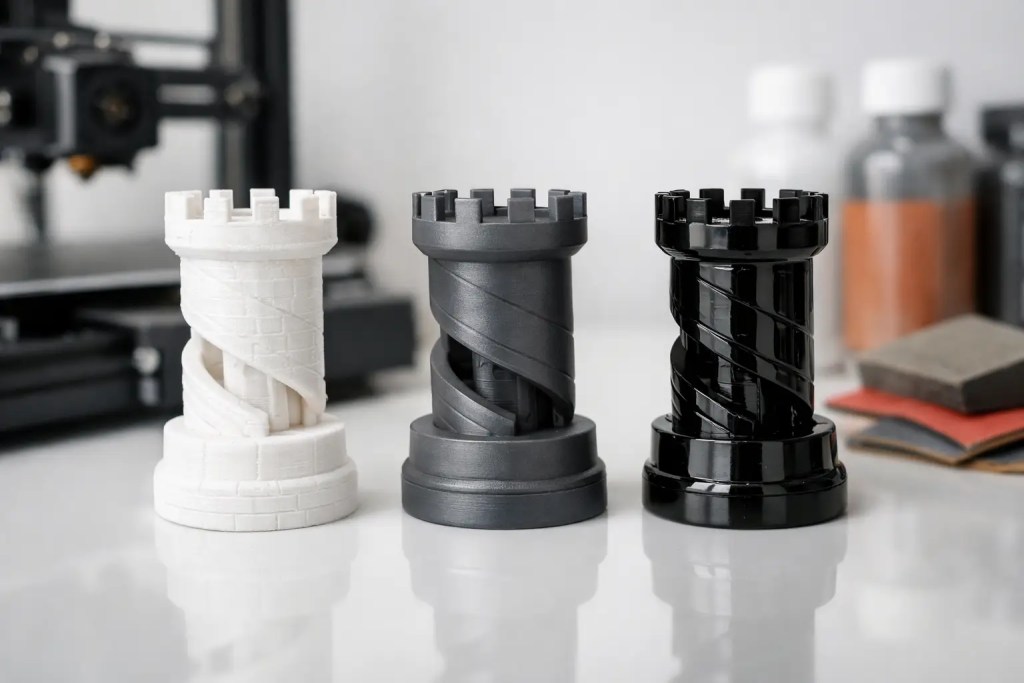
The most useful way to evaluate finishes is by manufacturing outcome, not by marketing label. In practice, most 3D printed parts fall into a few common finish categories: as-printed, blasted or smoothed, machined in critical areas, coated or painted, and polished for high visual or contact requirements.
As-printed finish
As-printed is the fastest and lowest-cost option because it preserves the part directly from the build process with minimal post-processing beyond support removal, powder removal, or curing. This is often the right choice for functional prototypes, internal fixtures, and early validation parts where geometry and speed matter more than appearance.
The trade-off is that each process leaves a distinct texture. MJF and SLS parts typically have a fine matte grain. SLA can achieve smoother surfaces and sharper visual detail, but support touchpoints still need to be considered. FDM shows visible layer lines, especially on curved faces. Metal SLM parts often have a relatively rough surface that may be acceptable for non-critical areas but not for sealing, mating, or cosmetic surfaces.
As-printed works well when the part will be handled by engineers rather than end users, or when secondary operations are limited to localized areas. It also helps teams keep lead times short during iterative development.
Media blasting and surface smoothing
For many polymer parts, blasting is the first practical step up from as-printed. It removes residual powder, evens out the visual texture, and gives parts a cleaner, more uniform matte appearance. On MJF and SLS components, this is a common route when customers want a production-ready look without moving into heavy cosmetic finishing.
Smoothing can go further by reducing surface roughness and making parts easier to clean or coat. Depending on the process and material, smoothing may improve touch feel and reduce the visibility of layer-based texture. That can be useful for enclosures, covers, medical-adjacent housings, and consumer-facing prototypes.
The caution is dimensional sensitivity. Any finish that modifies the outer skin of the part can affect tight tolerances, embossed text, or snap features if it is not controlled properly. For that reason, smoothing should be selected with the geometry and tolerance stack in mind, not added as an afterthought.
Machined critical surfaces
Some parts do not need a fully refined surface everywhere. They need precision where it counts. A printed part can be highly effective when near-net geometry is produced additively, then machined only at interfaces such as bores, flat datum faces, threads, or sealing zones.
This hybrid approach is common in both polymer and metal applications. It keeps additive manufacturing efficient for complex forms while tightening the features that control assembly performance. For jigs, fixtures, brackets, and custom machine components, this often delivers the best balance between cost and function.
It also gives engineering teams more control over repeatability. Instead of paying for a cosmetic upgrade across the whole part, they invest in the surfaces that directly affect fit and performance.
Painting, dyeing, and coating
When appearance, color consistency, or environmental protection matters, coating becomes relevant. Dyeing is often used on nylon parts to create a more uniform appearance, especially for black production components. Painting can provide broader color control and a more finished visual standard for presentation models, customer demos, or low-volume production housings.
Coatings may also serve a functional purpose. They can improve UV resistance, add chemical protection, or create a smoother cleanable outer layer. On metal parts, coating can support corrosion resistance or visual specification requirements.
The trade-off is process complexity. Coatings add labor, cure time, and another source of dimensional variation. They also make process control more important. If a part has threads, mating tabs, or close-clearance assemblies, masking and thickness management need to be planned early.
Polished and high-detail cosmetic finishes
For premium visual surfaces, polished or high-detail cosmetic finishing is usually associated with SLA and certain metal applications. SLA is often selected for master patterns, display prototypes, or parts where smoothness and sharp detail are priorities. With the right finishing workflow, surfaces can be prepared for painting or presentation at a much higher visual standard than powder-bed nylon or FDM can typically achieve in raw form.
Metal polishing is different. It can improve appearance and contact behavior, but it is more time-intensive and geometry-dependent. Internal channels, lattice regions, and recessed features may remain inaccessible. That makes polish level a practical discussion, not an absolute one.
For customer-facing parts, polished finishes can be worth the effort. For engineering builds, they are often unnecessary unless the surface directly affects testing or approval.
Matching finish to process and material
No finish exists in isolation from the print technology. MJF PA12 and PA11 parts are frequently chosen when teams want strong functional components with a consistent matte production look. SLS offers similar design freedom, though the final texture and post-processing path may differ depending on geometry and batch conditions.
SLA is usually the better fit when visual detail and smooth surfaces matter most. FDM remains practical for cost-sensitive prototypes and shop-floor tools, but visible layer lines are part of the trade-off unless additional finishing is applied. Metal SLM in materials such as AlSi10Mg or SS316L typically requires a more targeted finishing strategy because critical faces, threads, and contact areas often need secondary machining or treatment.
This is where supplier capability matters. A bureau that can combine additive production with machining and surface post-processing can align the finish with the application instead of forcing the application to fit a single process.
How to choose the right finish without overspending
The simplest starting point is to ask what the surface has to do. If the answer is only structural, keep the finish minimal. If the surface will be seen, touched, sealed, painted, or assembled to a tight tolerance, define that requirement clearly before quoting.
It also helps to separate global finish from local finish. Many parts need a standard overall surface and only a few refined features. That approach usually reduces cost and protects lead time. Engineers should also flag cosmetic surfaces on drawings or during RFQ review so orientation, support strategy, and post-processing can be planned upfront.
For teams moving from prototype to short-run production, repeatability should carry as much weight as aesthetics. A slightly less aggressive finish with better batch consistency is often the better production choice.
At Additive3D Asia, this kind of decision is usually most effective when the process, material, and post-processing plan are reviewed together rather than quoted separately. That reduces rework and gives buyers a clearer path from prototype intent to manufactured part.
The real question behind finish selection
The best finish is rarely the smoothest or the most expensive. It is the one that supports the part’s job, fits the process capability, and arrives on schedule without creating avoidable risk. If you define that requirement early, surface finish stops being a last-minute cosmetic request and becomes part of a controlled manufacturing outcome.