
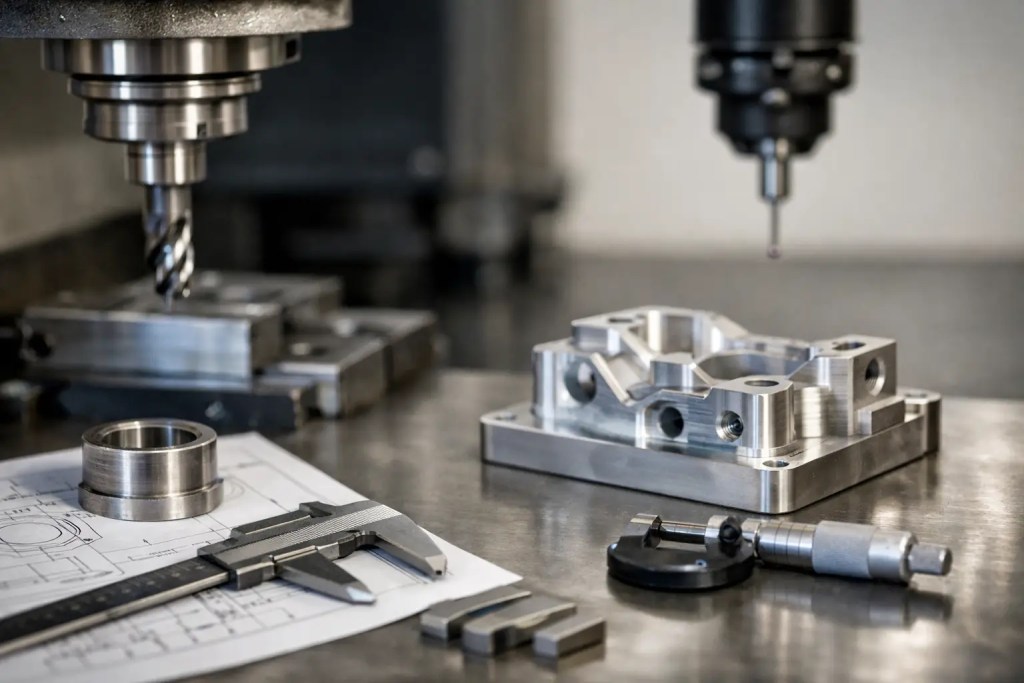
A shaft that presses in perfectly on one prototype can bind on the next batch if the drawing treats every dimension as equally critical. That is where a solid guide to design for CNC machining tolerances matters. Tolerances are not just drawing notes. They drive process choice, inspection time, cost, lead time, and whether a part works once it leaves the machine.
For engineering teams, the goal is not to make every dimension tighter. The goal is to control the dimensions that affect function and relax the ones that do not. Good CNC design balances manufacturability with performance, which means understanding what standard machining can hold, when tighter control is justified, and how to communicate that intent clearly.
What CNC machining tolerances actually control
A tolerance defines the acceptable variation around a nominal dimension. If a hole is called out at 10.00 mm with a tolerance of plus or minus 0.05 mm, any finished diameter between 9.95 mm and 10.05 mm is acceptable. That range sounds simple, but in production it affects tooling, machine setup, measurement method, and scrap risk.
In CNC machining, tolerances apply to more than linear dimensions. They also affect hole position, perpendicularity, flatness, concentricity, and surface finish. A part can meet its basic size dimensions and still fail in assembly because the datums were poorly selected or the true functional relationship between features was never defined.
This is why experienced design teams treat tolerances as part of functional design, not as a final drawing exercise. The machine can only produce what the print asks for, and the inspector can only verify what the print defines.
A practical guide to design for CNC machining tolerances
The first step is to separate critical features from general features. Critical features are the ones that affect fit, sealing, alignment, load path, or motion. These deserve tighter control. General features such as non-mating outside dimensions, cosmetic clearances, or stock removal on nonfunctional faces usually do not.
As a baseline, many CNC shops can hold around plus or minus 0.1 mm on standard machined features without special effort, depending on material, geometry, and machine condition. Tighter tolerances such as plus or minus 0.05 mm or below are possible, but they increase setup control, inspection requirements, and machining time. Once you move into very tight limits, the part may need secondary finishing operations such as reaming, grinding, honing, or lapping.
That trade-off matters. If the application only needs clearance for a fastener, calling out a high-precision bore adds cost with no functional gain. If the feature locates a bearing or seals against an O-ring, loose tolerances create downstream failure risk. The design decision should reflect the job the feature performs.
Start with function, not with default tightness
A common mistake is applying one blanket tolerance across the entire drawing. That often happens when teams are moving quickly or reusing legacy templates. The result is usually either over-tolerancing or under-defining critical relationships.
A better method is to ask three simple questions for each feature. Does it locate another part? Does it transfer force or motion? Does it affect sealing or alignment? If the answer is yes, tolerance that feature based on function. If the answer is no, keep it as open as practical within the manufacturing process.
This approach reduces cost and shortens turnaround because the machinist can focus effort where it matters. It also improves inspection efficiency. Measuring every face to high precision is slow. Verifying a defined set of critical dimensions against clear datums is much more effective.
Datums and GD&T make tolerances usable
Size tolerances alone are often not enough for production-ready parts. A pattern of holes can all be the right diameter and still be unusable if the pattern shifts relative to the mounting face. That is where datums and GD&T become important.
Datums establish the reference framework for manufacturing and inspection. They should reflect how the part is actually located in assembly. If a plate mounts against one face and references two edges, those surfaces are likely your primary, secondary, and tertiary datums. When datums reflect real-world assembly conditions, position and orientation tolerances become meaningful.
GD&T is especially useful when multiple features work together. Position tolerances on holes, flatness on sealing faces, and perpendicularity between locating surfaces can communicate design intent more accurately than a chain of plus or minus dimensions. It also prevents tolerance stack-up from becoming unmanageable.
That said, GD&T should be used with discipline. Overcomplicated callouts slow quoting, machining, and inspection. If a simple plus or minus tolerance communicates the requirement clearly, use it. Reserve GD&T for features where geometric relationship truly matters.
Tolerance stack-up is where assemblies fail
Individual dimensions can all be in spec while the finished assembly still misses alignment, preload, or clearance requirements. That is the effect of tolerance stack-up. It becomes more severe when multiple components, several machined operations, and mixed manufacturing processes are involved.
The fix starts at the design stage. Avoid long chains of dependent dimensions. Dimension features from common datums rather than from one feature to the next. This reduces cumulative error and makes machining more repeatable.
You should also think at the assembly level. If a CNC-machined aluminum housing mates with injection molded covers and off-the-shelf hardware, the tolerance strategy should account for all three. The machined part may be capable of very tight control, but the assembly may still need extra clearance because the molded part has wider variation. Designing each part in isolation usually creates expensive surprises later.
Material and geometry change what is realistic
Not every material machines the same way. Aluminum is generally stable and efficient to machine. Stainless steel can introduce more tool wear and heat. Plastics may move, burr, or deform during cutting and clamping. Thin walls, long unsupported features, and deep pockets also make tolerance control harder.
This is why a realistic guide to design for CNC machining tolerances must account for geometry, not just numbers on a print. A 20 mm block with an external profile is much easier to hold than a thin rib inside a deep cavity. A reamed hole can hold a tighter diameter than a drilled hole. A large flat surface may need facing strategy and inspection planning to meet flatness requirements.
If your design includes thin walls, deep slots, or slender pins, expect more variation and potentially higher cost. In many cases, a small geometry change improves both manufacturability and consistency. Increasing wall thickness, shortening unsupported lengths, or opening tool access can make the difference between routine production and frequent rework.
Holes, threads, and fits need special attention
Most CNC-machined parts fail functionally at interfaces, especially holes and threads. Designers should define whether a hole is for clearance, location, press fit, or post-machining operations. Those use cases require different process controls.
For standard clearance holes, broad tolerances are usually acceptable. For dowel pin holes or bearing seats, you may need tighter diameter and positional control, and often a finishing operation like reaming. Threads also need practical thinking. Internal threads in softer materials may not perform well if engagement is shallow or if the minor diameter is poorly controlled. Very small threads increase breakage risk during tapping and inspection.
Fits should be specified based on assembly behavior, not assumption. A sliding fit, transition fit, and interference fit each tolerate variation differently. If the fit is critical, define both mating parts together. Specifying only one side tightly while leaving the mating part vague creates avoidable assembly problems.
How to reduce cost without sacrificing performance
The most cost-effective CNC part is not the loosest one. It is the one with precision applied only where function requires it. That means using general tolerances for noncritical dimensions, minimizing unnecessary secondary operations, and avoiding cosmetic requirements that drive extra handling.
It also means engaging manufacturing input early. A capable production partner can flag tolerance risks before release, suggest alternative callouts, and recommend whether CNC machining should be paired with another process for speed or cost. Additive3D Asia supports this kind of decision-making across both machined and additive parts, which is useful when a design moves from prototype iteration into production-ready hardware.
When reviewing a drawing, check whether every tight tolerance can be defended by fit, performance, or inspection need. If not, open it up. If yes, make sure the datum scheme and measurement method support it. Precision without inspection clarity is not production control.
What to put on the drawing
A strong manufacturing drawing gives the machinist and inspector the same understanding of what matters. Include clear datums, realistic general tolerances, critical feature callouts, thread specifications, surface finish where function depends on it, and any notes about post-processing or coating that may affect final dimensions.
If a coating changes fit, tolerance before and after finishing should be clear. If a face must remain untouched for sealing, say so. If a bore is critical after anodizing, that requirement needs to be explicit. Small omissions at the drawing stage often become large delays on the shop floor.
The best tolerance strategy is usually the one that looks restrained. It reflects how the part functions, how it will be machined, and how it will be inspected. When those three line up, teams get faster quotes, fewer revisions, and parts that work the first time. That is the kind of control that pays back long after the first prototype ships.