

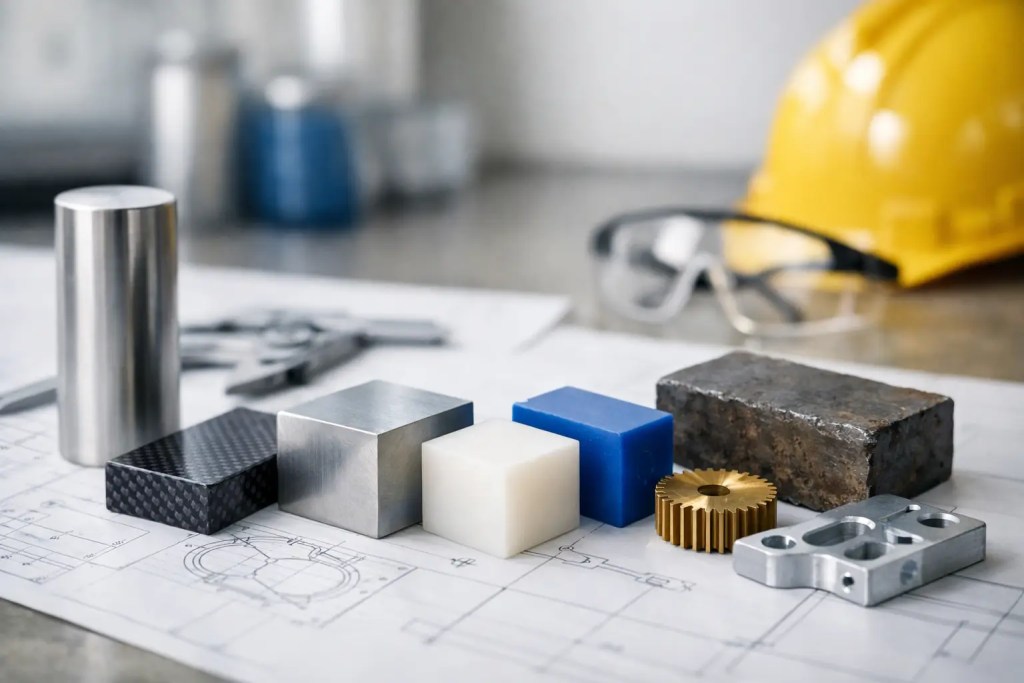
A part can pass CAD review, look right in the render, and still fail on the shop floor because the material was wrong from the start. That is why an engineering materials selection guide matters long before production begins. Material choice affects strength, heat resistance, dimensional stability, surface finish, certification pathways, lead time, and total unit cost.
For engineers and sourcing teams, the real challenge is not picking the strongest material on paper. It is selecting the material and process combination that meets the actual operating requirement without creating unnecessary cost or manufacturing risk. A prototype housing, a fixture, and a short-run end-use bracket may all share a similar geometry, but they rarely need the same material strategy.
What an engineering materials selection guide should answer
A useful engineering materials selection guide does not start with a material datasheet. It starts with the application. The first question is what the part must do in service. That includes mechanical load, impact exposure, operating temperature, chemical contact, wear, cosmetic expectations, and acceptable tolerance range.
The next question is how the part will be made and in what quantity. A material that performs well in CNC machining may not be the best fit for powder bed fusion. Likewise, a resin selected for visual prototyping may be unsuitable for functional testing under repeated stress. Process capability and material behavior have to be evaluated together.
The final question is operational: how quickly the part is needed, how repeatable the output must be, and whether the project may scale from prototype to low-volume production. In practice, the right answer often balances performance, manufacturability, and procurement speed rather than maximizing a single property.
Start with service conditions, not brand names
Engineers often receive material requests framed around a familiar grade or a previous project. That can be useful, but it should not replace a service-condition review. If a component sees intermittent loads, indoor use, and limited heat exposure, a polymer may meet the requirement at lower cost and with faster turnaround than a machined metal part.
If the part is load-bearing, exposed to elevated temperatures, or needs higher stiffness and long-term dimensional control, metal may be the safer route. But even that depends. Some metal parts are over-specified because the design team is compensating for uncertainty, not actual loading. In those cases, testing a high-performance polymer can reduce weight and cost without sacrificing function.
A practical selection workflow usually looks like this: define the load case, define the environment, define the critical dimensions, then match those requirements to process-compatible materials. That order matters because it filters out attractive but unsuitable options early.
Polymer selection for prototypes and functional parts
Polymer additive manufacturing is often the fastest way to move from design to physical validation, but different polymer families solve different problems. Nylon-based materials such as PA12 are frequently chosen for functional prototypes and production-intent parts because they offer a strong balance of toughness, dimensional stability, and process reliability. They are widely used for housings, brackets, clips, and jigs where mechanical performance matters more than a cosmetic Class A finish.
PA11 can be a better fit when higher ductility and impact resistance are needed. That matters for parts that will flex, snap, or absorb repeated handling. The trade-off is that material selection should still account for the geometry, wall thickness, and expected duty cycle. A more ductile material is not automatically better if stiffness is the main requirement.
Resin systems used in SLA are a different category. They are well suited to fine detail, smooth surfaces, and concept models where visual quality or feature resolution matters. Some engineering resins can support functional testing, but they should be validated carefully for long-term load, UV exposure, or thermal use. Teams sometimes choose SLA because the part looks finished straight off the machine, then discover that appearance and field performance are not the same thing.
FDM materials can be effective for larger prototypes, tooling aids, and cost-sensitive fixtures, especially when speed and scale matter more than isotropic strength or fine detail. Here again, the decision depends on the role of the part. A fixture used internally on a production line has a different risk profile than a customer-facing end-use component.
Metal selection when loads, heat, or durability increase
When the application requires higher structural performance, thermal capability, or wear resistance, metal additive manufacturing or conventional metal fabrication becomes more relevant. Aluminum alloys such as AlSi10Mg are often selected for lightweight parts that still need solid mechanical properties, good heat performance, and design freedom for complex internal features.
Stainless steels such as SS316L are commonly used where corrosion resistance and durability are priorities. That can include industrial tooling, fluid-contact components, and parts used in demanding environments. The key is not just whether the alloy is strong enough, but whether it aligns with the application’s exposure profile, finishing requirement, and tolerance expectation.
Machined metal may still be the better choice for simpler geometries, tighter tolerances, or lower-risk qualification paths. Additive metal is powerful when geometry complexity creates a real performance or assembly advantage. If the geometry does not benefit from additive, machining can be more efficient and more economical.
Process and material must be selected together
One of the most common selection errors is evaluating material properties in isolation from manufacturing process. Datasheet values are useful, but they do not tell the full production story. Build orientation, feature thickness, support strategy, post-processing, and heat treatment can all influence the final result.
For example, a nylon part produced through powder bed fusion may offer better functional consistency for complex geometries than a filament-based process, especially where unsupported features and stable mechanical behavior matter. A metal part built by SLM may enable internal channels and part consolidation, but it also introduces considerations around support removal, surface roughness, and secondary machining.
That is why experienced teams review material and process as a package. The right question is not “What is the best material?” but “What is the best manufacturable material for this geometry, requirement, and timeline?”
Cost is more than piece price
Material selection decisions often become distorted when teams focus only on quoted unit cost. The lower-priced option can become the expensive one if it causes failed tests, repeated iterations, or manual finishing work that was not considered upfront.
A material with better dimensional consistency may reduce assembly issues. A process with cleaner surface output may reduce post-processing labor. A production-ready polymer may cost more than a visual prototype resin but save an entire development cycle if it allows real-world testing sooner.
Volume also changes the answer. Additive manufacturing is highly effective for prototyping, bridge production, and lower-volume end-use parts, especially where design changes are likely. As volume rises, tooling-based processes such as injection molding may become the more efficient route. Good material selection accounts for where the program is today and where it is likely to go next.
Common selection mistakes to avoid
The first mistake is choosing by familiarity. A known material can feel safer, but if it was selected for a different geometry, environment, or production method, it may not fit the new application.
The second is treating prototype material as a placeholder with no strategic value. If the prototype will be used for functional testing, design verification, or customer approval, the material should reflect the decision being tested.
The third is underestimating finishing and tolerance requirements. A part that needs a fine cosmetic surface, threaded interfaces, or precise mating dimensions may need a different process or a hybrid route with machining and post-processing. Material choice should support that pathway, not fight it.
The fourth is ignoring procurement speed and repeatability. In production environments, the best material is one that can be sourced and manufactured consistently under controlled workflows. That is where an ISO 9001:2015-certified manufacturing partner with both additive and conventional capability can reduce risk, because material recommendation is tied to a repeatable production system rather than a single machine type.
A practical decision framework for engineering teams
If you need a fast screening method, narrow the choice using five filters: functional load, thermal exposure, environmental resistance, finish and tolerance requirements, and expected production volume. Once those are clear, material options usually narrow quickly.
From there, compare the realistic manufacturing routes, not just the material families. A PA12 part from MJF or SLS may be the right answer for one functional assembly, while CNC-machined aluminum is the right answer for another. The geometry, lead time, and test objective decide the path.
At Additive3D Asia, this is typically where multi-process capability matters most. When a supplier can evaluate additive polymers, metal AM, machining, molding, and finishing within one workflow, material selection becomes more reliable because the recommendation is based on fit, not on forcing every part into a single process.
Good material decisions shorten development cycles because they remove uncertainty early. If the part must survive real use, the material choice should be made with the same discipline as the design itself. Start with the operating requirement, validate against process capability, and choose the option that delivers repeatable performance on schedule.