
A 20-piece production run can expose the limits of an otherwise good manufacturing decision. A machined housing may meet a tight bearing fit but consume budget in setup and material removal. An SLS enclosure may be available faster and permit internal cable routing, yet need careful allowance for mating features. For SLS vs CNC machining for low volume parts, the right choice depends less on part quantity alone than on geometry, functional requirements, tolerance strategy, and finishing expectations.
Both processes produce capable functional parts without the tooling investment of injection molding. They do not produce the same result, however. Engineers should evaluate them against the requirements that affect assembly performance, validation schedules, and repeatability in service.
SLS vs CNC machining for low volume parts: the core difference
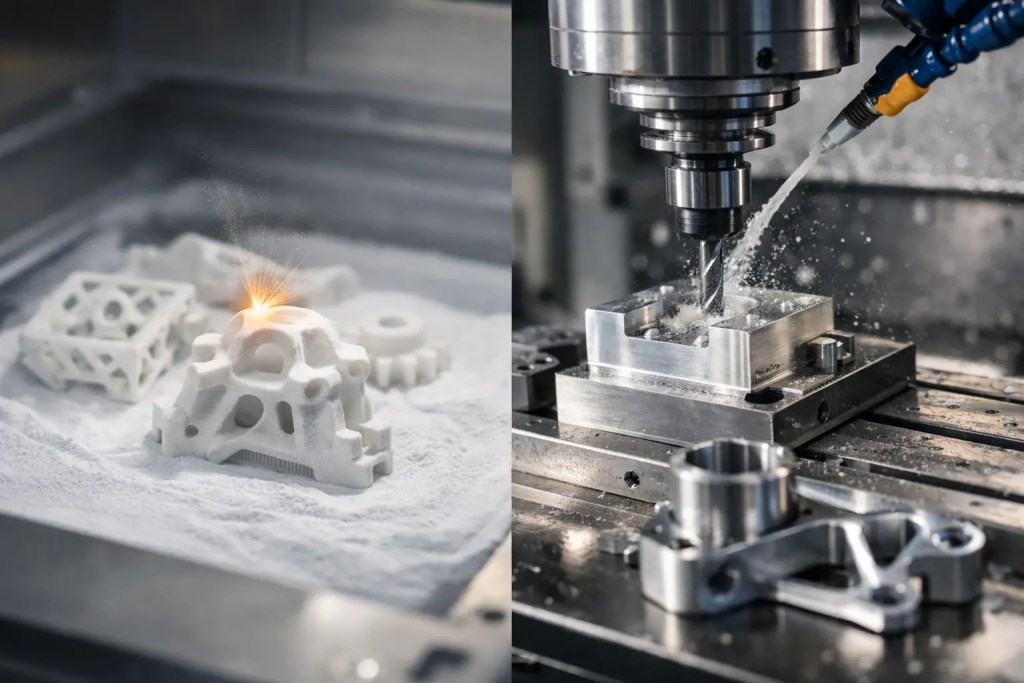
Selective Laser Sintering, or SLS, builds polymer parts layer by layer by fusing powdered material with a laser. PA12 is a common choice for functional components because it offers a useful balance of strength, chemical resistance, and dimensional stability. PA11 may be selected where improved ductility and impact performance are needed.
CNC machining is subtractive. A cutter removes material from a solid billet or plate to create the final geometry. It supports a broad selection of engineering plastics and metals, including aluminum, stainless steel, acetal, PEEK, and nylon. Because the part begins as bulk material, its properties generally reflect the source stock rather than a layer-based build process.
This distinction drives nearly every practical trade-off. SLS rewards complex geometry and part consolidation. CNC machining rewards precision, controlled surfaces, and material options that are difficult or impractical to print.
Start with function, not process preference
For low-volume work, teams often ask which method is cheaper. That is a valid question, but it should come after defining what the part must do. A cosmetic electronics cover and a precision metal mounting block may both be ordered in quantities of 25, but they have very different manufacturing priorities.
SLS is often a strong fit for housings, ducts, brackets, protective covers, clips, cable-management features, ergonomic prototypes, and fixtures with complex forms. It can produce enclosed channels, lattice structures, organic surfaces, and undercuts without custom fixtures. Since surrounding powder supports the part during printing, many geometries that would require multiple CNC setups can be manufactured as one component.
CNC machining is generally the better option when the part requires tight fits, flat sealing surfaces, accurate hole locations, threads, high stiffness, or a specific production-grade material. It is also appropriate when the part will see elevated temperatures, heavy loading, wear, or environmental exposure beyond the performance envelope of an SLS polymer.
A hybrid approach is frequently the most effective answer. Print the complex body in SLS, then machine critical datums, bores, or sealing faces. Alternatively, use an SLS part for early functional validation and move to CNC once the design is stable and high-precision interfaces are confirmed.
Geometry can change the cost equation
CNC machining is highly efficient for prismatic parts: plates, blocks, brackets, panels, and components with accessible pockets and holes. Simple geometry means fewer setups, shorter cycle times, and more predictable pricing. A rectangular aluminum bracket with tapped holes may be faster and more economical to machine than to print.
Cost rises when a CNC part needs multiple setups, deep narrow cavities, long-reach tools, difficult-to-access internal features, or extensive manual finishing. Each setup introduces time and potential variation. Features that cannot be reached by a cutting tool may require the part to be split into multiple components and assembled afterward.
SLS has a different cost structure. Build volume, packing efficiency, material usage, and post-processing affect price more than tool access. Multiple unique parts can be nested in the same build, which is useful for low-volume product variants and iterative design batches. A complex duct with integrated mounting tabs and internal routing may cost less in SLS than a simplified CNC version made from several joined pieces.
Part size still matters. Large SLS parts consume build capacity and may have longer cooling and post-processing requirements. For a large, simple component with readily accessible geometry, CNC may remain the more direct route.
Tolerances and critical interfaces require a clear plan
CNC machining offers the strongest control over precision features. Exact achievable tolerances depend on material, geometry, machine setup, and feature location, but machining is the preferred process for close-fit bores, bearing seats, precise thread engagement, and tightly controlled flatness.
SLS delivers good functional accuracy for many engineering applications, but it should not be treated as a drop-in substitute for precision machining. Thermal behavior during sintering, part orientation, wall thickness, and geometry can affect final dimensions. Design teams should identify critical dimensions early rather than applying unnecessarily tight tolerances to every feature.
For SLS parts, build in practical allowances. Use clearance for snap fits and mating components, specify threaded inserts where repeated fastening is required, and consider machining high-precision features after printing. This approach preserves the geometric advantages of additive manufacturing while controlling the interfaces that determine whether an assembly performs correctly.
For CNC parts, communicate datums and tolerance priorities clearly in the drawing or CAD package. A part can be machined accurately, but the manufacturer still needs to know which dimensions govern function. ISO 9001:2015-controlled workflows are particularly valuable when low-volume components must be inspected consistently across repeat orders.
Material behavior matters more than nominal strength
The material selection should follow the service condition, not a generic strength comparison. SLS PA12 is suitable for many end-use polymer applications, particularly where low weight, reasonable toughness, and design freedom are valuable. Its surface is naturally matte and slightly textured after depowdering, although finishing options can improve appearance and cleanability.
Machined plastics provide access to familiar engineering grades with known performance profiles. Acetal may suit low-friction components, polycarbonate may be useful where impact resistance is needed, and PEEK can address demanding thermal or chemical environments. Machined aluminum and stainless steel provide substantially higher stiffness, load capacity, and temperature resistance than polymer SLS parts.
Material directionality also deserves attention. SLS components are generally suitable for functional loading, but their layer-based manufacturing route can influence behavior depending on orientation and loading direction. For a highly loaded safety-critical component, a metal machined part may be the appropriate engineering decision even when SLS can reproduce the geometry.
Lead time is more than machine time
SLS can reduce lead time when a design is geometrically complex or when several part versions are needed at once. There is no custom tooling, no fixture design for every feature, and no need to wait for multiple machining setups. Once the CAD file is reviewed for manufacturability, parts can enter a scheduled build and proceed through depowdering, cleaning, and any selected finishing process.
CNC can be equally fast for simple parts, especially when material stock is readily available and the geometry is optimized for machining. The lead-time advantage narrows further when SLS parts require dyeing, coating, vapor smoothing, insert installation, or secondary machining.
The practical question is whether the process removes work from the overall production path. If printing consolidates four parts and eliminates assembly, it may shorten the schedule even if post-processing is required. If machining produces a finished, inspection-ready part directly from a standard material blank, it may be faster for a straightforward design.
Surface finish and appearance should be specified early
As-machined surfaces can range from visible tool marks to refined cosmetic finishes, depending on cutter selection and finishing operations. CNC is preferred for polished surfaces, transparent machined plastic features, controlled sealing faces, and applications where a premium cosmetic appearance is required.
SLS produces a matte, granular surface characteristic of powder-bed fusion. This is acceptable, and often desirable, for fixtures, functional prototypes, industrial covers, and concealed components. Where touch feel, appearance, or contamination resistance matters, processes such as media blasting, dyeing, coating, or vapor smoothing can change the result significantly.
Do not treat finishing as a final cosmetic decision. It can affect dimensions, thread quality, fit, cost, and schedule. Include surface requirements when requesting a quote so the production route can be planned correctly.
A practical selection framework
Choose SLS when the part benefits from complex internal geometry, lightweight design, consolidated assemblies, rapid iteration, or short runs of polymer components with moderate tolerance requirements. It is especially effective when design changes are still likely and avoiding machining-specific redesign will save engineering time.
Choose CNC machining when precision interfaces, material certification, high stiffness, demanding environmental performance, or refined surfaces drive the requirement. It is often the most efficient route for simple, accessible geometry and components that must match established production materials.
When requirements span both categories, use both processes intentionally. Additive3D Asia can assess CAD geometry, material needs, tolerance callouts, and finishing requirements across additive and conventional manufacturing routes rather than forcing the part into a single process.
The most reliable low-volume decision starts with the interfaces that cannot fail: the load path, mating dimensions, temperature exposure, and finish requirement. Once those are defined, the manufacturing process becomes a controlled engineering choice rather than a guess based on quantity alone.