
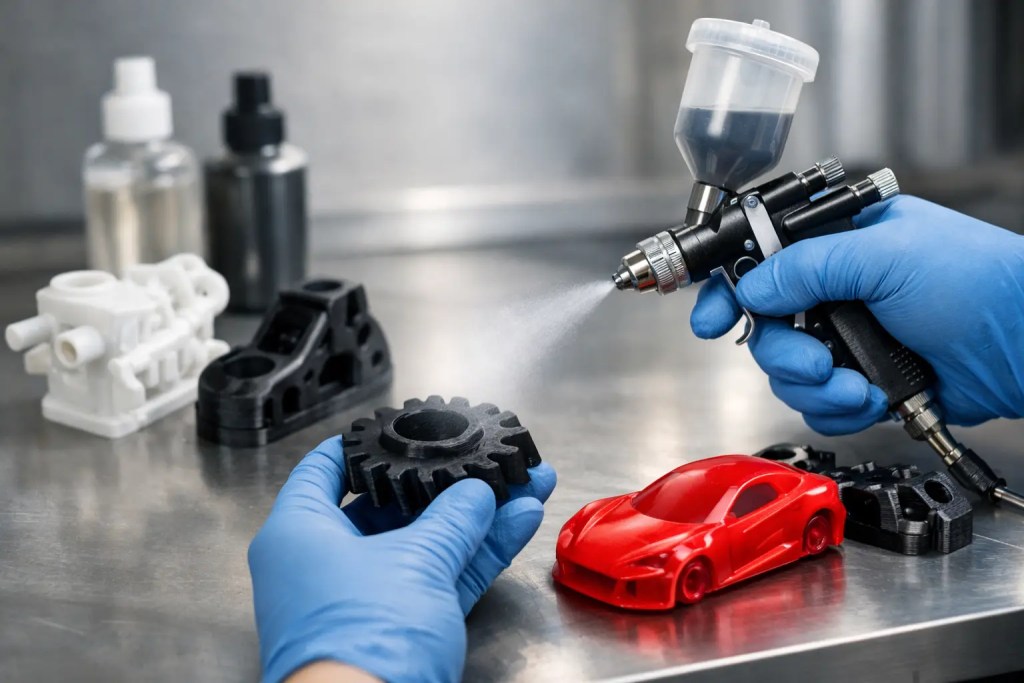
A printed part can meet dimensional requirements and still fail the application because the surface was treated as an afterthought. In production environments, surface coating for printed parts is not cosmetic cleanup. It is a functional decision that affects wear, chemical resistance, cleanability, part handling, and whether a prototype can credibly represent a production component.
For engineers and procurement teams, the right finish depends on three variables working together: the printing process, the base material, and the service environment. A coating that performs well on an SLA master pattern may be the wrong choice for an MJF PA12 enclosure or a metal SLM bracket. Selecting correctly means understanding what the coating is expected to do, what the substrate can accept, and what trade-offs come with the added post-processing step.
What surface coating for printed parts is meant to solve
Surface finishing usually starts with a problem statement, not a color chart. In some cases the issue is straightforward – a rough polymer surface traps dirt, sheds powder, or looks unfinished in front of a customer. In others, the need is performance-driven: the part needs better UV stability, lower friction, higher corrosion resistance, electrical insulation, or a more controlled tactile feel.
That is why coating should be evaluated as part of the manufacturing route, not after the parts are already built. If a team is producing assembly aids, end-use covers, medical-adjacent housings, or low-volume machine components, the finish can affect both qualification and cost. A poor match may lead to cracking, weak adhesion, tolerance stack-up, or inconsistent part appearance across batches.
Start with the printing process and substrate
Different additive processes create different surface conditions, and coating performance follows from that starting point.
Polymer powder-bed parts
MJF and SLS parts, typically in PA12 or PA11, often have a matte, slightly porous surface. They are well suited for dyeing, painting, sealing, and certain chemical smoothing workflows. The advantage is design freedom and stable mechanical performance, but the surface can absorb coatings unevenly if not prepared correctly. Porosity, residual powder, and edge geometry all influence coating uptake.
For these parts, preparation often matters more than the coating itself. Media blasting, cleaning, and controlled sealing help create a repeatable base. If appearance consistency is critical across a production run, process control in pre-finishing is essential.
SLA and material jetting parts
SLA can deliver very fine detail and smoother as-printed surfaces, which makes it attractive for cosmetic prototypes and master patterns. Coatings can produce excellent visual results, but resin chemistry matters. Some photopolymers remain more brittle or heat-sensitive than engineering thermoplastics, and aggressive coating or curing systems can create stress, distortion, or long-term embrittlement.
On the other hand, when the objective is a presentation-quality prototype, SLA often requires less build-up to reach a premium finish. That reduces sanding time and helps preserve small features.
FDM parts
FDM parts present a different challenge because layer lines are more pronounced and surface texture is directional. Coating can improve appearance significantly, but getting to a smooth finish may require filler, sanding, priming, and multiple coating passes. That increases labor and can erase the cost advantage of the printing process for appearance-critical parts.
For jigs, fixtures, and internal tools, this may be unnecessary. In those cases, a light seal or protective coating may be enough if the goal is cleanability or chemical resistance rather than showroom finish.
Metal printed parts
Metal SLM parts such as AlSi10Mg or SS316L often require machining, blasting, polishing, passivation, anodizing, or specialized protective coatings depending on application. Surface roughness from additive metal processes affects both aesthetics and fatigue-sensitive performance. A coating can improve corrosion behavior or provide a more controlled external finish, but it does not replace proper mechanical post-processing where tolerances or load-bearing surfaces are involved.
Common coating options and where they fit
There is no single best finish. The correct option depends on whether the part is for visual models, functional testing, or end use.
Paint systems
Paint is one of the most flexible routes for polymer printed parts. It supports brand color matching, visual realism, and some level of environmental protection. Primers are usually required to improve adhesion and reduce visible texture, especially on MJF, SLS, and FDM parts.
The trade-off is thickness control. Paint can soften edges, close small holes, or alter fit surfaces if masking is not planned. For presentation models this is manageable. For mating components or threaded interfaces, it needs tighter control.
Dyeing and impregnation
Dyeing is especially common for powder-bed nylon parts. It changes color without creating a thick external film, so dimensional impact is lower than with paint. Black-dyed PA12, for example, is widely used for production-ready housings, brackets, and consumer-facing parts.
The limitation is functional performance. Dye improves appearance but does not provide the same barrier properties as a true protective coating. If the part needs higher abrasion resistance, easier cleaning, or moisture sealing, additional finishing may still be required.
Clear coats and sealers
Clear coatings are used when the goal is to preserve the underlying appearance while improving handling, stain resistance, or minor environmental durability. They can also reduce the dusty feel of porous polymer prints.
This approach works well when a customer wants a more finished surface without heavy visual modification. It is less effective if the base surface is highly irregular, because clear coats do not hide geometry or layer artifacts.
Chemical smoothing with coating follow-up
For some thermoplastics, smoothing processes can reduce surface roughness before a final coating is applied. This can create a more injection-molded appearance on printed parts intended for customer evaluation or low-volume end use.
The benefit is a substantial improvement in touch and visual quality. The caution is that smoothing may round edges, alter very small features, and slightly change dimensions. For close-tolerance assemblies, this needs validation.
Metal finishing and protective conversion layers
Metal printed parts may use passivation, anodizing, powder coating, or application-specific coatings depending on alloy and service conditions. SS316L may benefit from passivation in corrosive environments. Aluminum alloys may use anodizing where surface protection and appearance both matter.
These are engineering decisions, not default upgrades. Coating a metal part without considering heat exposure, contact surfaces, conductivity requirements, or downstream assembly can create more problems than it solves.
How to choose surface coating for printed parts
The practical selection method is to define the function first. Ask whether the coating is primarily for appearance, environmental protection, touch, electrical behavior, or wear. If the answer is all of the above, rank them. Most finishing systems are stronger in one area than another.
Next, review geometry. Deep channels, lattices, sharp corners, embossed text, threaded features, and sealing surfaces all affect what finish is realistic. A thick sprayed system may look good on an external housing but fail on a precision clip or snap-fit feature.
Then evaluate quantity. One-off prototypes can justify labor-intensive hand finishing. Short-run production usually needs repeatable, controlled workflows with predictable lead times and cosmetic consistency. At that point, process capability matters as much as finish quality.
Finally, consider inspection and acceptance criteria. If color match, gloss level, coating thickness, or surface cleanliness matters, those requirements should be specified before production starts. That is especially true when printed parts are being used as bridge production or customer-facing hardware.
Cost, lead time, and repeatability
Coating adds value, but it also adds variables. Every sanding, masking, curing, or blasting step increases labor content and extends lead time. For low-volume manufacturing, that may be justified. For fast concept validation, it may not be.
This is where an engineering-first manufacturing partner can reduce risk. A supplier that manages printing and post-processing under controlled workflows can advise whether the target finish is realistic for the material, batch size, and delivery window. Additive3D Asia approaches this as a production decision rather than a cosmetic add-on, which is the right model for teams moving from prototype to short-run supply.
Repeatability is the issue many teams underestimate. A finish that looks excellent on one sample can be difficult to hold across 50 or 200 parts if substrate variation, build orientation, or manual finishing steps are not controlled. ISO-aligned quality systems help here because they reduce variation in preparation, inspection, and release.
When coating is the wrong fix
Sometimes the finish is being asked to solve the wrong problem. If a part needs tighter tolerances, different surface energy, better mechanical strength, or superior heat resistance, switching material or process may be more effective than adding a coating. A poor substrate cannot be turned into a production-grade component by paint alone.
That is especially true for functional assemblies. If a part sees repeated mechanical contact, elevated temperature, aggressive cleaning agents, or outdoor exposure, material selection should come first. Coating can then refine the result, not rescue it.
The best printed parts are designed with finishing in mind from the beginning. That means selecting a process that can achieve the right geometry, choosing a material that can survive the application, and applying a finish that supports performance without creating new failure modes. When those decisions are aligned early, surface coating becomes a controlled manufacturing step rather than a last-minute correction. For teams building real products on real timelines, that difference shows up quickly in quality, lead time, and the number of rework cycles you never have to pay for.