
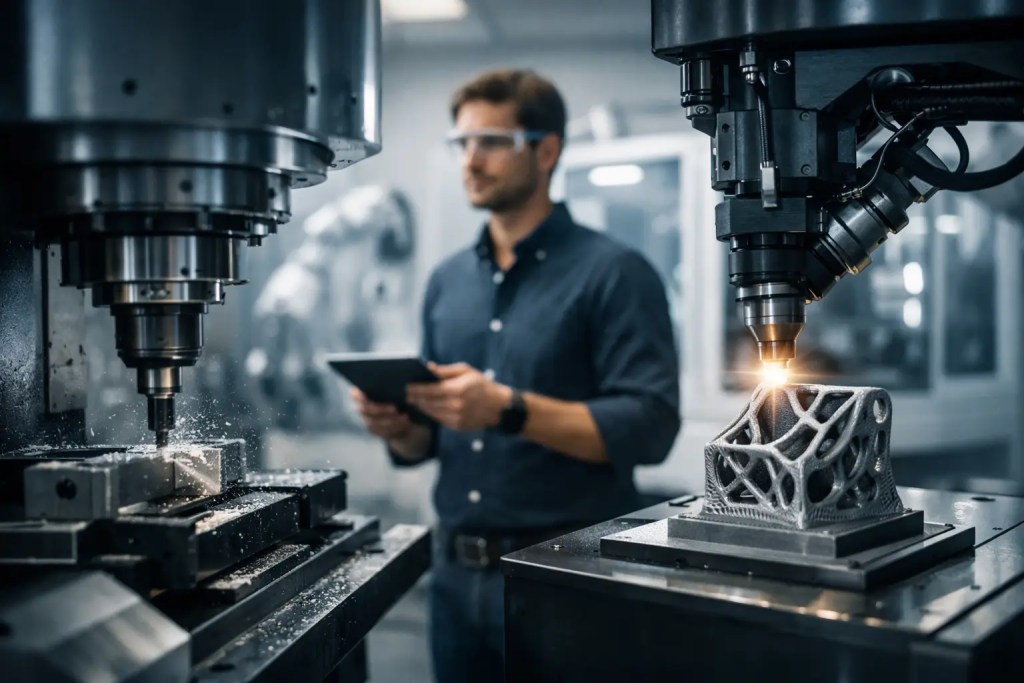
A prototype that performs well in PA12 may need a machined sealing face, tapped metal inserts, and a specified surface finish before it can become a reliable field-ready component. This is where the future of hybrid manufacturing workflows is being decided: not by choosing additive or conventional manufacturing, but by connecting both processes around the functional requirements of the part.
For engineering teams, hybrid manufacturing is increasingly a practical operating model. Additive manufacturing provides speed, geometric freedom, and low setup cost. CNC machining, molding, sheet metal fabrication, and finishing provide the tolerances, surface control, material consistency, and volume economics that many applications require. The value comes from making these processes work as one controlled production route rather than a collection of disconnected vendor transactions.
Why Hybrid Manufacturing Workflows Are Expanding
Most production parts do not have a single manufacturing requirement. A housing may need internal channels that are impractical to machine, but it may also need flat mounting surfaces within a tight tolerance. A fixture may benefit from a lightweight, topology-optimized polymer body but require hardened wear points. A short-run enclosure may need additive prototypes for fit verification, then sheet metal or injection molding once demand stabilizes.
Additive manufacturing is no longer limited to concept models, and conventional processes are not limited to high-volume production. The overlap between them is expanding. Industrial polymer processes such as Multi Jet Fusion and SLS can produce durable PA12 or PA11 functional parts. Metal SLM can build complex AlSi10Mg or SS316L components that consolidate multiple assemblies into one geometry. Yet neither process removes the need for post-machined datums, thread quality, sealing interfaces, cosmetic surfaces, or repeatable assemblies.
A hybrid workflow treats these requirements as part of the initial process plan. Instead of producing a printed part and deciding later how to make it usable, engineering teams define where additive manufacturing creates value and where conventional operations must take over.
The Workflow Shifts From Process Selection to Process Planning
The first question should not be, “Can this be 3D printed?” It should be, “What manufacturing route delivers the required performance at the right lead time and cost?” That distinction changes the design review.
A strong hybrid workflow begins with the CAD model and the part’s critical-to-quality requirements. These typically include dimensional tolerances, load direction, temperature exposure, chemical resistance, surface finish, electrical needs, fastener strategy, and expected production quantity. The manufacturing method follows from those requirements.
Additive Manufacturing Handles Complexity and Iteration
Additive processes are particularly effective when geometry changes are likely, part quantities are low to moderate, or internal features create machining constraints. Engineers can use MJF or SLS for functional polymer enclosures, brackets, jigs, and fixtures with complex forms. SLA may be suitable where fine details and smooth surfaces matter, while FDM remains useful for fast, economical fit checks and larger-format prototypes.
For metal components, SLM is valuable when lightweighting, internal flow paths, or part consolidation justify the process. A consolidated metal assembly may reduce the number of fasteners, shorten assembly time, and eliminate tolerance stack-up between separate components. However, SLM does not automatically deliver every required functional surface. Features such as bearing bores, mating faces, and precision threads often require machining after printing.
Conventional Processes Control Interfaces and Scale
CNC machining remains essential for high-precision features, tight positional tolerances, and controlled surface finish. It can be used as a complete manufacturing route or as a secondary operation after additive production. Machining a reference face on a printed component, for example, creates a reliable datum for assembly and inspection.
Injection molding becomes more economical when volumes rise and the design has stabilized. Vacuum or urethane casting can bridge the gap between additive prototypes and molded production, especially when teams need multiple units in production-like materials without committing immediately to tooling. Sheet metal fabrication offers a different route for enclosures, brackets, and panels where formed geometry, conductivity, and material availability are more important than additive complexity.
The right route depends on the part. Hybrid manufacturing does not mean every component requires every process. It means the workflow has access to the appropriate next process without forcing a new supplier search or a new interpretation of the design intent.
The Most Valuable Hybrid Use Cases
Hybrid workflows are already producing measurable gains in three areas: functional development, production tooling, and short-run end-use parts.
For functional development, a team may print an MJF PA12 enclosure to validate packaging, assembly access, and field ergonomics. After feedback, the same design can move to CNC machining for a low-volume aluminum version, or to sheet metal and powder coating if heat dissipation and electromagnetic shielding become priorities. The workflow preserves learning while changing the process to match the next risk.
For production tooling, additive manufacturing reduces the lead time for custom jigs, soft jaws, drill guides, and inspection fixtures. Conventional machining can then add hardened inserts, accurate locating pins, or threaded metal interfaces. The result is often a lighter, faster-to-produce tool that still meets shop-floor durability requirements.
For end-use parts, hybrid manufacturing supports applications where a printed core geometry needs secondary finishing. A printed SS316L fluid component may be machined at connection points and pressure-tested. A polymer part may be dyed, bead blasted, coated, or fitted with threaded inserts. These secondary steps are not cosmetic afterthoughts. They establish the final part’s performance, usability, and consistency.
Quality Control Must Follow the Part Across Processes
A hybrid route only improves production if quality controls carry through each handoff. The main risk is not that additive and conventional processes are incompatible. The risk is that design files, revisions, tolerances, inspection methods, and acceptance criteria become fragmented between them.
ISO 9001:2015 quality systems provide a useful framework because they formalize document control, traceability, nonconformance handling, and process consistency. For hybrid production, this discipline should start before the first machine cycle. The approved revision, material specification, build orientation where relevant, machining datums, finishing requirements, and inspection plan should be defined as one package.
This is particularly important when post-processing changes a critical feature. A printed polymer part may shrink or warp within expected process limits. A machined feature added afterward must be referenced to the correct datum, not simply measured from an uncontrolled surface. Similarly, a metal printed part may require stress relief, support removal, machining, and surface finishing in a defined sequence to maintain dimensional intent.
Inspection should also match risk. Not every prototype requires the same verification as an end-use component. A fit-check part may only need basic dimensional confirmation. A production fixture or pressure-bearing metal part may require more formal measurement, material documentation, and functional testing. Applying the right level of control protects lead time without treating every order as a full production qualification program.
Digital Quoting Will Make Hybrid Decisions Earlier
The next improvement in hybrid manufacturing will occur before production begins. Instant-quote platforms are already reducing the time required to obtain pricing and manufacturability feedback for individual processes. The more useful evolution is a quoting workflow that compares viable routes for the same part.
An engineer should be able to upload a STEP or STL file, identify material and performance requirements, and assess alternatives such as MJF PA12 with inserts, CNC-machined acetal, urethane cast polyurethane, or injection molding. The goal is not to automate away engineering judgment. It is to surface trade-offs earlier, when a change costs minutes in CAD rather than weeks in procurement and rework.
The same principle applies to production planning. If a printed part requires machining, coating, and assembly, those steps should be scheduled as a connected route with defined ownership and inspection points. Fragmented sourcing can make a nominally low-cost part expensive once shipping, repeat quoting, delayed communication, and rejected handoffs are included.
What Engineers Should Design for Now
Teams preparing for hybrid production should identify critical surfaces and interfaces early. Define where precision is required, where additive surface texture is acceptable, and where machining allowance is necessary. Design threaded connections intentionally, using inserts or post-machined threads where repeated assembly loads demand them.
Material selection deserves the same discipline. PA12 offers a strong balance of durability and dimensional stability for many functional polymer parts, while PA11 may be preferable where higher ductility is needed. AlSi10Mg supports lightweight metal geometries, whereas SS316L can be appropriate for corrosion resistance. The correct material is not simply the strongest available option. It is the one that meets the mechanical, environmental, finishing, and cost requirements of the full workflow.
Finally, plan for volume transitions. A design that begins as an FDM prototype may move to MJF for functional testing, then to urethane casting or injection molding as demand increases. Keeping the design intent, acceptance criteria, and revision history controlled across that transition avoids repeating validation work unnecessarily.
The most capable manufacturing teams will not treat additive and conventional production as competing choices. They will build a repeatable decision system around both, selecting each process where it contributes the most to speed, precision, and part performance. For a new component, the useful next step is simple: define the critical requirements first, then build the manufacturing route around them.