
A prototype housing passes fit checks on Monday, but by Wednesday the team needs tighter bores, a cleaner sealing face, and a faster path to a pilot build. That is exactly where understanding how 3d printing & cnc machining work together becomes commercially useful. These processes are not competing options in a modern production workflow. Used together, they reduce iteration time, improve part quality where it matters, and give engineering teams more control over cost, tolerances, and delivery.
Why how 3d printing & cnc machining work together matters
3D printing and CNC machining solve different manufacturing problems. Additive processes build geometry layer by layer, which makes them strong candidates for complex internal channels, lightweight structures, fast design changes, and low tooling overhead. CNC machining removes material from billet or plate, which makes it better suited for high-accuracy features, tighter positional tolerances, and predictable surface finishes on critical interfaces.
When teams treat these capabilities as complementary rather than separate purchasing categories, they can choose accuracy only where it is needed, print complexity where it adds value, and avoid overengineering the entire part around one process. That matters in prototyping, bridge production, jigs and fixtures, and even selected end-use components.
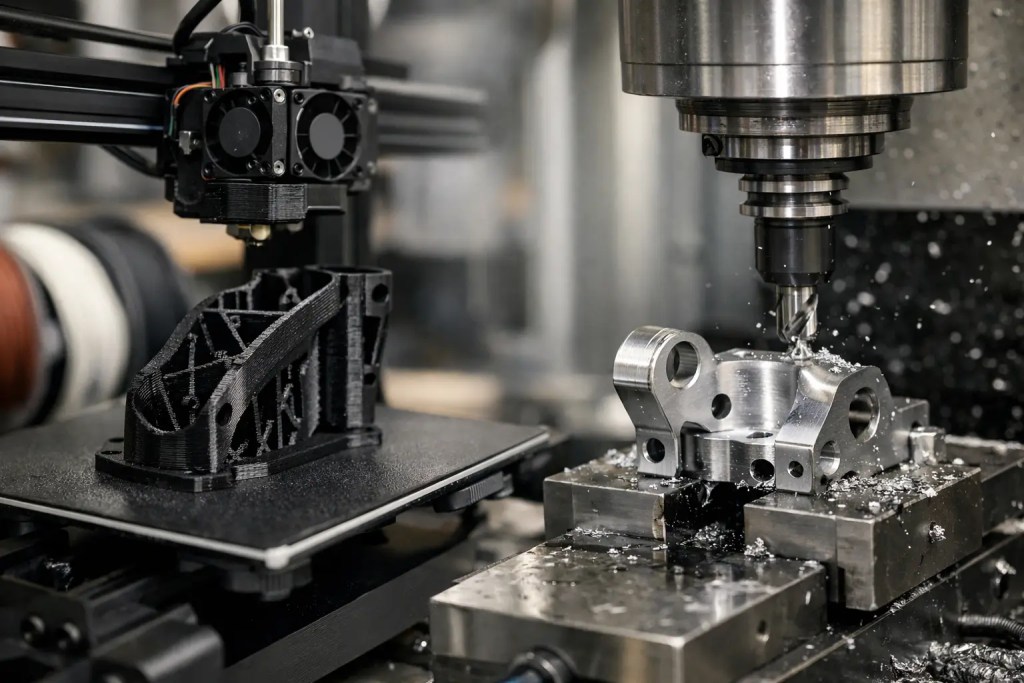
This combined approach is especially useful when a part has mixed requirements. A component may need organic geometry to reduce weight, but still require machined datum faces, threaded features, or bearing seats. Printing the full shape and machining only the critical features is often the faster and more economical route.
The practical model: print for geometry, machine for precision
The simplest way to understand the relationship is this: additive manufacturing handles geometric freedom, while CNC machining handles precision where the design demands it.
In polymer parts, that often means printing housings, brackets, ducts, and fixtures in processes such as MJF, SLS, SLA, or FDM, then machining selected features after printing. Teams may machine gasket surfaces, ream holes, or create precise mounting points that need better tolerance control than the printed process can consistently provide on its own.
In metal, the same principle applies at a higher performance level. A metal SLM part in AlSi10Mg or SS316L can be printed near net shape with internal features that would be difficult or impossible to machine conventionally. After that, CNC machining can finish flatness-critical surfaces, interfaces for assembly, or tight-tolerance bores. This hybrid route is common when part complexity justifies additive, but final function still depends on machined accuracy.
That does not mean every printed part should be machined. If the printed tolerances and surface condition already meet the requirement, additional machining adds cost and lead time. The right choice depends on what the part must actually do in service.
Where the combination delivers the most value
Hybrid manufacturing is most effective when speed and functional performance both matter. Product development is the obvious example. Engineers can print first-article parts quickly, validate form and function, then machine only the interfaces that affect fit, sealing, or motion. That shortens the path between design iteration and meaningful test data.
Fixtures and production aids are another strong use case. A fixture body can be printed to reduce weight and incorporate ergonomic or part-specific geometry, while machined inserts or locating surfaces provide repeatable accuracy. The result is a tool that is faster to fabricate than a fully machined fixture, without sacrificing process control on the shop floor.
Low-volume production also benefits. If a batch size is too small to justify tooling, but the application still needs reliable assembly and post-processing, printing and machining together can bridge the gap. This is often the case for custom enclosures, robotic end effectors, medical-adjacent devices, industrial spare parts, and pilot production builds.
How 3d printing & cnc machining work together in a real workflow
A reliable workflow starts at design review, not after the part is built. The CAD model should identify which features are additive-friendly and which features should be machined later. Datums, machining stock, fixturing strategy, and material behavior all need to be considered up front.
Step 1: Design the part around functional priorities
The first decision is not which machine to use. It is which features drive performance. Internal channels, lattice sections, undercuts, and rapid design changes typically point toward additive. Precision bores, critical threads, flat sealing faces, and bearing fits typically point toward machining.
This is where engineering teams save time by separating must-have tolerances from nice-to-have tolerances. If every face is called out tightly, the part may become unnecessarily expensive. If only the critical features are machined, the cost structure stays more efficient.
Step 2: Select material and additive process
Process selection affects what happens later in machining. MJF and SLS are often chosen for strong functional polymer parts with good dimensional stability. SLA may be chosen for high detail and smoother as-printed surfaces, although material performance depends on resin selection. In metal, SLM supports complex, high-value geometries, but the final machining plan must account for support removal, residual stress, and stock allowance.
Material choice matters just as much. PA12, PA11, AlSi10Mg, and SS316L all behave differently under cutting, clamping, and finishing. A hybrid manufacturing plan works best when the additive and subtractive steps are evaluated as one process chain rather than two disconnected services.
Step 3: Print near net shape
The additive stage should produce the geometry as close as practical to final shape, while leaving enough material on selected areas for post-machining. That allowance must be deliberate. Too little stock creates risk during finishing. Too much stock increases machining time and may distort the cost advantage of printing.
Orientation also matters. Build orientation affects surface quality, support strategy, and dimensional behavior. It can also determine whether a feature is easier to machine later or harder to fixture accurately.
Step 4: Machine only the critical features
Once the printed part is stable and post-processed as needed, CNC machining brings the key interfaces into tolerance. This may include surfacing, drilling, tapping, boring, reaming, or contour finishing. The objective is not to remake the entire part by subtractive means. It is to apply machining where it has the highest functional return.
For production teams, that targeted strategy improves predictability. Critical dimensions are controlled by machining, while the rest of the part benefits from additive speed and design freedom.
Trade-offs engineers should evaluate early
There is no universal rule that hybrid manufacturing is always faster or cheaper. It depends on geometry, quantity, tolerance stack-up, and material.
If a part is simple and mostly prismatic, full CNC machining may still be the better option. If the part has no truly critical machined features, additive alone may be enough. The value appears when geometry is too complex for efficient machining, but performance still requires precise interfaces.
Post-processing time is another factor. Printed parts may need support removal, stress relief, bead blasting, sanding, or heat treatment before machining. Those steps should be included in the lead-time plan. Surface finish expectations should also be realistic. A machined face can be highly controlled, but adjacent printed surfaces may still show the texture of the additive process unless additional finishing is specified.
Inspection should not be an afterthought. Hybrid parts often need dimensional checks at multiple stages because process capability comes from more than one manufacturing method. Teams that work with ISO 9001:2015-controlled workflows usually benefit from clearer traceability, revision control, and repeatable quality gates through the full process chain.
Choosing a manufacturing partner for hybrid work
The operational challenge with hybrid parts is coordination. If additive manufacturing, CNC machining, and finishing are spread across multiple vendors, delays and tolerance disputes become more likely. A single manufacturing partner with both additive and conventional processes in-house can reduce handoff risk and shorten procurement cycles.
That matters for engineers who need rapid quoting, manufacturability feedback, and a realistic recommendation instead of a process-biased answer. In practice, the best result usually comes from matching the part to the requirement, not forcing the requirement to fit one machine. Additive3D Asia supports that model by combining industrial polymer and metal printing with CNC machining and post-processing under a structured production workflow.
The most effective parts are rarely designed around manufacturing ideology. They are designed around performance, lead time, and total production risk. When 3D printing creates the geometry and CNC machining finishes the precision, teams get a practical route from concept to functional hardware without unnecessary compromise.
The useful question is not whether additive or machining is better. It is which features need freedom, which need control, and how fast you need the answer in your hands.