
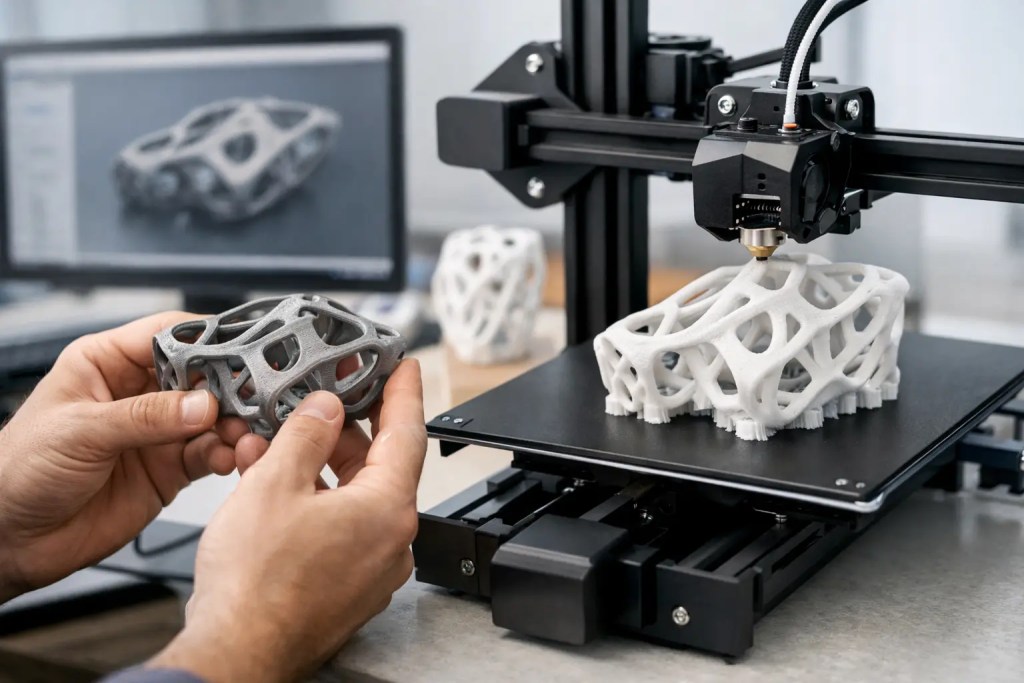
A topology-optimized bracket can remove a surprising amount of material from a conventional design while maintaining its required load path. But that geometry is often impossible, uneconomical, or slow to produce with subtractive machining. That is where generative design + 3D printing: the perfect match becomes a practical engineering proposition, not simply a visual one.
Generative design uses defined inputs such as loads, constraints, keep-out zones, material, and manufacturing method to generate design options. Additive manufacturing can then produce the complex, organic, and internally optimized forms that result. Together, they give engineering teams a route to reduce mass, consolidate assemblies, and shorten development cycles while retaining a disciplined path to production.
The fit is powerful, but it is not automatic. A successful part must be designed around a validated manufacturing process, not just optimized in software. Build orientation, support strategy, minimum feature sizes, powder removal, tolerances, finishing, and inspection requirements all influence whether the final component performs as intended.
Why Generative Design + 3D Printing Work Together
Traditional design methods usually begin with familiar geometries: plates, ribs, machined pockets, and fastened subassemblies. These forms reflect the limitations and economics of conventional manufacturing. Generative design reverses the sequence. Instead of starting with a shape, the engineer starts with functional requirements and allows the software to explore the material distribution needed to meet them.
The resulting structures may include branching load paths, variable wall thicknesses, lattices, and curved transitions that are difficult to machine or mold. Industrial 3D printing is well suited to these features because it builds parts layer by layer rather than relying on cutting-tool access or a two-part mold split.
This combination is particularly relevant where mass and performance affect the system-level outcome. A lighter end-of-arm tool can improve robot cycle time. A consolidated fluid manifold can reduce leak paths and simplify assembly. A redesigned aerospace or motorsport component can achieve stiffness targets with less material. In each case, the value is not unusual geometry for its own sake. It is improved functional performance from a part that can be manufactured reliably.
Part consolidation changes more than the CAD model
One of the strongest use cases is replacing multiple components with one additive part. A conventionally manufactured assembly may require separate brackets, fasteners, fittings, seals, and machining setups. A generative workflow can preserve the critical interfaces while merging surrounding structures into a single optimized component.
Fewer parts can reduce assembly labor, inventory exposure, and tolerance stack-up. However, consolidation should be evaluated carefully. A single component may be more difficult to replace in service, and certain interfaces may still require machining to meet precision or sealing requirements. The appropriate decision depends on lifecycle cost, not just part count.
Start With Engineering Inputs, Not Software Outputs
Generative design quality depends on the quality of the problem definition. If forces, constraints, or exclusion zones are incomplete, the optimized result can be misleading. The software does not know which assumptions are realistic unless the engineering team provides them.
Begin by defining the design space and preserving all critical interfaces. Mounting faces, bearing bores, threaded features, electrical clearances, and sealing surfaces should be modeled as keep-out or preserved geometry. Load cases should reflect actual use, including fatigue cycles, shock events, thermal exposure, and off-axis forces where relevant.
Material selection must also happen early. A PA12 component produced by Multi Jet Fusion or SLS behaves differently from an AlSi10Mg part made by metal SLM. PA12 is often a strong choice for lightweight functional polymer components, jigs, housings, and low-volume end-use parts. PA11 can offer greater ductility for applications that need impact resistance and flexibility. AlSi10Mg provides a favorable strength-to-weight balance for many metal structures, while SS316L may be selected for corrosion resistance and demanding operating environments.
The selected material affects not only mechanical performance but also the allowable geometry. Thin walls, unsupported features, thread strategy, and post-processing requirements vary by process. Engineering teams should set these constraints before generating candidates rather than trying to force a finished concept into production afterward.
Design for the Actual Additive Process
A generative model is not automatically printable. The production route must be defined alongside the optimization target.
For polymer powder-bed processes such as SLS and HP Multi Jet Fusion, the surrounding powder supports the part during the build. This enables complex internal channels and geometries without dedicated support structures. It also means powder evacuation must be considered for enclosed cavities. Drainage holes, access paths, and appropriate channel dimensions are essential where loose powder cannot remain in the final part.
Metal SLM requires more active planning. Supports may be necessary to manage overhangs, anchor parts to the build plate, and control thermal distortion. Orientation affects surface quality, build time, support removal effort, and the direction-dependent properties of the finished part. A form that looks efficient in a generative design environment may require substantial redesign to reduce support volume or provide access for removal.
SLA can deliver fine detail and high-quality cosmetic surfaces, but resin selection and post-curing requirements must align with the intended mechanical and environmental performance. FDM may be suitable for quick fixtures, fit checks, and early prototypes, though anisotropy and surface finish should be assessed before specifying it for a loaded end-use component.
Plan precision features and surfaces separately
Additive manufacturing is often the right route for the overall geometry, but not every surface should be printed to final specification. Critical bores, tight flatness requirements, bearing seats, and high-accuracy interfaces may benefit from post-machining. This hybrid approach is frequently more dependable than demanding machining-level tolerances across an entire printed part.
Surface finishing should be specified based on function. Bead blasting, sanding, polishing, dyeing, coating, heat treatment, and machining can each improve a different aspect of the part. For example, a cosmetic enclosure and a fluid-contact component require different finishing strategies even if they share the same additive process.
Validate Before Moving to Production
Generative design can produce several feasible concepts, but feasibility is only the beginning. Engineers should compare candidates against structural performance, printability, finishing effort, inspection access, cost, and lead time. The lightest concept is not always the best production choice.
A structured validation plan typically includes simulation review, prototype testing, dimensional inspection, and functional testing under realistic loading. For metal parts, teams may also require material certification, heat treatment records, and process-specific quality documentation. For safety-critical or highly loaded applications, physical testing remains essential even when simulation results are favorable.
It is useful to build early prototypes in the intended process whenever possible. A polymer prototype can verify assembly interfaces and ergonomics, but it may not reveal the distortion, support-removal challenges, or thermal behavior of a metal SLM production part. Conversely, using a lower-cost polymer iteration before committing to metal can reduce development cost when the key questions are fit, routing, or installation.
Where the Economics Make Sense
Generative design and 3D printing are most compelling when complexity adds measurable value. Common examples include lightweight brackets, custom medical or ergonomic devices, heat exchangers, manifold bodies, drone structures, fixtures, robot end-effectors, and low-volume replacement parts.
The economics are less favorable when the component is a simple, high-volume shape with no performance benefit from optimization. Injection molding, CNC machining, sheet metal fabrication, or casting may deliver a lower unit cost in those cases. The right manufacturing route depends on annual volume, material requirements, geometry, qualification needs, and the cost of assembly.
For many teams, the most efficient path is not additive versus conventional manufacturing. It is additive where design freedom creates value, combined with CNC machining, finishing, or molding where those processes are more appropriate. A multi-process manufacturing partner can help prevent a promising concept from being limited by a single technology.
Turn Optimization Into a Manufacturable Part
The transition from generative output to a production-ready component requires clear communication between design and manufacturing. Provide the native CAD or STEP file where possible, identify critical dimensions and datums, define the intended material and finish, and state the part’s functional requirements. An STL file may be sufficient for early quotation, but it does not carry the design intelligence needed for detailed engineering review.
At Additive3D Asia, this review can connect generative geometry to the appropriate polymer or metal process, then account for machining, surface finishing, and inspection where required. That process-led approach helps teams move from an optimized concept to repeatable parts with defined production controls.
The next time a bracket, manifold, fixture, or structural component seems constrained by familiar manufacturing rules, begin with the performance target and the real production conditions. The most useful generative design is not the one with the most dramatic geometry. It is the one that ships as a validated part, performs predictably, and improves the system it was designed to serve.