
A common failure mode in prototype-to-production handoffs is material mismatch: the prototype looks right, but the first real parts warp, crack at clips, or change dimension after heat exposure. When you need polymer parts that behave like production parts – and you need them fast – hp multi jet fusion pa12 is often the most efficient place to start.
PA12 (nylon 12) in HP Multi Jet Fusion (MJF) has become a default for functional prototypes, jigs and fixtures, and short-run end-use components because it balances mechanical performance, dimensional stability, and throughput. It is not the right answer for every requirement, but it is one of the most reliable “workhorse” combinations for engineers who care about repeatability.
What HP Multi Jet Fusion PA12 actually gives you
HP MJF builds parts in a powder bed and uses agents plus thermal energy to fuse geometry selectively. Compared with many polymer additive processes, the practical advantage is consistency across a full build – you can nest many parts, run dense builds, and still hold predictable outcomes when the workflow is controlled.
PA12 is the material that makes this combination broadly useful. It is stiff enough for housings and brackets, tough enough for snap fits (when designed correctly), and stable enough to be machined post-print when required. For most engineering teams, the real value is that you can iterate quickly without changing the manufacturing physics every time you modify a feature. That repeatability is what makes PA12 in MJF suitable not only for “prototype-grade” parts, but also for validated fixtures and end-use components when the operating environment fits.
Material behavior: where PA12 performs, and where it does not
PA12 is a semi-crystalline nylon with a practical balance of strength and ductility. In the field, this often translates to parts that tolerate handling, assembly, and moderate impact without brittle fracture. It is also relatively low in moisture absorption compared to some other nylons, which helps dimensional stability in real operating conditions.
That said, PA12 is still a nylon. It can soften at elevated temperatures relative to high-heat polymers, and it will creep under sustained load depending on geometry, temperature, and how the load is applied. If you are designing a latch that holds constant force for months, or a bracket that sees elevated ambient temperatures, you should treat creep and heat exposure as first-order requirements rather than afterthoughts.
Chemical resistance is generally good for many oils, fuels, and common industrial fluids, but it depends on the specific chemical and exposure time. If your part will see aggressive solvents or continuous immersion, it is worth validating with targeted test coupons rather than relying on generic charts.
Dimensional accuracy and the realities of tolerance
Engineers usually ask one of two questions: “How tight can you hold?” and “Will it be the same next month?” With MJF PA12, the more useful answer is that you can get consistent, production-style repeatability when the design is aligned with the process.
MJF produces parts with isotropic-ish behavior compared with filament-based methods, but geometry still matters. Long, thin walls can distort. Large flat panels can show slight bowing. Features near the edge of a part can behave differently than those deep inside a thick section because of thermal gradients during the build and cooling cycle.
If you need tight fits, treat MJF as a near-net-shape process and plan secondary operations where it makes sense. Bored holes, reamed dowel locations, and tapped threads are common examples. For press fits and bearing seats, printing undersize and machining to final dimension is typically the most controllable route.
Surface finish: what you can expect without overpromising
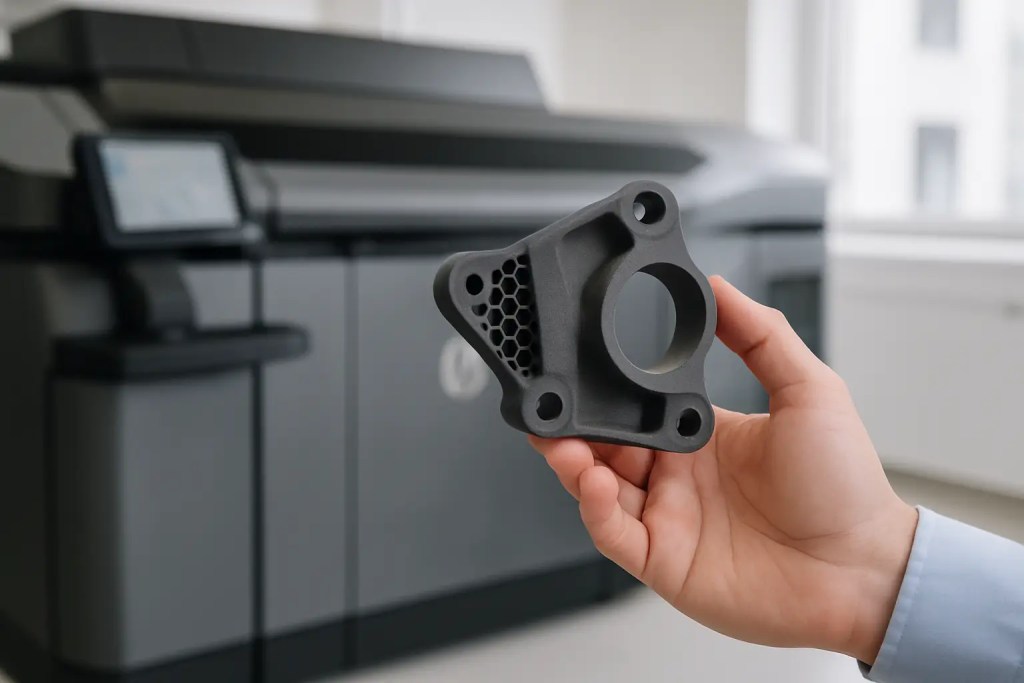
As-printed PA12 from MJF has a fine, matte texture that reads “industrial.” It is not glossy, and it is not injection-mold smooth. For many functional applications – internal brackets, ducting, assembly aids, fixtures – that texture is acceptable and sometimes beneficial for grip.
When surface quality matters, finishing choices become part of the design decision. Media blasting can even out appearance and remove loose powder. Dyeing can produce consistent black or other colors for consumer-facing components, although color uniformity still depends on geometry and wall thickness. For higher cosmetic demands, additional post-processing like smoothing or coating may be required, with the trade-off that coatings add thickness and can shift dimensions on tight interfaces.
If appearance is critical and tolerances are tight, decide early which surfaces are “cosmetic-only” and which are “interface-critical.” That separation prevents downstream surprises where a cosmetic finish becomes a dimensional problem.
Design decisions that make PA12 in MJF succeed
Most MJF PA12 issues are not “printer problems.” They are predictable outcomes of geometry, loading, and interface requirements.
Snap fits are a good example. PA12 can work very well for snaps, but the design must respect strain limits and use generous radii at the root. Thin cantilevers with sharp corners will eventually crack, even if they survive initial assembly. If your snap is a lifecycle feature, it is worth prototyping multiple geometries and testing to failure rather than assuming the first design is acceptable.
Living hinges are another common request. PA12 can flex, but it is not the same as polypropylene in injection molding. If a true living hinge is required for repeated cycles, you may need a different polymer strategy or a hybrid approach.
For assemblies, consider how you will join parts. Self-tapping screws can work, but repeated service may strip threads. Heat-set inserts are often the better approach when you need reliable torque and rework capability. Bonding is feasible, but adhesive selection and surface preparation matter because nylon chemistry can be less cooperative than ABS-like materials.
When MJF PA12 is a better choice than alternatives
SLS and MJF both produce nylon powder-bed parts, and both can be appropriate. In practice, teams choose MJF PA12 when they want strong throughput, consistent builds, and good feature definition for functional parts. If your program involves multiple iterations or parallel variants (A/B designs, fixture families, left-right versions), MJF’s ability to run dense builds efficiently is a real operational advantage.
Compared with SLA, MJF PA12 is usually preferred when mechanical durability matters more than ultra-smooth surfaces. SLA excels in fine detail and cosmetics, but many SLA resins have different failure modes under impact and long-term load.
Compared with FDM, MJF PA12 typically offers better repeatability and fewer anisotropy-driven surprises, especially on clips and thin features. FDM can still be the right answer for very large parts, simple geometries, or low-cost concept models, but it is less predictable for production-like mechanical performance unless you control a lot of variables.
If you are ultimately heading toward injection molding, MJF PA12 often serves as a practical bridge. You can validate assembly, packaging, and functional testing at low-to-mid quantities before committing to tooling. The key is to remember that MJF is not molding – ribs, bosses, and snap behaviors may translate, but surface, tolerances, and long-term creep performance should be validated in the correct context.
Production use cases where PA12 shines
In real manufacturing environments, MJF PA12 tends to deliver the most value in three categories.
First, jigs and fixtures: drill guides, assembly nests, gauge bodies, soft jaws, and ergonomic tooling. PA12’s stiffness-to-weight and durability make it a strong replacement for machined plastics in many cases, especially when you need multiple iterations or custom variants per line.
Second, enclosures and brackets: sensor housings, protective covers, cable management, and light structural mounts. Here, the combination of adequate strength, good dimensional stability, and easy finishing can shorten design cycles significantly.
Third, low-to-mid volume end-use components: ducting, manifolds (non-high-pressure), robotics accessories, customized grippers, and aftermarket parts. When volumes are not high enough to justify tooling, MJF PA12 can support a production program with controlled, repeatable output.
Quality control and why process discipline matters
If you are using additive for production intent, treat quality as a workflow, not a hope. That means controlled material handling, calibrated machines, standardized build setups, documented post-processing steps, and inspection practices that match your risk profile.
For critical interfaces, inspection should focus on the features that drive function: mating surfaces, hole patterns, datum relationships, and any geometry that impacts sealing or alignment. For cosmetic parts, inspection criteria should be clearly defined (texture consistency, dye uniformity, allowable surface marks) so procurement and engineering evaluate parts the same way.
If you need a manufacturing partner that runs polymer and metal additive plus complementary processes under an ISO 9001:2015 quality system, Additive3D Asia supports MJF PA12 production workflows alongside CNC machining and post-processing, which can be useful when a program needs both printed parts and precision-finished interfaces.
Practical checkpoints before you commit to a build
The fastest way to de-risk MJF PA12 is to align expectations before you upload CAD.
Be clear about what the part must do: load cases, temperature exposure, assembly cycles, and any chemical contact. Then decide which dimensions are critical and which are flexible. If you need tight holes, plan to machine them. If you need cosmetic surfaces, specify which faces matter and what finish is acceptable. If you need traceability, request it early so the documentation matches your internal requirements.
The best additive outcomes are not accidental. They come from choosing a process-material pair that matches the physics of the part and then controlling the workflow so every build behaves like the last.
A helpful closing thought: if you can describe your part in terms of interfaces, loads, and environment instead of “prototype vs production,” you will make better decisions faster – and hp multi jet fusion pa12 becomes a very predictable tool rather than a gamble.