
A fixture that needs to survive a week on the factory floor fails for a very different reason than a beautiful concept model. The first cracks at a stress riser, creeps under clamp load, or distorts when it warms up near a motor. That is why the decision between Material Jetting (often called MJM or PolyJet-style printing) and Selective Laser Sintering (SLS) should start with performance requirements, not aesthetics.
Below is a decision-focused look at mjm vs sls for functional parts – with the trade-offs that actually show up during testing, assembly, and day-to-day use.
MJM vs SLS for functional parts: what the processes really build
MJM (Material Jetting)
MJM prints by jetting droplets of photopolymer resin and curing them with UV light, layer by layer. It typically prints with a support material that must be removed after the build. The value proposition is precision, smooth surfaces, sharp cosmetic detail, and the ability (on some platforms) to blend materials and colors.
The limitation is that photopolymers behave differently than engineering thermoplastics. Even when a resin is marketed as “tough” or “high temp,” it is still a crosslinked polymer system with different failure modes: more brittle behavior, potential long-term creep, and sensitivity to heat, UV exposure, and certain chemicals.
SLS (Selective Laser Sintering)
SLS uses a laser to sinter polymer powder (commonly PA12 or PA11) into solid layers. The surrounding powder acts as self-support, so complex geometries can be built without dedicated support structures. SLS is usually the workhorse choice for functional polymer parts because the base materials are true engineering nylons with predictable mechanical performance.
The trade-off is that the surface is naturally matte and slightly grainy, and fine cosmetic detail can be less crisp than MJM. Dimensional consistency is strong for functional work, but your design still needs to respect minimum walls, hole sizing, and post-processing allowances.
Mechanical performance: stiffness, toughness, and fatigue
If your part must take load, survive drops, or handle repeated cycles, SLS typically has the advantage.
SLS PA12 and PA11 are widely used for end-use housings, brackets, ducting, snap features, and fixtures because they tolerate real-world abuse. They tend to fail in a more ductile way than photopolymers, and they hold up better under cyclic loading. This matters for functional assemblies where the part is not just “strong once,” but must remain stable after hundreds of actuations or clamp cycles.
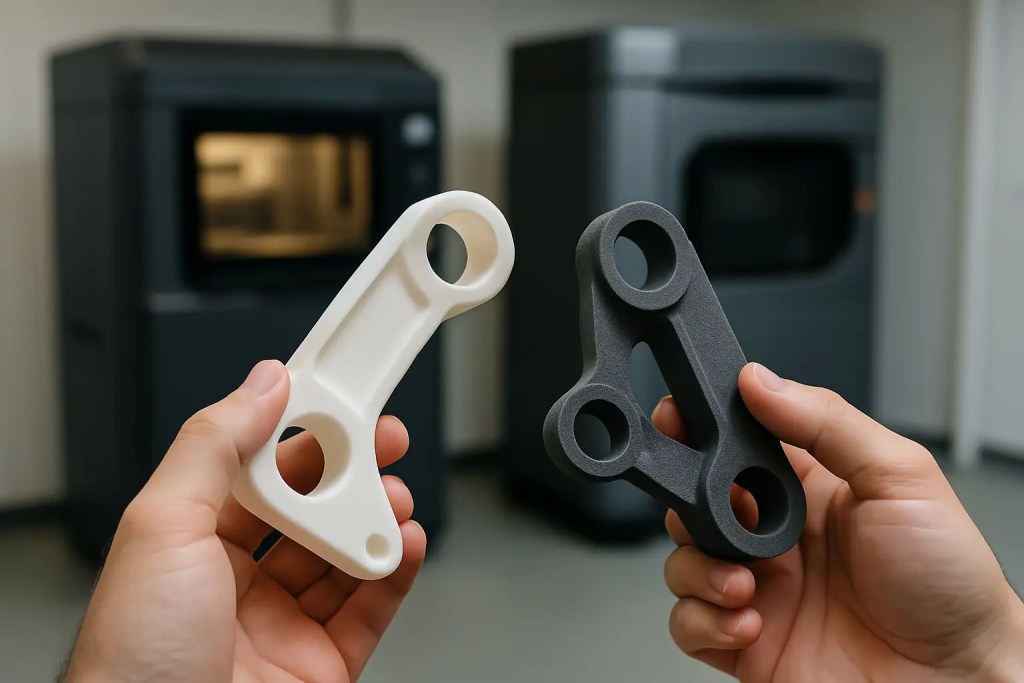
MJM can still be appropriate for functional testing, but the test must match the material behavior. If you are validating fit, clearance, visibility, ergonomics, or assembly sequence, MJM can be a fast path to a part that looks and measures close to nominal CAD. If you are validating long-term durability or impact resistance, MJM often becomes a proxy test rather than a final-material test.
A practical rule: if the intent is “does it work mechanically,” lean SLS; if the intent is “does it fit and present correctly,” MJM can be efficient.
Heat resistance and environmental stability
Functional parts fail quietly when temperature rises. A fixture can drift just enough to mis-locate a component, or a cover can warp and interfere with a latch.
SLS nylon parts generally maintain performance across a broader operating window than typical photopolymers used in MJM. They also tend to be less sensitive to UV exposure over time. For equipment enclosures, jigs sitting near heat sources, ducting around motors, or parts left in vehicles or non-climate-controlled spaces, SLS is usually the safer baseline.
MJM has specialty resins aimed at higher temperature performance, but “high temp” does not always mean “stable under load at temperature.” In practice, you should treat MJM as condition-dependent: verify not only heat deflection characteristics, but also creep and retention of tolerances during exposure.
Dimensional accuracy and feature resolution
This is where MJM often shines.
MJM is commonly selected when you need crisp edges, small embossed text, smooth mating surfaces, or fine features that must look like an injection molded surface straight out of the machine. It is also useful when appearance is part of function – for example, optical clarity (on certain materials), human-facing surfaces, or customer-ready demo units.
SLS delivers reliable accuracy for functional geometries, but it is not typically chosen for micro-features and “cosmetic sharpness.” Holes often need to be drilled or reamed if you require tight pin fits. Threads are often better as heat-set inserts or post-tapped features, depending on load.
If your functional requirement is truly tolerance-driven, define it clearly: critical-to-function dimensions, datum strategy, and where you can accept post-processing. The best process is the one that hits the required tolerances consistently, not the one that prints the prettiest test coupon.
Surface finish and friction in assemblies
Surface texture is not just an aesthetic preference. It changes how parts slide, seal, and pick up dirt.
SLS has a slightly porous, powder-textured surface. For many functional parts, that is acceptable and even beneficial for grip. But it can be a liability for sealing surfaces, fluid paths, or cosmetic consumer products. Post-processing like bead blasting, tumbling, dyeing, or coating can reduce roughness and improve cleanability, but that adds time and cost and may affect dimensions.
MJM surfaces are typically smoother out of the machine. If you need controlled contact surfaces for light sliding, cosmetic housings that must photograph well, or a surface you plan to paint with minimal prep, MJM reduces finishing work.
For functional sealing, neither process is automatically “watertight” in all geometries. Your wall thickness, print orientation, and post-processing plan matter more than the process name.
Design freedom: supports, channels, and complex internal geometry
SLS powder support enables complex internal channels, lattices, and nested assemblies without support removal. That is a real advantage for functional ducting, manifolds, protective shrouds, and parts with deep internal cavities.
MJM relies on support material. That support must be removed, and the further it is from an accessible opening, the more it becomes a design constraint. If you have long, narrow internal channels or enclosed voids, MJM can become impractical or require design compromises.
If you are designing parts with internal airflow paths, cable routing tunnels, or hidden snap features, SLS usually offers fewer manufacturability surprises.
Cost and lead time drivers that affect production decisions
Engineers often ask for “the cheaper one,” but the cost model is different between MJM and SLS.
MJM cost tends to track with the amount of resin used, the amount of support required, and machine time driven by high-resolution printing. It can be cost-effective for small, detailed parts where cosmetic finish replaces downstream labor, but it can get expensive for bulky geometries.
SLS pricing is usually influenced by part volume, packing efficiency in the build, and required post-processing. For functional production runs, SLS often scales better because you can nest many parts in one build, and you are not paying a penalty for support structures.
Lead time is also about workflow maturity. When you need repeatable output across iterations, the advantage goes to processes that are stable under standardized build parameters and post-processing. This is one reason many teams use SLS nylon as their “default functional baseline” during development and low-volume production.
Use-case fit: when MJM is the right call
MJM is a strong choice when the functional need is dominated by precision, presentation, or user interaction.
If you are validating a complex assembly where tiny interferences matter, MJM can help you catch issues early. If you need a part for a customer demo that must look like a production plastic but you still want accurate geometry, MJM is hard to beat. It is also useful for visual inspection aids, surgical or ergonomic mockups, and low-load components where surface finish drives usability.
The key is to be honest about load and environment. If the part will be clamped, torqued, or left in a warm enclosure, MJM may still work – but it should be specified with a resin that matches those conditions and tested accordingly.
Use-case fit: when SLS is the safer default
SLS tends to win when “functional” means load-bearing, durable, and repeatable.
For jigs and fixtures, brackets, clips, housings, protective covers, and end-use nylon components, SLS offers a more production-like mechanical profile. It is also a strong option when you need complex geometry without worrying about support removal, or when you plan to iterate quickly while keeping material behavior consistent.
If you expect the part to become a short-run production item, SLS often reduces the gap between prototype and production – and makes it easier to maintain performance as quantities scale.
A decision framework that reduces iteration cycles
Most process mistakes happen when requirements are implied instead of stated. The fastest path is to define the few parameters that actually control success.
Start with the load case (static clamp load, impact, cyclic fatigue), then define the environment (temperature, UV, oils/chemicals, humidity). Next, identify which surfaces are critical: sealing faces, bearing faces, datum features, and cosmetic faces. Finally, decide whether you need a “looks-like” part or a “behaves-like” part.
If you want one practical shortcut: choose SLS when the part must behave like a real nylon component, and choose MJM when you need tight detail and presentation with light to moderate functional demands.
For teams that need fast, repeatable output with manufacturability guidance across polymer and metal options, Additive3D Asia runs an ISO 9001:2015-certified workflow that helps align process selection with the actual performance requirement, not just the print method.
The most useful question to end on is not “Which is better?” It is “What does failure look like for this part?” Answer that clearly, and the right process choice between MJM and SLS becomes much easier – and your next build is far more likely to be the last one you need.