
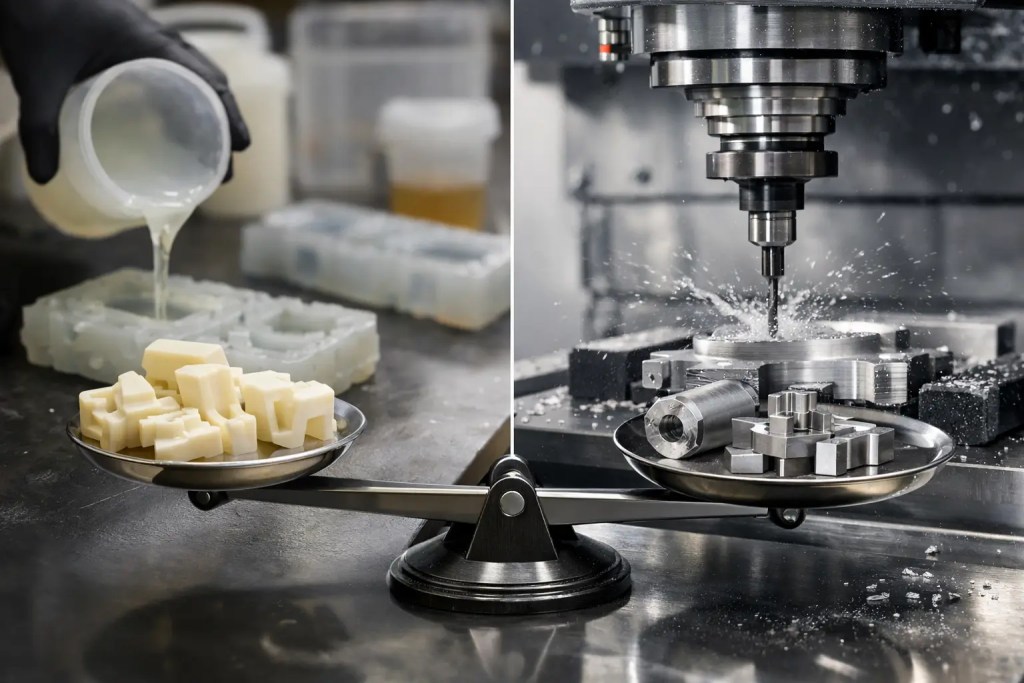
A project can look economical at the quoting stage and still become expensive once iteration, tooling updates, scrap risk, and lead time pressure are factored in. That is why urethane casting vs CNC machining cost tradeoffs are rarely decided by piece price alone. For engineers and sourcing teams, the better choice depends on what is driving the program: appearance validation, functional testing, tolerance control, or short-run production speed.
Urethane casting and CNC machining both serve low-volume manufacturing, but they do so in very different ways. One process spreads mold cost across multiple parts. The other removes material directly from solid stock and avoids soft tooling altogether. The cost crossover point is not fixed. It moves based on geometry, material requirements, finish expectations, and how stable the design is.
Where urethane casting vs CNC machining cost tradeoffs start
The first cost split is upfront investment. Urethane casting usually requires a master pattern and silicone tooling before production parts can be poured. CNC machining does not need molds, so the first article can often start directly from a STEP file. If you only need one or two parts, machining often has the cleaner cost structure.
That changes when quantities rise. Once silicone molds are built, urethane casting can reduce the per-part cost for small batches, especially when parts have complex outer geometry that would take long machine cycles to produce. For housings, covers, enclosures, and cosmetic components, that shift can happen quickly.
The key question is not which process is cheaper in general. It is which cost model matches your volume and design maturity.
Tooling cost versus setup cost
Urethane casting carries tooling cost early
Urethane casting typically starts with a master pattern, often produced through SLA or CNC, followed by silicone mold fabrication. That introduces non-recurring cost at the start of the job. If the design changes after tooling is made, that cost may need to be paid again.
For stable designs, that is acceptable. The mold cost is distributed over multiple units, making each subsequent part more economical. For unstable designs, the tooling burden becomes the main financial risk.
CNC machining carries setup and programming cost instead
CNC machining shifts cost into programming, fixturing, machine time, and material removal. There is no mold to amortize, which makes it attractive for prototype phases where revision frequency is high. When a design update arrives, the toolpath can be changed without rebuilding silicone molds.
That flexibility has value. Teams often underestimate how expensive design churn can be when a process depends on tooling.
Volume is usually the biggest driver
If you need a single part, CNC machining often wins on total cost because there is no tooling overhead. If you need 10, 20, or 50 parts, urethane casting becomes more competitive, especially when the geometry is difficult to machine efficiently.
Still, volume alone is not enough to make the call. A simple rectangular aluminum bracket may remain cheaper to machine even at moderate quantities because cycle time is short and tolerances are straightforward. A contoured plastic enclosure with ribs, texture targets, and cosmetic surfaces may favor urethane casting much earlier.
This is why experienced manufacturing teams review both geometry and demand together rather than using quantity thresholds in isolation.
Geometry changes the economics fast
CNC machining cost rises with complexity in ways that are easy to miss at the design stage. Deep cavities, undercuts, thin walls, multi-sided setups, and long tool reach all add machine time or require more advanced fixturing. Every extra operation affects cost.
Urethane casting handles external complexity more efficiently once the mold exists. Organic shapes, curved housings, and cosmetic details are often less expensive to replicate in cast resin than to cut repeatedly from billet or plate stock. For visual prototypes and low-volume product shells, that can create a meaningful cost advantage.
Internal features complicate the picture. If the design includes inserts, threaded features, tight internal tolerances, or load-bearing sections, secondary machining may still be needed after casting. At that point, the apparent savings can narrow.
Material cost is not the same as material performance
CNC machining usually works from engineering-grade stock with known mechanical properties. Aluminum, acetal, ABS, POM, nylon, and other machinable materials deliver predictable behavior for structural and functional testing. If the part must survive torque, heat, wear, or repeated assembly cycles, machining can justify its higher unit cost.
Urethane casting offers a wide range of resin systems that simulate production plastics well, particularly for appearance models, fit checks, and moderate functional use. But simulated material behavior is not always equivalent to machined stock or final molded resin. If test data matters, especially under load or temperature, a lower casting price may produce a more expensive validation mistake.
That is a real tradeoff. The cheaper process is not cheaper if it produces the wrong test outcome.
Tolerances and rework cost
Tolerance expectations often decide the process before price does. CNC machining is generally the better fit for tighter tolerances, flatness control, and critical datum relationships. It is also more predictable for parts that interface with bearings, shafts, seals, or precision fasteners.
Urethane casting can achieve good dimensional consistency for many non-critical features, but silicone molds wear over time, and resin shrink behavior must be managed carefully. For cosmetic housings and general-fit components, that is usually acceptable. For precision mating geometry, it may not be.
Rework risk matters here. A low-cost cast part that requires post-machining, manual fitting, or rejection due to dimensional drift can erase its savings quickly.
Surface finish and cosmetic quality
For external appearance parts, urethane casting often performs well from a cost perspective. The mold reproduces the surface condition of the master pattern, which allows teams to target a high-quality finish across a short run without machining every visible surface individually. For investor samples, sales models, or pilot enclosures, that efficiency is valuable.
CNC machining can also achieve excellent surface finish, but cosmetic quality on visible faces adds labor through finishing, sanding, bead blasting, or coating. If the part includes flowing external surfaces, the finishing burden can be significant.
The tradeoff is that machined parts often communicate functional realism better for metal components or highly engineered assemblies, while cast urethanes often make more economic sense for plastic-like cosmetic parts.
Lead time is a cost variable, not just a schedule variable
When a team is under delivery pressure, lead time has direct financial impact. A delayed prototype can hold up testing, customer approval, tooling release, or pilot production. In that context, the process with the lower nominal quote is not necessarily the lower-cost option.
CNC machining can be faster for urgent one-off parts because there is no mold-making stage. Urethane casting can be efficient for batch production once the master and mold are approved, but the front-end preparation adds time. If you need parts this week for a design review, machining may be the more economical decision even if the unit price is higher.
For repeatable low-volume batches, casting can regain the advantage after that initial setup is complete.
When each process usually makes sense
Urethane casting tends to make financial sense when the design is mostly frozen, the parts are plastic-like, the batch size is above one-off level, and cosmetic consistency matters. It is especially effective for bridge production, market validation builds, and short runs where injection molding would be excessive.
CNC machining usually makes more sense when the design is still changing, the part needs tight tolerances, the material properties are critical, or the quantity is very low. It is also the safer route for fixtures, functional prototypes, and hardware that must behave like the final engineering material.
In practice, many programs use both. A team may machine the first functional articles, validate assembly and performance, then shift stable cosmetic or enclosure components into urethane casting for lower batch cost. That hybrid approach often delivers the best outcome because it aligns each process to the stage of the product lifecycle.
An experienced manufacturing partner should be able to review CAD, quantity, tolerance zones, and material intent before recommending a route. At Additive3D Asia, that process is often part of the quoting workflow, which helps engineering and procurement teams compare options before cost gets locked into the wrong process.
The best purchasing decision is usually the one that reduces total project risk, not just quoted unit price. If the part needs to prove performance, pay for certainty. If the design is stable and the goal is short-run efficiency, spread the cost through casting. The smart move is to choose the process that fits what the part has to do next.