
A bracket that survives field loads, a housing that snaps together correctly on the first assembly, a fixture that holds tolerance across repeated cycles – this is where the question of the best 3D printing for end use parts stops being theoretical. For engineers and procurement teams, the right process is the one that meets performance requirements, holds repeatable quality, and arrives on schedule without forcing a tooling investment too early.
End-use production with additive manufacturing is no longer limited to niche geometries or low-stakes components. The practical decision is not whether 3D printing can produce real parts. It is which process, material, and post-processing route will deliver the right mechanical properties, surface quality, dimensional control, and total cost for the application.
What makes the best 3D printing for end-use parts?
There is no single best process for every production part. The right answer depends on loading conditions, operating temperature, cosmetic requirements, tolerances, regulatory needs, and batch size. A nylon duct for an industrial machine, a metal mounting feature, and a customer-facing enclosure may all be end-use parts, but they do not belong on the same manufacturing route.
For most teams, process selection comes down to five variables. First is material performance – tensile strength, elongation, impact resistance, heat resistance, and chemical compatibility. Second is accuracy and repeatability. Third is surface finish and detail resolution. Fourth is production economics at the target volume. Fifth is lead time, including any secondary machining, finishing, or inspection needed before shipment.
That is why end-use additive manufacturing works best when it is treated as a production decision, not just a prototyping shortcut.
Comparing the best 3D printing for end-use parts by process
HP Multi Jet Fusion for functional polymer production
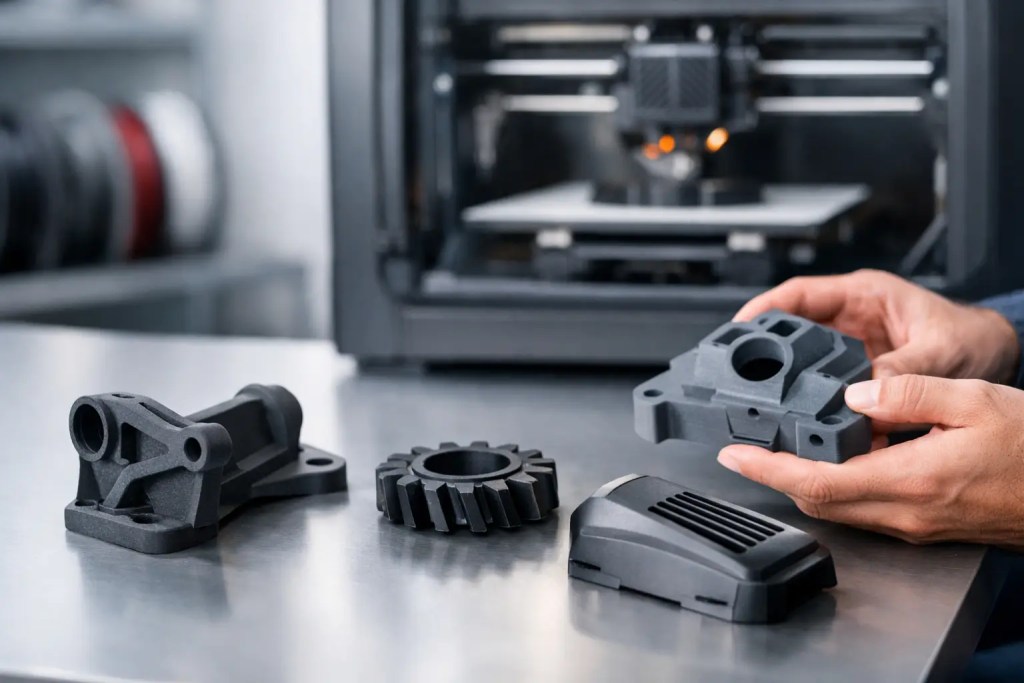
For many functional polymer components, HP Multi Jet Fusion is one of the strongest candidates. It is especially effective for end-use housings, covers, brackets, cable guides, clips, ducts, and low-volume production parts that need consistent mechanical performance.
MJF parts in PA12 typically offer a strong balance of stiffness, durability, and dimensional stability. The process also supports complex geometry without tooling, which makes it useful when lightweighting, lattice structures, or integrated assemblies reduce part count. Because the powder bed supports the part during printing, geometry freedom is high and support removal is minimal.
The main advantage for production teams is repeatability across batches. Surface finish is more uniform than filament-based methods, and throughput is better suited to short-run manufacturing. MJF is often the practical choice when parts need to move from prototype to production without changing design intent too much.
The trade-off is that MJF does not deliver the transparent appearance or ultra-fine surface quality of resin processes, and for highly cosmetic consumer-facing parts, dyeing or secondary finishing may still be needed.
SLS for durable nylon parts with design freedom
Selective Laser Sintering remains a strong option for end-use nylon parts, especially where mechanical durability and geometric complexity matter more than cosmetic finish. SLS is widely used for functional covers, enclosures, jigs, fixtures, and lightweight structural components.
Like MJF, SLS avoids the support limitations seen in some other processes. That makes it useful for nested production builds and intricate internal features. Materials such as PA12 and PA11 can support different performance priorities, with PA11 often preferred when higher ductility and impact resistance are needed.
Compared with MJF, SLS can be highly effective for production, but the exact economics and surface consistency depend on machine configuration, build density, and post-processing workflow. If your priority is rugged nylon performance and design flexibility, SLS remains a reliable manufacturing route.
SLA for appearance, detail, and controlled applications
SLA is usually not the first process engineers choose for heavily loaded end-use parts, but it can be the right answer for certain categories. If the part needs very fine features, smooth surfaces, or presentation-grade detail, SLA has clear advantages.
This makes it useful for covers, medical device housings, fluidic components, and low-load parts where visual quality or fine resolution matters. With the right engineering resin, SLA can also serve functional applications, but material behavior should be evaluated carefully. Resin parts can be more brittle than nylon-based powder-bed parts, and long-term UV or thermal exposure may limit suitability.
In other words, SLA can absolutely be used for end-use parts, but only when the actual service environment matches the resin’s performance envelope.
FDM for cost-sensitive functional parts
FDM still has a place in end-use manufacturing, particularly for larger parts, simple geometries, and applications where cost control matters more than isotropic strength or premium surface quality. It is commonly used for fixtures, guards, mounting aids, and custom manufacturing tools.
The process benefits from a wide material range, including engineering thermoplastics. It can also be a practical choice when a design needs to be produced quickly in moderate size without the cost profile of powder-bed systems.
The limitation is layer-dependent mechanical behavior. Part strength can vary by build orientation, and surface finish typically requires more post-processing if appearance is important. For some factory-floor applications, that is acceptable. For tight-tolerance consumer products or mechanically demanding assemblies, it may not be.
Metal SLM for high-performance end-use components
When polymer performance is not enough, metal additive manufacturing becomes relevant. Selective Laser Melting is used for end-use parts in aluminum and stainless steel where weight reduction, part consolidation, thermal performance, or complex internal geometry justify the process.
Materials such as AlSi10Mg and SS316L are common choices for production-grade components. Metal AM is valuable for aerospace-adjacent hardware, custom industrial tooling, manifolds, heat-management parts, and specialized machine components where conventional machining would be slow, restrictive, or uneconomical for the geometry.
The key point is that metal AM is rarely chosen on print technology alone. Success depends on build strategy, support planning, heat treatment, machining allowances, and inspection. For critical parts, additive is often one step in a controlled manufacturing sequence rather than the whole process.
How to choose the right process for your part
The fastest way to make a poor process decision is to start with the machine instead of the requirement. Start with the part’s real job.
If the part sees repeated loading, ask whether you need isotropic strength, impact resistance, or just adequate stiffness. If the part sits near heat or chemicals, verify environmental resistance first. If it interfaces with mating components, identify tolerance-critical features early and decide whether those surfaces should be printed, machined, or post-processed.
Volume matters too. For one-off or low-volume production, additive often wins on speed and design freedom. As annual volume increases, injection molding, urethane casting, CNC machining, or sheet metal fabrication may become more economical depending on geometry and material needs. The best manufacturing partner should be able to recommend that transition honestly instead of forcing every part into a single process.
This is where an engineering-first workflow matters. Uploading a CAD model and receiving manufacturability feedback before production reduces expensive iteration later. A reliable supplier should flag wall thickness concerns, unsupported features, unrealistic tolerances, and finish requirements before the job reaches the machine.
End-use parts require quality systems, not just print capacity
A good-looking sample part is easy. Repeatable production is harder.
For end-use manufacturing, process control matters as much as printer capability. Material traceability, machine calibration, inspection procedures, post-processing standards, and documented workflows all affect whether the fiftieth part matches the first. This is especially relevant for jigs, fixtures, spare parts, and customer-facing products where inconsistency creates assembly issues or field failures.
An ISO 9001:2015-certified workflow gives procurement and engineering teams more confidence that production is being managed systematically rather than informally. That does not guarantee every part is suitable for every application, but it does reduce variability in quoting, production, inspection, and delivery.
For companies that do not want to build in-house additive capacity, working with a manufacturing partner that spans polymer, metal, CNC, molding, casting, and finishing can also prevent vendor fragmentation. At Additive3D Asia, that matters because many projects start as functional prototypes, move into short-run additive production, and then shift to another process as volume or cost targets change.
Where most end-use 3D printing projects succeed or fail
Most failures are not caused by additive manufacturing itself. They come from selecting the wrong material, overestimating achievable tolerances, ignoring orientation effects, or treating cosmetic finishing as an afterthought.
Successful projects are usually more disciplined. The team defines functional requirements clearly, identifies critical dimensions, matches the process to the use case, and plans finishing or machining where needed. They also leave room for engineering review before release to production.
If you are evaluating the best 3D printing for end use parts, the strongest approach is simple: choose the process that fits the part’s duty cycle, not the one that is most familiar. When additive is selected with production logic, it can deliver not just speed, but dependable parts that are ready to work.