
A production line can appear efficient while quietly creating expensive waste: obsolete spare parts, rejected components with no recovery path, tooling built for one program, and materials whose composition is no longer known once they leave the factory. The future of circular manufacturing is not defined by recycling claims alone. It is defined by whether engineers can keep materials, components, and production assets at their highest useful value for longer – without compromising quality, safety, or delivery performance.
For engineering and procurement teams, this changes the manufacturing brief. The question is no longer only, “What is the lowest unit cost?” It is also, “Can this part be repaired, remanufactured, recycled into a known feedstock, or produced only when demand is confirmed?” The answers depend on design discipline, material data, process control, and a production partner capable of selecting the right method for each stage of a product lifecycle.
Why circular manufacturing is becoming an engineering requirement
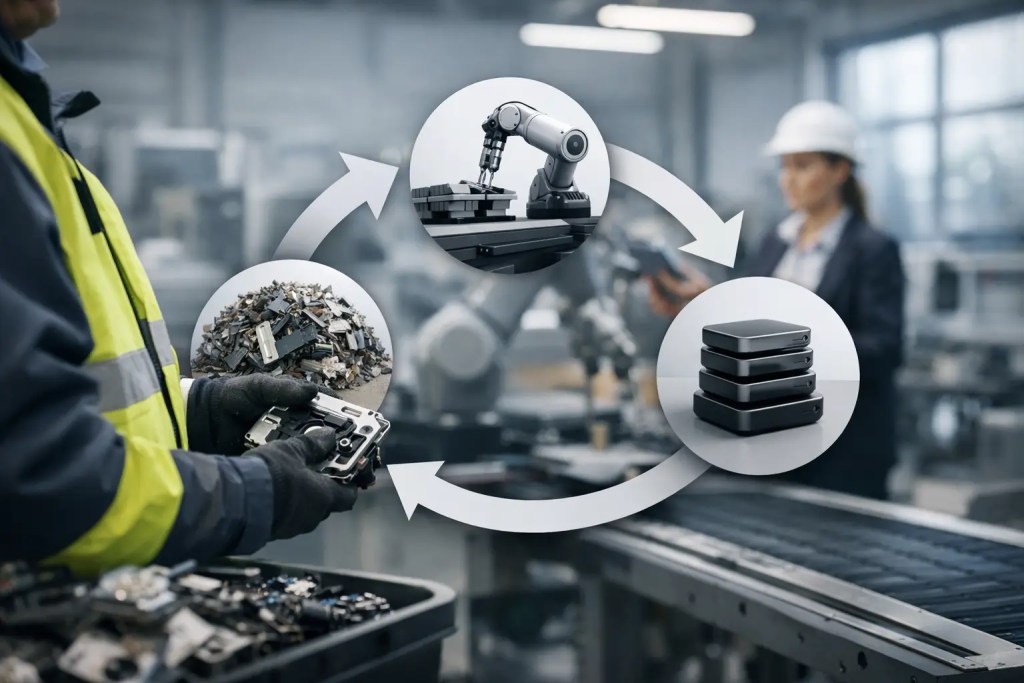
Circular manufacturing aims to reduce the extraction of virgin material and the disposal of usable value. In practice, that means designing products for longer service life, reducing production scrap, recovering components where possible, and returning materials to controlled manufacturing loops.
The business case is becoming more concrete. Supply disruptions have shown the risk of relying on long, opaque material chains. Warehousing slow-moving spare parts ties up capital. Customers and regulators increasingly ask for evidence behind environmental claims. At the same time, product teams still face familiar constraints: mechanical performance, tolerances, qualification requirements, lead time, and cost.
A circular approach must work inside those constraints. A part made from recycled polymer is not automatically suitable for a load-bearing fixture. A remanufactured metal component may require inspection and requalification before it can return to service. Material recovery has limited value if batches cannot be identified and controlled. Circularity is therefore an operational manufacturing discipline, not a marketing layer applied after production.
The priority is retaining value, not simply processing waste
Recycling is necessary, but it is often the last available option. Reusing a serviceable assembly, repairing a worn feature, or remanufacturing a component can preserve far more of the energy, machining time, and embedded material value already invested in the part.
This hierarchy affects engineering decisions. A replaceable wear insert may be preferable to replacing a complete assembly. A standardized enclosure can be updated with a new internal bracket rather than redesigned from scratch. Spare parts manufactured on demand can reduce the risk of writing off inventory when a product revision changes.
None of these choices are universal. A sealed medical device, a heavily loaded aerospace component, and a consumer electronics housing each have different safety, validation, and end-of-life requirements. The practical objective is to identify where value can be retained without introducing unacceptable technical or commercial risk.
The future of circular manufacturing starts at design release
The largest circularity gains are often determined before the first part is made. Once a design locks in bonded assemblies, incompatible materials, inaccessible fasteners, or undocumented finishes, recovery becomes costly and uncertain.
Design for disassembly is one useful principle, but it should not be treated as a requirement for every product. Permanent joining may still be the correct choice where sealing, weight, vibration resistance, or tamper control matters. The better approach is to make deliberate decisions: use reversible fastening where service access has value, and document permanent joins where they cannot be avoided.
Material selection requires the same rigor. A material may be technically recyclable but difficult to recover from a multi-material assembly. Engineers should consider material identification, contamination risk, expected service environment, and available recovery pathways alongside tensile strength, heat deflection temperature, chemical resistance, and surface requirements.
For polymer additive manufacturing, PA12 and PA11 can support durable functional components, jigs, fixtures, and short-run production parts. Their suitability for a circular strategy depends on the application and the powder management system used by the manufacturing provider. Reused powder ratios, material refresh rates, storage controls, and traceability all affect consistency. A circular objective cannot override the need for stable mechanical properties and repeatable part quality.
For metal applications, materials such as AlSi10Mg and SS316L can support high-value components where repair, redesign, or remanufacturing may be more valuable than disposal. Yet metal powder reuse also requires disciplined controls. Particle size distribution, oxygen pickup, contamination, and batch history must be managed to maintain process stability. ISO 9001:2015 quality systems provide a useful framework for documenting and controlling these decisions, although individual part requirements may demand additional validation.
Digital inventory reduces physical inventory risk
One of the most immediate circular manufacturing applications is digital spare-parts inventory. Instead of storing years of low-volume components, organizations can retain approved CAD files, material specifications, process parameters, and inspection requirements in a controlled digital record. Parts are produced when demand is confirmed.
This model is especially relevant for service parts, legacy equipment, custom fixtures, and low-volume assemblies. Additive manufacturing can produce geometry that is difficult or uneconomical to tool, while CNC machining, sheet metal fabrication, and molding remain appropriate when the material, tolerance, finish, or production volume requires them.
The key word is approved. A CAD file alone is not a production specification. A usable digital inventory record should include revision control, critical dimensions, material and finish callouts, orientation-dependent requirements where relevant, post-processing instructions, and acceptance criteria. Without this information, on-demand production can become a source of variation rather than a controlled alternative to warehousing.
Additive manufacturing has a specific role, not a universal one
Additive manufacturing supports circular production because it can reduce tooling dependence, enable localized or on-demand output, and make repair-oriented or lightweight designs practical. It also allows engineers to consolidate assemblies, reducing the number of individual components that must be sourced, assembled, and eventually managed at end of life.
However, additive manufacturing is not automatically lower-impact than every conventional process. Energy use, support structures, post-processing, build failures, powder handling, and shipping distance all matter. A machined part from standard stock may be the better choice for a simple prismatic component. Injection molding may be the correct production process for a stable, high-volume polymer part. Circular manufacturing improves when each process is selected for its actual production role.
A multi-process manufacturing partner can help prevent false choices. A team may use SLA for a high-detail concept model, Multi Jet Fusion or SLS for functional polymer trials, CNC machining for tight-tolerance interfaces, and urethane casting for a short bridge run before injection molding. This reduces rework between development stages and avoids forcing a design into one technology because that is the only available option.
At Additive3D Asia, this process selection can be coordinated from prototype through short-run and end-use production, helping teams preserve design intent while matching material and process capability to the part’s service requirements.
Traceability turns circular intent into a repeatable system
Circularity fails when information is lost. A recovered component with unknown service exposure, an unlabeled polymer stream, or a mixed batch of metal powder is difficult to use responsibly. Traceability is what allows manufacturers to make informed decisions about reuse, repair, reprocessing, or disposal.
For production teams, this means establishing a clear record of incoming material, process route, machine parameters where applicable, post-processing, inspection results, and final part identification. The depth of documentation should match the part’s risk profile. A noncritical assembly aid does not require the same evidence package as a pressure-bearing or safety-critical component.
Traceability also improves root-cause analysis. If a recycled or recovered material batch produces unexpected variation, the team needs to distinguish between feedstock condition, equipment performance, design geometry, finishing operations, and handling damage. Without that visibility, circular programs can create hidden quality costs.
Measure the right outcomes
A circular manufacturing program should be assessed with operational measures, not broad promises. Useful indicators include scrap rate by process, percentage of components repaired or remanufactured, inventory avoided through on-demand production, reuse rate for fixtures and tooling, material recovery yield, and the number of parts designed with replaceable high-wear features.
These metrics must be interpreted carefully. Reducing scrap is valuable, but not if it increases field failures. Producing locally can reduce freight exposure, but not if a lower-yield process creates more material loss. The best results come from measuring quality, lead time, cost, and material efficiency together.
The next manufacturing advantage will not come from claiming that every part is circular. It will come from building product and production systems that keep proven materials and components in service where they make engineering and economic sense – with the records, controls, and process capability to do it reliably.