
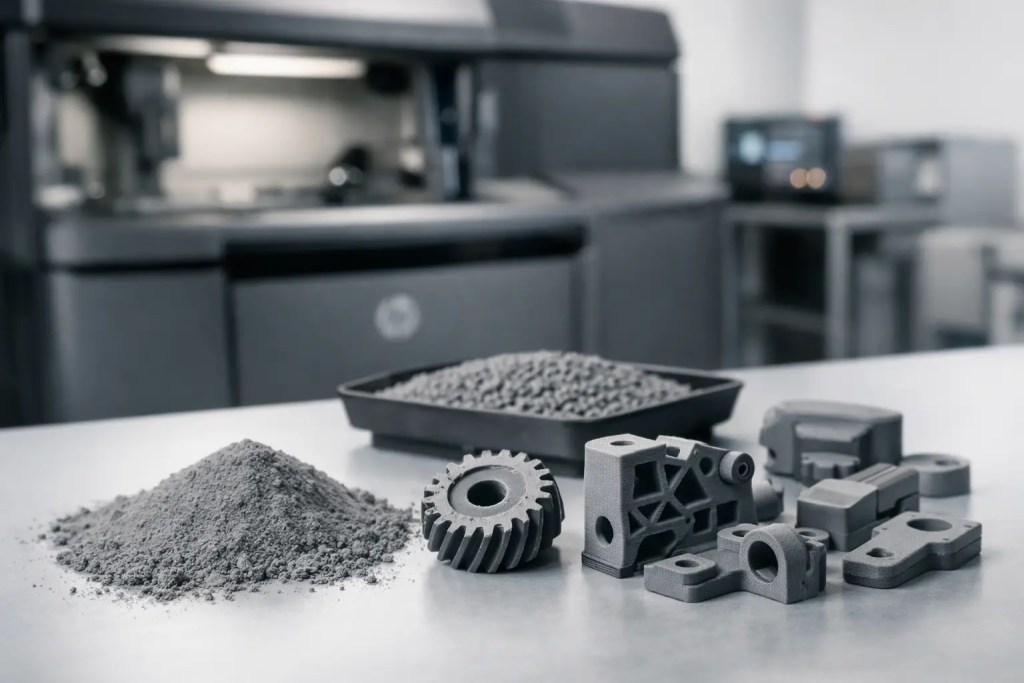
A bracket that survives repeated assembly, a fixture that holds its geometry, or an enclosure that must arrive production-ready does not need an experimental material. It needs predictable mechanical performance and a process that can reproduce it. This HP MJF PA12 material review examines where nylon 12 delivers that result, where its limits appear, and how to specify it for reliable manufacturing decisions.
HP Multi Jet Fusion builds PA12 parts by selectively applying fusing and detailing agents to a powder bed, then using thermal energy to fuse the intended geometry layer by layer. The process produces functional nylon components without support structures, making it well suited to complex internal channels, nested assemblies, lattice features, and short-run batches.
What HP MJF PA12 Delivers
PA12, or polyamide 12, is a widely used engineering thermoplastic valued for its balanced strength, stiffness, impact resistance, and chemical resistance. In MJF, it is typically the default material when a part requires more than visual form validation. It performs well for functional prototypes, production aids, housings, clips, covers, ducts, brackets, and low-volume end-use components.
The practical advantage is not one headline property. It is the balance. MJF PA12 has enough rigidity to maintain the form of a fixture or enclosure, enough toughness for many snap-fit and handling applications, and enough elongation to avoid the brittle behavior associated with many photopolymer parts. It also provides good resistance to oils, greases, hydrocarbons, and a range of industrial chemicals, subject to the specific chemical, concentration, temperature, and exposure duration.
For engineering teams, this balance reduces the risk of optimizing a part around a material that is either too fragile for the field or unnecessarily expensive for the requirement. PA12 is often a sound first production material when the operating environment is moderate and the design does not demand the high-temperature performance of specialized polymers or metal.
Strength, Accuracy, and Surface Quality
MJF PA12 parts are generally strong and consistent across the build because the process fuses each layer within a surrounding powder bed. This is a meaningful distinction for parts loaded in more than one direction. Like all additive processes, part orientation, geometry, wall thickness, and local heat behavior still influence the final result, but MJF often provides more uniform mechanical behavior than extrusion-based polymer printing.
Dimensional accuracy is suitable for many assemblies, jigs, and production components, particularly when the design accounts for additive manufacturing tolerances. Critical holes, bearing seats, threads, sealing faces, and tight mating interfaces should not be treated as print-and-forget features. They may require allowance for post-machining, tapping, reaming, or another secondary operation.
The as-built surface has a fine, matte, slightly textured finish. It is more refined than many FDM surfaces, but it is not equivalent to injection-molded tooling or a machined cosmetic surface. Fine lettering, embossed features, and complex geometry reproduce well when designed with appropriate feature sizes. However, thin unsupported details, sharp corners, and narrow slots should be reviewed for manufacturability before release.
Surface finishing changes both appearance and function. Bead blasting can create a more uniform visual finish. Dyeing is practical for black parts and selected color requirements. Vapor smoothing can reduce surface roughness and improve cleanability or fluid handling in suitable applications. Machining can establish precise interfaces. The correct finishing route depends on whether the part is customer-facing, mechanically critical, or used inside a production environment.
Design Features That Need Extra Attention
Wall thickness should be kept sufficiently uniform where possible. Large differences in section thickness can create uneven cooling behavior and increase the likelihood of distortion. Hollow components should include powder escape paths large enough for dependable depowdering, especially where internal channels or cavities are present.
Snap fits are feasible in PA12, but they should be designed around material flexibility rather than copied directly from injection-molded designs. Generous radii at the base of cantilevers, realistic deflection targets, and prototype validation under expected cycle counts are necessary. For threaded connections, inserts or tapped post-processed holes are usually more dependable than repeatedly driving screws into printed polymer.
Where PA12 Is a Strong Material Choice
PA12 earns its place when teams need functional performance without the cost and lead time of hard tooling. It is particularly effective for manufacturing aids: drill guides, locating nests, inspection fixtures, robot end-effector components, protective caps, and handling tools. These parts often benefit from low weight, geometry freedom, and fast replacement cycles.
For product development, MJF PA12 supports the transition from prototype to short-run production without changing the fundamental manufacturing method. That continuity matters when testing enclosures, airflow components, wearable hardware, cable-management elements, or mechanical interfaces. Engineers can validate fit, assembly sequence, and field handling using a material that behaves more like an engineering plastic than a presentation model.
It is also a practical option for low-volume end-use parts when demand is uncertain, tooling investment is difficult to justify, or designs are still expected to evolve. Production quantities are not the only decision factor. A complex part with multiple molded subcomponents may be economically viable in MJF at a higher unit volume than a simple geometry would be.
Limitations in This HP MJF PA12 Material Review
PA12 is not the automatic answer for every nylon requirement. It has good heat resistance for many industrial uses, but continuous elevated-temperature service, high heat loads, or demanding under-hood conditions may require a different polymer, a reinforced grade, or metal. Material selection should be based on the actual service temperature, duration, load, and safety margin rather than a single heat-deflection value.
The material can absorb moisture over time, as polyamides do. Moisture conditioning can affect dimensions and mechanical response, particularly in thin or precision interfaces. For controlled assemblies, define the environmental condition under which the part will be measured and used. This is more relevant for tight-tolerance mechanisms than for a general protective cover.
MJF PA12 is also not inherently watertight, pressure-tight, electrically insulating under every condition, or suitable for direct food, medical, flame-retardant, or regulated applications without material-specific verification. The porous nature of an as-built polymer surface may matter in fluid, vacuum, hygiene, or cosmetic applications. Sealing, smoothing, coating, and validation may be required.
Color is another trade-off. Natural gray is the standard visual result, while dyed black is a common production finish. If brand-critical color matching, high-gloss appearance, or transparent optics are primary requirements, another process may be a better fit.
PA12 Compared With Other Production Options
Compared with SLS nylon, MJF PA12 offers comparable application territory but is frequently selected for its fine feature capability, productivity, and consistent process control. The right choice still depends on available material grades, geometry, finishing requirements, and batch economics.
Compared with PA11, PA12 is generally the more balanced choice for stiffness and dimensional stability, while PA11 may be preferred where greater ductility and impact performance are central to the design. A living hinge, flexible clip, or component expected to experience repeated deformation may justify evaluating PA11 rather than defaulting to PA12.
Compared with FDM, MJF PA12 removes the need for sacrificial support structures and can produce more complex, production-oriented geometry with a more uniform surface and stronger functional behavior. FDM can remain the better option for very large parts, simple prototypes, or applications where specific filament materials are required.
Compared with injection molding, MJF avoids tooling and supports rapid design changes. Injection molding becomes more compelling as volumes rise, geometry stabilizes, and unit-cost reduction outweighs tooling cost and lead time. A capable manufacturing partner should be able to support both routes rather than force the part into one process.
Specifying PA12 for Repeatable Results
A useful request for quotation includes more than an STL file. Provide a STEP file where available, identify critical dimensions and datums, state the intended load and operating environment, and note whether the part requires cosmetic finishing, threads, inserts, sealing, or machining. If an assembly has a non-negotiable fit, identify it early so tolerances and post-processing can be planned instead of corrected after production.
For first articles, validate the features that can create downstream cost: mating interfaces, snap fits, hole locations, wall deflection, and finished appearance. Once those requirements are established, MJF PA12 is well suited to repeatable short-run supply. Additive3D Asia applies an ISO 9001:2015 quality framework to help keep this transition from prototype to production controlled and traceable.
The best PA12 part is not simply one that prints successfully. It is one designed around real loads, realistic tolerances, the correct finish, and a production path that remains viable when the next order is larger than the first.