
A design revision should not require a week of emails before a buyer can understand its cost and delivery impact. Yet that has long been the reality for many engineering teams: send drawings to several vendors, wait for responses, compare incomplete quotes, clarify tolerances, then restart when the CAD changes. How online manufacturing platforms are changing procurement starts with removing that delay from the decision itself.
For engineers, procurement managers, and product teams, the shift is not simply toward ordering parts through a website. It is toward a more connected manufacturing workflow where CAD data, material requirements, process selection, pricing, quality expectations, and fulfillment are addressed earlier. When managed properly, this reduces iteration time without reducing technical control.
Procurement is moving closer to engineering
Traditional sourcing often separates engineering from purchasing. Engineering defines a part, purchasing requests quotes, and suppliers interpret the requirements after the fact. That structure can work for stable, high-volume programs with established suppliers. It becomes slow and expensive when parts are still evolving, quantities are uncertain, or multiple manufacturing processes must be evaluated.
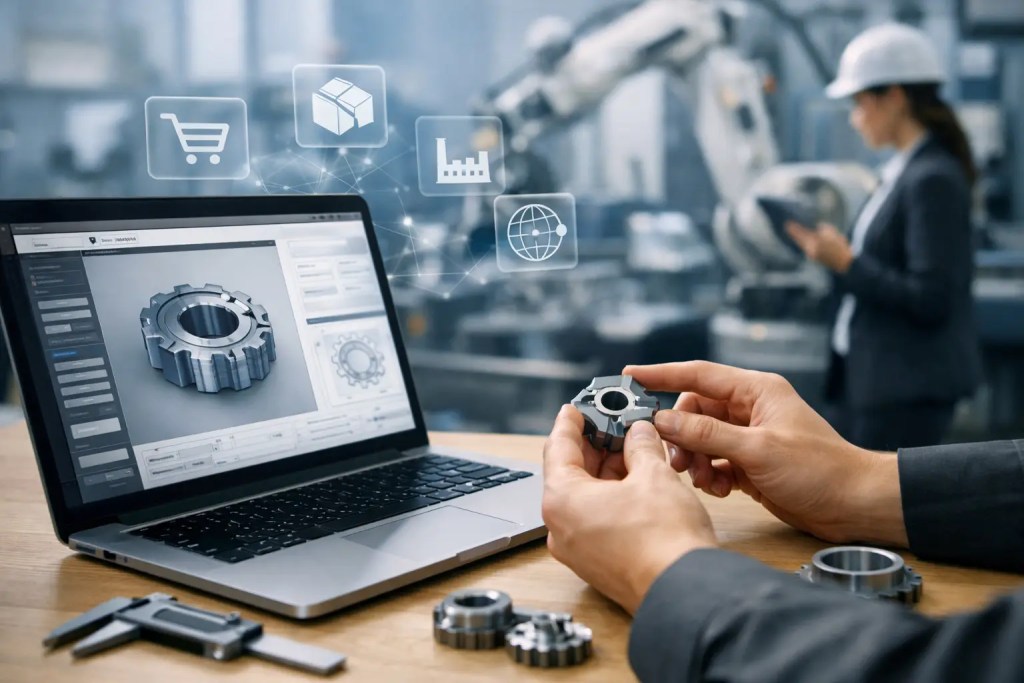
Online manufacturing platforms bring the sourcing decision closer to the point where the design is created. An engineer can upload an STL or STEP file, review process and material options, receive pricing guidance, and identify manufacturability concerns before a formal purchase order is issued. Procurement retains the controls that matter – approved suppliers, budgets, documentation, and delivery requirements – but spends less time chasing basic production information.
This matters most in early-stage development and low-to-mid-volume work. A prototype housing may begin as SLA for visual review, move to PA12 produced by Multi Jet Fusion or SLS for functional testing, and later shift to injection molding when volumes justify tooling. The ability to assess these paths through one production partner prevents the team from rebuilding its supplier base at each stage.
How online manufacturing platforms change procurement decisions
The central change is speed, but speed alone is not the objective. Faster procurement is valuable only when the quote reflects a production method capable of meeting the part’s requirements.
Quotes become a technical input, not just a price check
A conventional quote is often the first moment a supplier sees a design. If the part contains unsupported features, unsuitable wall thicknesses, inaccessible machining areas, or tolerances that do not match the selected process, clarification follows. Each clarification extends lead time and makes project schedules less predictable.
A well-run online platform uses the uploaded model to create an earlier feedback loop. It can flag potential issues and direct the buyer toward decisions that affect cost and performance: material, orientation, finishing, quantity, dimensional requirements, and turnaround. This does not replace engineering review for demanding applications, especially metal components or tightly toleranced interfaces. It does ensure that obvious risks are addressed before the order enters production.
For procurement teams, this creates a more useful quote. Instead of comparing a group of headline prices, they can compare like-for-like production specifications. A lower price on an undefined process is not necessarily lower total cost if it leads to rework, failed fit checks, or missed delivery dates.
Supplier consolidation becomes more practical
Vendor fragmentation is a common source of procurement friction. One supplier produces polymer prototypes, another machines metal brackets, a third handles sheet metal, and a fourth provides finishing. Each relationship carries separate onboarding, communication, shipping, quality, and invoicing requirements.
Online manufacturing platforms can consolidate a wider set of processes under a single operating workflow. For example, a development program may require an SLS PA12 enclosure, CNC-machined aluminum test fixtures, laser-cut sheet metal panels, and urethane-cast pre-production parts. Working through one capable source can reduce administrative load while keeping technical requirements aligned across the build.
Consolidation is not always the correct answer. A specialized supplier may remain the best option for highly regulated work, unusually large components, validated production tooling, or a proprietary process. The advantage of a multi-process platform is not that every job must be centralized. It is that teams have a qualified option for work that would otherwise require several disconnected suppliers.
Capacity becomes an on-demand resource
Building in-house production capability requires capital equipment, skilled operators, maintenance, material inventory, quality procedures, and scheduling discipline. For many organizations, those investments make sense only when machine utilization is consistently high and the process is strategically critical.
Digital manufacturing platforms provide another model: use production capacity when the project requires it. This gives R&D teams room to increase output during validation, produce jigs and fixtures for a new line, or order short runs of end-use parts without committing to equipment that may sit idle between projects.
The trade-off is dependency on an external production schedule. Teams should still plan around defined lead times and communicate priority requirements early. On-demand does not mean unlimited capacity or instant manufacturing. It means that capacity can be accessed without owning and operating every process internally.
Quality data has to move at the same speed as the quote
Fast ordering is only useful when quality controls remain visible. This is where online procurement can either improve discipline or create risk. A platform that treats every uploaded file as a commodity order may be appropriate for simple, noncritical components. It is not sufficient for parts with dimensional, material, traceability, or repeatability requirements.
Industrial buyers should look beyond the upload interface. They need to know how the supplier controls files, revisions, materials, machine parameters, inspection requirements, finishing, and nonconforming parts. ISO 9001:2015 certification is one meaningful indicator that documented quality systems are in place, though certification should be evaluated alongside the supplier’s actual process capability and the needs of the application.
Material selection also requires specificity. “Nylon” does not communicate the same performance expectations as PA12 or PA11. “Stainless steel” is not a substitute for identifying SS316L when corrosion resistance and mechanical properties matter. Likewise, AlSi10Mg, machined aluminum, and sheet metal can each be suitable for different load cases, finishes, and delivery targets. A useful platform makes these distinctions clearer rather than hiding them behind a generic material category.
The procurement workflow is becoming more iterative
Digital manufacturing changes the timing of purchasing. Rather than treating procurement as the last step after design release, teams can use manufacturing feedback throughout development. Early parts can test fit and assembly. A second build can validate material behavior. A short production run can reveal handling, finishing, and packaging requirements before a larger commitment is made.
That iterative approach is particularly valuable for hardware startups and established manufacturers developing new products under compressed schedules. It allows teams to spend money in stages, with each build reducing uncertainty. The objective is not to produce more prototypes for their own sake. It is to use each order to answer a defined production question.
At Additive3D Asia, this model combines additive and conventional manufacturing from an ISO 9001:2015-certified operation, allowing customers to move from rapid prototypes to production-oriented parts without treating each manufacturing stage as an entirely new sourcing event.
What buyers should require from a platform
The best procurement outcome depends on more than an instant price. Buyers should confirm that the quoted process matches the part’s function, that material specifications are clear, and that finishing requirements are stated rather than assumed. Tolerances should be assigned where they affect interfaces and performance, not applied broadly without purpose, because unnecessary precision can add cost and limit process options.
They should also verify revision control. A platform can accelerate ordering, but it cannot prevent the wrong revision from being manufactured if internal release practices are weak. Approved CAD files, unambiguous drawings where needed, defined inspection criteria, and a clear owner for technical approval remain essential.
Finally, procurement should evaluate delivery as a complete outcome. A low unit price can lose value quickly if parts arrive without the required finish, documentation, packaging, or lead-time reliability. For globally fulfilled projects, shipping time and customs planning belong in the manufacturing decision from the start.
A better question for procurement teams
The question is no longer whether parts can be ordered online. Most can. The more useful question is whether the platform turns digital convenience into dependable manufacturing execution.
For a simple prototype, the answer may be a fast quote and a standard process. For a functional assembly, production fixture, or end-use metal component, it may require engineering review, material verification, finishing controls, and documented quality procedures. Teams that define those needs before uploading a file will use online manufacturing platforms not merely to buy faster, but to make better production decisions with every revision.