
A product team gets the geometry “right” in CAD, then loses three to six weeks waiting for a production tool just to learn the snap-fit needs 0.2 mm more clearance. That gap between design intent and molded reality is where rapid tooling earns its keep – not as a cheaper version of hard tooling, but as a faster decision engine.
Rapid tooling for injection molding is the use of accelerated tooling methods and materials to produce injection-molded parts on compressed timelines, typically for prototyping, bridge production, or early market builds. The value is simple: you validate molded behavior (shrink, warp, gate vestige, knit lines, ejection marks, cosmetic limits) using the same process you plan to scale, without committing to a long-lead, high-cost production mold before the design is stable.
What “rapid tooling” actually means in practice
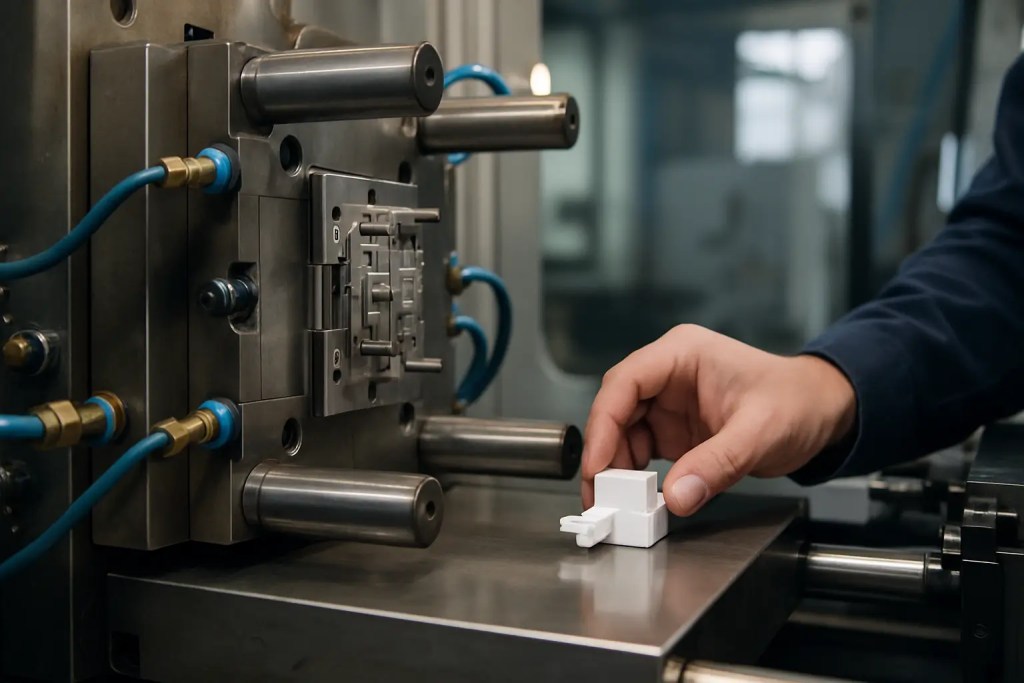
Most teams use the term loosely, so it helps to define it operationally. Rapid tooling usually involves one of two approaches: machining a simplified mold quickly (often aluminum, sometimes softer steel) or creating mold inserts using additive manufacturing and placing them into a mold base. Either way, the goal is to shorten the path from CAD to first shots.
The “rapid” part isn’t only about tool fabrication. It also shows up in how the tool is designed: fewer cavities, fewer moving features, simplified cooling, and a plan to accept that the tool may be modified once or twice. Many rapid tools are built explicitly for iteration – you are buying speed of change as much as speed of first delivery.
Where rapid tooling fits in the product lifecycle
Rapid tooling is most effective when you need injection-molded truth, not just a shape. If your risk is mechanical performance, assembly behavior, or cosmetic acceptability under real molding conditions, rapid tooling is often the fastest way to de-risk.
It also fits when your demand curve is uncertain. You can ship an early run with a bridge tool while the design locks and demand becomes clearer. If volumes climb, you roll the learning into a hardened steel tool with fewer surprises.
Where it is usually not the best first move is very early concept work. If you’re still changing wall thicknesses, rib patterns, and major surfaces every week, additive prototypes or urethane casting often deliver faster learning per dollar.
Rapid tool types: what to choose and why
CNC-machined aluminum molds
For many engineering teams, aluminum is the workhorse of rapid injection tooling. It machines quickly, supports decent surface finishes, and can deliver functional molded parts in production thermoplastics. The trade-off is durability and thermal behavior. Aluminum tools typically wear faster than hardened steel, and aggressive glass-filled resins can shorten tool life.
Aluminum also tends to be more forgiving for quick edits. If you need to open up a shutoff, adjust a feature, or rework a gate location, an aluminum tool often makes that iteration simpler.
Soft steel or pre-hardened steel molds
If you expect higher shot counts, tighter dimensional control over time, or you’re molding abrasive materials, a soft steel or pre-hardened option can be the better “rapid” choice. It may take longer to cut than aluminum, but it buys durability and process stability.
This route is common for bridge tooling where the tool might run long enough to cover early orders, validation builds, or regulatory samples without immediately rebuilding in hardened steel.
Additively manufactured inserts (hybrid tooling)
3D-printed inserts can be useful when the geometry is difficult to machine quickly, or when you want to test multiple variations of a localized feature while keeping the rest of the tool constant. The limitations are predictable: insert strength, heat resistance, surface finish, and the risk of premature wear.
Hybrid tooling can still be a serious engineering tool, but it works best when you design around its constraints – controlled shot counts, careful resin selection, and realistic expectations about cosmetic surfaces.
What you learn from rapid injection molding that 3D printing won’t tell you
A good rapid tool pays back because injection molding has its own physics. Even highly accurate additive parts can mislead you on:
Shrink and sink – especially around bosses, ribs, and thick-to-thin transitions.
Warp – driven by flow orientation, cooling imbalance, and part geometry.
Knit lines and weld strength – critical for housings, clips, and thin ribs.
Gate vestige and flow marks – cosmetic and sometimes functional.
Ejection behavior – pins, sleeves, draft adequacy, and surface scuffing.
Assembly stack-up at scale – molded parts repeat differently than printed parts, and the directionality of variation matters.
If your next decision is “commit to a production mold,” these are the failure modes you want to expose early.
The constraints engineers should plan for
Rapid tooling isn’t a shortcut around molding fundamentals. In fact, it often punishes marginal design choices because there’s less margin in cooling and tool rigidity.
Cooling is the biggest reality check. Many rapid tools use simplified cooling circuits, which can increase cycle time and amplify warpage. You can still get excellent functional parts, but you should align expectations: a rapid tool is optimized for learning and early supply, not always for peak cycle efficiency.
Tolerances are also context-dependent. Tight tolerances can be achieved, but they depend on part geometry, resin choice, tool temperature control, and whether the tool will be tuned after first shots. If you need consistent, tight dimensions on critical features, plan for measurement feedback and at least one optimization loop.
Material selection matters more than teams expect. Commodity resins can run well in rapid tools, but glass-filled and high-temperature materials increase wear and stress on the tool. Sometimes the correct approach is to validate geometry and assembly in a close proxy resin first, then run the final resin once the tool is proven.
Finally, don’t underestimate surface finish reality. A polished cavity can still show flow lines or gloss variation depending on resin and gate strategy. If appearance is a primary requirement, you want a molding-first validation path, not a purely additive one.
When rapid tooling is the right call (and when it isn’t)
Rapid tooling is a strong option when you have a stable external form and you’re mainly validating moldability, assembly, and performance. It is also a strong option when procurement needs a predictable manufacturing route for early volumes, with traceability and repeatable output.
It is less compelling when your main risk is internal fit of electronics that will change, or when you only need a handful of visual models for stakeholder review. In those cases, polymer additive processes can move faster and keep iteration costs lower.
A practical way to decide is to ask: will the next design decision depend on molded behavior? If yes, rapid tooling tends to outperform any proxy.
A decision-oriented workflow that reduces iteration cycles
Most delays happen because teams treat rapid tooling like “mini production” without planning for iteration. A cleaner approach is to treat it as a controlled experiment.
Start with DFM aligned to your intent. If you want to preserve the ability to change specific features, define them as swappable inserts or isolate them in an area that can be reworked. Draft angles, shutoffs, and parting lines should be set with the expectation that the tool will actually run, not just look correct in CAD.
Then set a validation plan before cutting steel or aluminum. Define what must be proven on T0/T1 samples: critical dimensions, snap engagement force, torque-out on bosses, leak performance, cosmetic acceptance zones, and any test conditions (temperature, UV, chemical exposure) that influence material behavior.
Finally, close the loop quickly: measure parts, adjust process, then decide whether the tool needs a change. The fastest projects are the ones where the learning cycle is planned, not accidental.
If you need a single partner to move between additive prototypes, bridge tooling, injection molding, and post-processing with controlled workflows, Additive3D Asia runs ISO 9001:2015-certified digital manufacturing programs designed for that handoff – from CAD upload and manufacturability feedback through global shipping.
Cost, lead time, and risk: the trade you are actually making
Teams sometimes evaluate rapid tooling only on tool price. That misses the point. The real comparison is the cost of waiting and the cost of being wrong.
A rapid tool may cost more than a set of printed prototypes, but it can eliminate a much larger mistake: building a production tool around an unproven gate location, a marginal ejection concept, or a cosmetic requirement you can’t actually meet with the selected resin.
Lead time is also not just “days to tool.” It includes the time to get parts that are decision-grade. If you can receive molded samples quickly, test them, and lock the design with confidence, you compress the full development timeline – and that’s often where the financial win lives.
Risk is the final lever. Rapid tooling reduces technical risk by exposing molding-specific issues early, but it introduces program risk if you assume it will behave like a full production tool. Treat it as a phase with defined learning objectives, and it behaves predictably.
The practical takeaway engineers can use immediately
If you are debating rapid tooling for injection molding, frame it as a question of decision speed: how quickly can you get real molded data that changes what you do next? When the answer is “we can’t commit without seeing molded parts,” rapid tooling stops being an extra step and becomes the shortest path to a reliable production mold and a predictable launch.
Build the tool to learn what matters, specify what you will measure, and leave room for one smart revision. The best rapid tooling programs are the ones that make the second build – the production build – boring.