
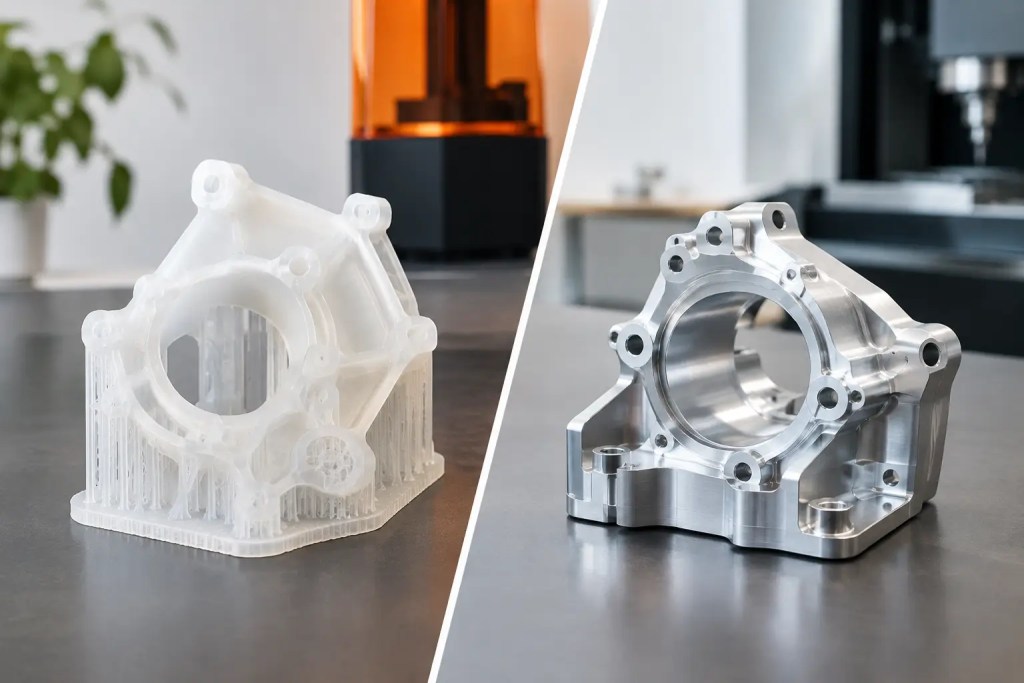
A housing that looks right under studio lighting can still fail a design review if its seams are visible, its texture is inconsistent, or its color does not match the intended production part. That is the practical decision behind SLA vs CNC appearance models. Both processes can deliver presentation-ready prototypes, but they create different visual results, use different materials, and introduce different constraints during finishing.
For industrial design verification, investor presentations, customer demonstrations, and pre-production approvals, selecting the process early prevents avoidable rework. The best option depends less on which technology is generally more accurate and more on what the model needs to communicate: form, surface, material realism, color, assembly, or all of the above.
What an appearance model must prove
An appearance model is built to evaluate and communicate the intended look and feel of a product. Unlike an early proof-of-concept prototype, it should accurately represent external geometry, proportions, interface locations, logos, textures, color breaks, and visible assemblies. It may also need to survive handling during presentations or user evaluations.
The requirements are often more demanding than they first appear. A small consumer enclosure may require sharp embossed graphics, a uniform painted finish, translucent light pipes, and close gaps between multiple parts. An automotive interior component may need a grain texture that reads correctly under raking light. A medical device prototype may need to resemble the final molded product while remaining suitable for a limited ergonomic assessment.
SLA and CNC machining can both support these objectives. The distinction is how each process gets there and what compromises are required along the way.
SLA vs CNC appearance models at a glance
SLA produces a part by curing liquid photopolymer resin in thin layers. It is particularly effective for fine features, smooth curved surfaces, small components, and complex shapes that would be difficult or inefficient to machine. After support removal, sanding, priming, painting, and other post-processing, SLA can produce a highly refined visual model.
CNC machining removes material from a solid block of engineering plastic or metal. For appearance work, common choices include ABS-like plastics, acrylic, polycarbonate, nylon, aluminum, and other materials selected for the target application and finishing plan. Because the part begins as a solid billet, it can better represent the material character and structural feel of many final production components.
Neither process is automatically superior. SLA usually provides more geometric freedom and fine detail at lower effort for complex, low-volume models. CNC is often the stronger choice when the prototype must have production-like material behavior, crisp edge definition, controlled wall thicknesses, or superior durability during assembly and handling.
Where SLA is the better appearance-model process
SLA is often the efficient route when visual complexity is high and the model is required quickly. It handles organic surfaces, compound curvature, deep cosmetic contours, and small text without requiring custom tooling or extensive machining setups. This makes it well suited to consumer product shells, cosmetic caps, wearable-device enclosures, miniature architectural features, and design-validation models with intricate exterior geometry.
Fine layer heights give SLA a strong starting point for surface finishing. Layer lines can still be present, especially on shallow angles or curved surfaces, but they are generally easier to remove than the pronounced stair-stepping associated with lower-resolution printing processes. With controlled support placement and a defined finishing sequence, SLA parts can be primed and painted to a near-production visual standard.
SLA also enables internal complexity without dividing the model into multiple machined components. Snap features, internal channels, lattice-supported shells, and enclosed cavities may be feasible when they serve the design intent. This is valuable when the appearance prototype must also demonstrate packaging volume or basic assembly architecture.
The main limitation is resin behavior. SLA photopolymers can be more brittle than injection-molded thermoplastics, and their response to impact, heat, ultraviolet exposure, and repeated fastening varies by resin grade. Thin walls, clips, and screw bosses should be evaluated carefully if the model will be assembled and disassembled repeatedly. A painted SLA prototype can look like molded ABS, but it will not necessarily behave like it.
Where CNC machining is the better appearance-model process
CNC machining is the preferred route when appearance and material authenticity must align. A machined ABS, PC, PMMA, or nylon part can provide a more representative tactile feel and mechanical response than a photopolymer equivalent. This matters for products that will be held, pressed, clipped together, or reviewed by stakeholders who expect the prototype to reflect final-product quality.
Machining is also effective for models requiring tight interface control. Mating covers, buttons, bezels, transparent windows, and multi-part housings can be produced with predictable fits when tolerance requirements are defined in the CAD data. CNC is particularly valuable when cosmetic surfaces must align across separate components, such as a two-piece enclosure with a controlled perimeter gap.
For clear or translucent elements, machining acrylic or polycarbonate can be advantageous. A properly machined and polished light guide, lens cover, or display window can achieve optical clarity that is difficult to obtain consistently from standard SLA resins. The material choice also supports more realistic testing of diffusion, illumination, and internal light leakage.
CNC does have geometric restrictions. Every internal corner is limited by the diameter of the cutting tool, deep narrow features can be difficult to access, and undercuts may require multiple setups or special tooling. Complex freeform surfaces are machinable, but machining time and cost can increase rapidly. The process may also require the part to be split into sections, creating joint lines that need to be managed during finishing.
Surface finish is a process plan, not a machine setting
For appearance models, the machine is only the first stage. The final result depends on a controlled post-processing plan that considers surface preparation, filler requirements, primer selection, paint system, texture, masking, graphics, and final inspection.
SLA parts typically need support marks addressed before priming. A skilled finishing workflow can remove these marks and create a uniform paint-ready surface, but support locations should be planned away from class-A surfaces where possible. Hollow parts also need suitable drainage and cleaning provisions to avoid resin retention and later surface defects.
CNC parts may show tool paths, witness marks from workholding, or minor variations where multiple machining operations meet. These can be sanded, bead blasted, polished, textured, painted, or otherwise finished based on the desired result. When the goal is to retain the natural appearance of the substrate, machining strategy becomes especially important. A clear acrylic component, for example, requires a different finishing path than a painted ABS enclosure.
Color matching should be treated as its own requirement. If the model must match a defined brand color, provide the relevant color reference and identify whether the finish is matte, satin, gloss, metallic, soft-touch, or textured. Painted samples can vary with lighting, substrate, and coating thickness. For critical reviews, approve a color chip or finish sample before completing the full build.
Cost and lead time depend on geometry and finishing effort
The initial manufacturing cost of SLA is frequently lower for complex single-piece geometry. It does not require programming multiple cutting operations or fixturing each face of the part, so it can be an efficient choice for intricate forms and several design iterations. This advantage can narrow if extensive manual finishing is required to achieve a premium painted surface.
CNC may have a higher starting cost because programming, setup, material preparation, and machining time are part of every build. For simpler geometries, however, it can be highly predictable. It may also reduce downstream risk if the model needs functional strength, accurate assemblies, or a specific production-grade material.
The decision should account for the complete scope: manufacturing, finishing, assembly, graphics, inspection, and shipping. A low-cost printed shell that requires multiple finishing passes may not be the fastest path to an approved prototype. Conversely, machining a highly organic enclosure from solid stock may consume time and budget that SLA would avoid.
Specify the model around the review objective
Before requesting a quote, define what the appearance model must accomplish. Identify the visible surfaces, required material impression, color and texture targets, assembly requirements, and any dimensions that are critical to fit. Provide STEP data when possible for precise machining evaluation, along with STL files where additive production is being considered.
It also helps to distinguish cosmetic requirements from functional ones. A prototype intended only for photography can prioritize finish and geometry. A unit for executive review may need a realistic weight and tactile response. A model for user testing may need durable buttons, transparent features, and repeated assembly. These are different manufacturing briefs, even when the exterior CAD is identical.
At Additive3D Asia, process selection can be evaluated alongside finishing and complementary manufacturing options, so the model is planned as a complete deliverable rather than a raw part. That approach is useful when one assembly needs SLA housings, CNC-machined clear components, painted surfaces, and controlled fit between parts.
The most effective appearance model is the one that answers the next decision with confidence. Define that decision first, then select SLA, CNC, or a combined approach that gives reviewers the evidence they need to move the product forward.