
A functional prototype looks great on a screen until someone needs to assemble it, test it, and ship it to a stakeholder who will judge it like a real product. That is where process choice stops being theoretical. Vacuum casting sits in a very specific, high-value zone: it gives you injection-mold-like parts without paying the time and tooling penalty of injection molding, and it avoids some of the surface and material compromises of many 3D printing processes.
If you are deciding when to use vacuum casting, think of it as a bridge between prototype and production – especially when you need multiple identical parts fast, with controlled appearance and predictable handling.
What vacuum casting actually delivers
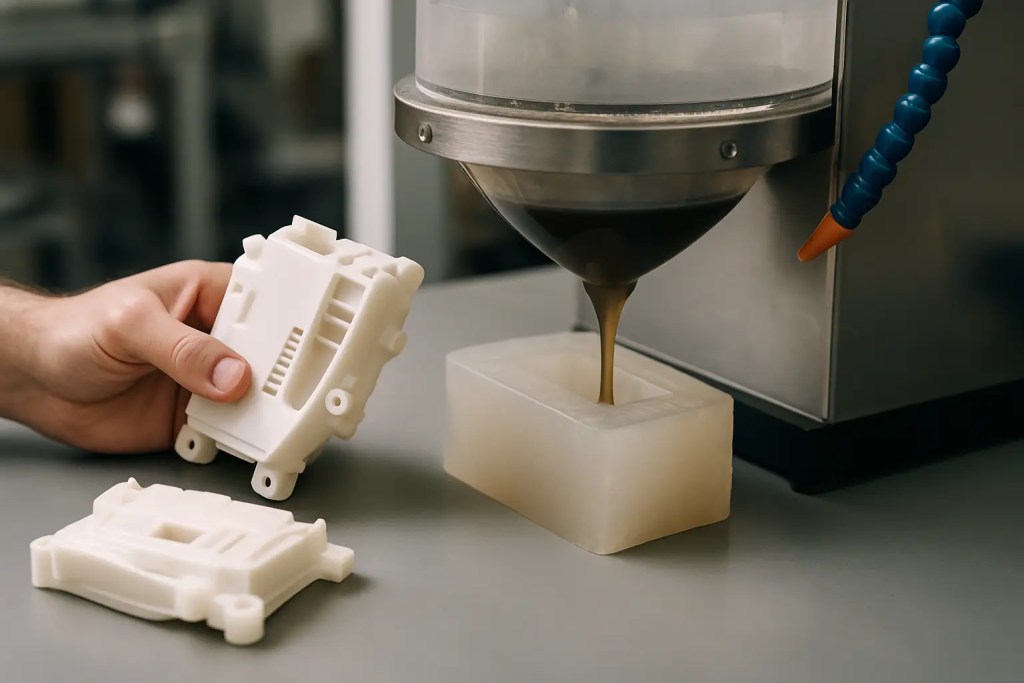
Vacuum (urethane) casting uses a master pattern (often 3D printed or CNC machined) to create a silicone mold. Liquid polyurethane resins are mixed and poured under vacuum to reduce trapped air and improve feature replication. After curing, you demold the part, repeat the pour, and run a short production batch until the mold reaches end of life.
The practical outcome is simple: you get consistent copies of a “golden” master with very good surface finish, fine detail reproduction, and a wide selection of resin behaviors that can mimic common thermoplastics.
That combination is why vacuum casting is not just “another prototyping method.” It is a short-run production process with real manufacturing intent.
When to use vacuum casting (and why it wins)
You need 10 to 200+ parts and they must match
One-off prototypes are usually faster in additive. But as soon as you need a small fleet of parts that must look and behave the same, the economics shift. Vacuum casting typically becomes attractive when the team needs tens of units for EVT/DVT builds, customer trials, service spares, sales samples, or pilot production.
The key advantage is repeatability from one mold cavity, produced from a single master. You are not tuning print orientation or chasing per-part surface variability across a print farm. You are copying a known geometry.
You need an injection-mold-like surface without injection tooling
For housings, covers, bezels, handles, and other user-facing components, surface drives perception. Vacuum casting can deliver smooth surfaces and sharp cosmetic detail straight out of the mold, and it takes post-processing well. If you need paint, texture, or color matching, cast urethanes are often easier to finish than porous or layered additive parts.
This is also where vacuum casting helps procurement and stakeholders. A pilot batch that looks like production reduces the risk of late design churn caused by “prototype artifacts” that were never part of the intended end state.
You need material behavior that 3D printing cannot easily match
Engineering teams often pick a process based on geometry and then get surprised by performance. Vacuum casting offers resin families that can mimic ABS-like toughness, PP-like flexibility, PC-like stiffness, rubber-like elastomers, and transparent grades for lenses or light guides.
No casting resin is a perfect substitute for a named injection polymer, but for functional testing, assemblies, snap features, and handling, it can be closer than many printed materials. This is especially useful when the design intent is “consumer plastic feel” rather than “prototype feel.”
You are validating design before committing to steel tooling
Injection molding is the right answer for high volumes, but it is an expensive commitment when the design is still evolving. Vacuum casting is commonly used to de-risk:
- Fit and stack-ups across multi-part assemblies
- Cosmetic expectations for customer-facing parts
- Fastener bosses, snap fits, and latching features
- Labeling, paint, and secondary operations
If the part passes functional and cosmetic validation in cast form, you commit to injection tooling with more confidence and fewer change requests.
You need complex geometries without split lines that drive redesign
Injection molding imposes draft, parting lines, and gating constraints. For early design phases, those rules can force changes you may not want to lock in yet. Vacuum casting still uses molds, but silicone tooling is more forgiving and can often accommodate challenging features and undercuts that would be expensive or impossible in hard tooling.
That flexibility is valuable when the primary goal is to test the product, not perfect the mold design.
When vacuum casting is not the right tool
Vacuum casting is powerful, but it is not a universal substitute.
You need high-volume economics or long-term dimensional stability
Silicone molds wear out. As a result, vacuum casting is inherently short-run. If you need thousands of parts, or you require tight tolerances across multiple lots over months, injection molding or CNC machining is typically more predictable. Urethane resins can also show different long-term behavior than the target thermoplastic, especially under heat, UV exposure, or chemical contact.
You need very tight tolerances without secondary operations
Vacuum casting can be accurate, but it is not usually chosen for micron-level precision. Silicone molds can flex slightly, and resin shrinkage varies by formulation and geometry. If the part interfaces with bearings, precision shafts, or sealing surfaces, CNC machining (or machining critical features after casting) is often safer.
Your geometry is dominated by thick sections
Large mass and thick walls can create heat during cure and drive local shrink or cosmetic defects. In these cases, redesigning for uniform wall thickness, adding ribs, or switching processes can reduce risk.
The decision point is not “can it be cast?” It is “can it be cast with repeatable outcomes across the entire batch?”
Vacuum casting vs 3D printing vs injection molding
The clearest way to choose is to compare what you are optimizing.
If you are optimizing for speed on a single part, 3D printing is usually the baseline. Processes like SLA can deliver high detail; SLS and HP Multi Jet Fusion can deliver durable nylon parts quickly; FDM is useful for large, simple fixtures.
If you are optimizing for appearance and uniformity across a short run, vacuum casting often wins. You avoid layer lines and the per-part variability that comes from changing orientation, support strategy, or machine-to-machine differences.
If you are optimizing for lowest unit cost at scale and true production polymers, injection molding is the endgame. Vacuum casting is what you use to prove the design before you pay for it.
In practice, many teams combine them: 3D print the master quickly, vacuum cast the pilot batch, then move to injection molding when the design is frozen.
Design and DFM considerations that prevent rework
Most vacuum casting issues are predictable at the CAD stage.
Wall thickness consistency matters. Uniform sections reduce cure-related distortion and improve cosmetic outcomes. Sharp internal corners can concentrate stress and may tear silicone during demolding, so radii are your friend.
Think early about where you can accept a parting line. Silicone tooling is flexible, but it still needs a split strategy, and cosmetic surfaces should be oriented accordingly.
Also plan for inserts or post-machining if you need durable threads or precise bores. Cast resins can take self-tapping screws, but if the part will be serviced repeatedly or torqued, metal inserts are often the more reliable design choice.
What to expect on lead time and workflow
A typical workflow starts with a master pattern, then silicone mold fabrication, then casting cycles.
The master quality sets the ceiling for the batch. If you need an A-surface, the master must have it. That is why many engineering teams choose high-resolution SLA for the master, then finish it to the cosmetic standard before molding.
Once the mold is built, cycle time becomes predictable. That predictability is the operational value: you can align a pilot build schedule, plan kitting, and ship a controlled set of parts to multiple sites without managing print queues or machining capacity across different vendors.
If you want a single supplier that can produce the master, build silicone tooling, cast the parts, and handle post-processing under a controlled quality system, Additive3D Asia runs vacuum casting alongside polymer and metal additive manufacturing and conventional processes, which simplifies handoffs when a project moves from prototype to production intent.
A practical decision check for engineers and procurement
If you are still unsure, the fastest way to decide is to frame the requirement in three questions.
First: do you need multiple identical parts with a production-like finish? If yes, vacuum casting is a strong candidate.
Second: are you still validating the design before tooling, or are you already locked for high-volume manufacturing? If you are still validating, vacuum casting buys you credible parts without long-term commitment.
Third: are the critical requirements cosmetic quality and realistic material feel, rather than maximum temperature, chemical resistance, or ultra-tight tolerances? If yes, vacuum casting aligns well. If no, you may be looking at CNC machining, metal additive, or true injection polymers.
Choosing vacuum casting is ultimately about risk management. It reduces the risk of making decisions based on prototype artifacts, and it reduces the risk of locking into expensive tooling before the product earns it.
If you are operating on real schedules – test builds, stakeholder demos, and pilot shipments – vacuum casting is less about “making parts” and more about keeping the program moving with parts that behave like the real thing.