
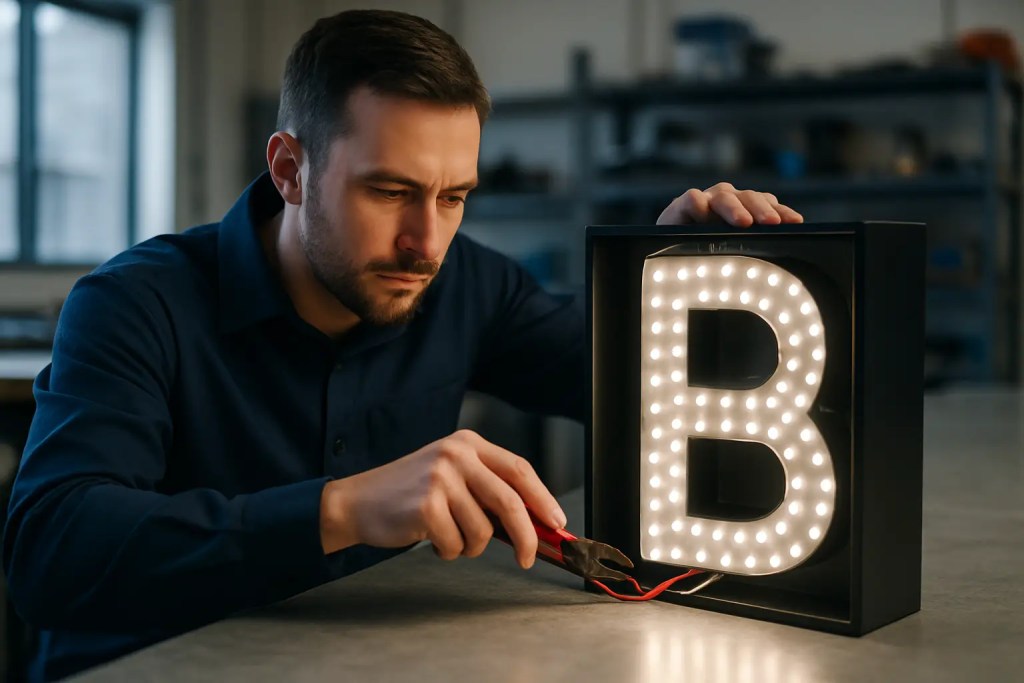
A backlit logo looks simple in a render. In production, it is a small system: optics, thermal management, environmental sealing, mounting strategy, wiring, and a cosmetic surface that has to stay consistent across multiple builds. If you are sourcing a led signage fabrication service, the fastest way to avoid rework is to treat the sign like a product, not a one-off graphic.
This guide is written for engineering and procurement teams who need predictable outcomes: repeatable color and brightness, parts that assemble without hand fitting, and a bill of materials that can survive revision control.
What a led signage fabrication service actually covers
A true led signage fabrication service is usually a bundle of mechanical fabrication plus integration steps. You are not just buying “a sign.” You are buying a housing, a diffuser stack-up, internal features for LED mounting, cable routing, and hardware that meets the install constraints.
Most projects break into three mechanical groups. First is the visible exterior: faceplates, returns, trims, and cosmetic bezels. Second is the internal structure: LED carriers, standoffs, brackets, heat spreaders, and cable guides. Third is the interface: wall mounts, studs, access panels, gaskets, strain relief, and serviceability features.
When a vendor only quotes the cosmetic shell, you inherit risk in the integration work. The better approach is to ask for clear boundaries: what is fabricated, what is assembled, what is tested (illumination uniformity, ingress protection checks, basic electrical verification), and what is left to your team.
Start with requirements that fabrication can actually control
LEDs are only part of what determines how the sign reads at 10 feet or 100 feet. Fabrication choices will influence optical performance, durability, and how hard the build is to reproduce.
Brightness and uniformity are where many programs fail. A diffuser that is too thin or too clear will telegraph hotspots, while an over-diffused face will look flat and underpowered. This is not solved by “more LEDs” alone because it increases heat and power density. Uniformity is controlled by diffuser material, diffuser thickness, standoff distance between LEDs and diffuser, internal reflectivity, and tight control of part geometry so the gap does not drift.
Outdoor durability forces different decisions than indoor branding. UV exposure, temperature cycling, and water ingress turn small design shortcuts into field failures. Sealing features, drainage strategy, and coating selection matter as much as the substrate.
Finally, serviceability is a real requirement. If the sign must be maintained from the front, you need access panels, fastener strategy, and wire routing that can be reworked without destroying the cosmetic surfaces.
Process selection for LED signage: what fits and why
Fabrication for LED signage typically mixes processes because no single method optimizes cosmetics, tolerance, and cost at every size.
CNC machining for precision interfaces
CNC is the reliable choice for parts that set alignment and stack-up: LED carrier plates, heat spreaders, mating flanges, and mounting brackets. If the sign has to locate onto studs, align multiple modules, or maintain a consistent diffuser gap, machined datums reduce surprises.
Trade-off: machined cosmetic shells get expensive quickly as surface area grows, and tool access can constrain internal geometry.
Sheet metal for structural housings
Sheet metal is efficient for medium-to-large housings, especially when stiffness and flatness are required. It also supports robust mounting features and can be powder coated for consistent finishes.
Trade-off: tight cosmetic radii, sculpted geometry, and complex internal light management features are harder in sheet metal without secondary operations.
Polymer 3D printing for geometry and iteration speed
Additive manufacturing is useful for LED signage in two places: rapid iteration of optical and mechanical features, and production of complex, low-volume geometries that would be costly to tool. SLS and HP Multi Jet Fusion (MJF) are strong options for functional polymer parts such as internal LED carriers, cable channels, or complex bracketry. SLA can be effective for high-detail lenses, light pipes, and small cosmetic elements where surface quality and fine features matter.
Trade-off: polymer prints can show surface texture (SLS/MJF) and may need post-processing for cosmetics. Also, material selection must account for heat near LED arrays and long-term UV exposure.
Casting and molding for repeatability at higher volumes
If the program moves from pilots to repeated builds, vacuum/urethane casting can bridge the gap before investing in injection tooling. For stable, high-volume runs, injection molding delivers repeatability and surface finish, but requires design for moldability and upfront tooling lead time.
Trade-off: every step toward tooling increases commitment. If branding or geometry is still changing, additive and machining remain safer.
Material choices that affect optics and longevity
Engineers often focus on LED binning and driver selection but underestimate what plastics and coatings do over time.
For diffusers, you are balancing transmission, haze, and long-term yellowing. Acrylic and polycarbonate are common, but the grade, UV stabilization, and thickness define performance. For housings, aluminum is a common baseline for outdoor applications because it is stable, easy to finish, and provides a thermal path. Stainless can be justified for harsh environments but adds weight and cost.
For 3D printed parts, PA12 and PA11 are common for durable polymer components. If the LEDs and drivers generate meaningful heat, you need to validate the thermal environment and ensure the polymer is not creeping or warping over time. If outdoor exposure is expected, plan for coatings or shielding because many polymers will degrade under UV without protection.
Tolerances and stack-ups: the hidden driver of uniform light
A sign that looks inconsistent across modules is often a tolerance problem, not an LED problem. Small variations in diffuser gap, internal rib height, or LED carrier flatness change the light field.
A fabrication partner should be able to discuss tolerances where they matter, and relax them where they do not. For example, holding tight datums on LED-to-diffuser standoffs can stabilize brightness, while cosmetic outer profiles may allow more variation if the edge is not a mating interface. If you are building modular letters, define a datum scheme so each module references the same surfaces during assembly.
Also consider thermal expansion. Large panels and long runs of aluminum or polymer will move. If you lock everything down without allowances, you can introduce stress, warpage, or gasket compression changes that affect sealing.
Finishing and graphics: where reliability meets brand
Finishing is not just aesthetics. It impacts corrosion resistance, cleanability, and how well the sign holds up under field handling.
Powder coating is common for metal housings because it is repeatable and durable, but it adds thickness and can affect fit if you do not account for it in the design. Anodizing provides a stable finish on aluminum but changes the visual appearance and may be less forgiving for certain color requirements.
For printed polymers, bead blasting, dyeing, painting, and clear coating can significantly change the final look and feel. If the sign includes translucent elements, verify that finishing does not change optical properties or introduce visible surface defects under backlighting.
If brand color is critical, treat color matching like an engineering requirement. Specify the standard, define acceptable delta, and insist on controlled sampling because different lots and finishes can shift appearance under different lighting temperatures.
What to ask a led signage fabrication service before you commit
You can usually predict project outcomes by asking a few operational questions.
First, ask how they validate illumination uniformity. A good vendor has a method, even if it is simple: test setup distance, camera settings, and acceptance criteria. Second, ask how they control revision changes and build documentation. LED signage often evolves during branding review, and uncontrolled changes lead to mismatched modules in the field.
Third, ask whether they can support mixed processes under one workflow. Many signs need printed internal features, machined interfaces, and sheet metal housings. Vendor fragmentation increases lead time and ambiguity around fit and responsibility.
Finally, ask what they consider high risk. The best suppliers will flag issues like thin translucent walls, insufficient diffuser distance, poor access for wiring, or sealing designs that are hard to manufacture consistently.
From prototype to repeat builds without re-quoting every time
A practical way to buy LED signage is to split the work into a development build and a controlled repeat build.
In the development phase, prioritize speed and learning. Use additive manufacturing and CNC where it reduces iteration cycles, and expect to adjust diffuser thickness, standoff distance, and internal reflectivity after you see real light output.
Once performance is stable, lock the features that drive uniformity and sealing, then optimize cost. That may mean moving brackets from CNC to sheet metal, converting printed parts to cast parts, or keeping additive manufacturing if volumes stay low and geometry complexity is high.
This is also where you should formalize acceptance criteria: dimensional checks at key datums, finish standards, and a basic functional test that is repeatable across shipments.
Where Additive3D Asia fits in a signage build
If your LED signage program benefits from combining fast iterations with production-ready processes, Additive3D Asia can serve as a single manufacturing partner across polymer and metal 3D printing plus CNC machining, sheet metal fabrication, and post-processing, under an ISO 9001:2015 quality system. The practical advantage is reduced handoffs: you can upload CAD (STEP/STL), get manufacturability feedback, and move from prototype assemblies to short-run production without rebuilding the supplier base. Learn more at https://www.additive3dasia.com.
A led signage fabrication service is easiest to manage when you treat the sign like a controlled product: define what “good” looks like in measurable terms, lock the few dimensions that drive optical performance, and choose processes that can repeat those decisions on schedule.