
A tooling decision made too early can lock in unnecessary cost. Made too late, it can delay launch. When teams evaluate injection molding vs urethane casting, the right answer usually comes down to volume, lead time, material requirements, and how much design change is still likely.
Both processes produce polymer parts with much better repeatability and finish than most prototype methods. But they serve different stages of the product lifecycle. Urethane casting is often the faster path for functional prototypes and low-volume runs. Injection molding becomes the stronger option when volumes rise, tolerances tighten across thousands of parts, and piece-price efficiency matters more than upfront tooling cost.
Injection molding vs urethane casting at a glance
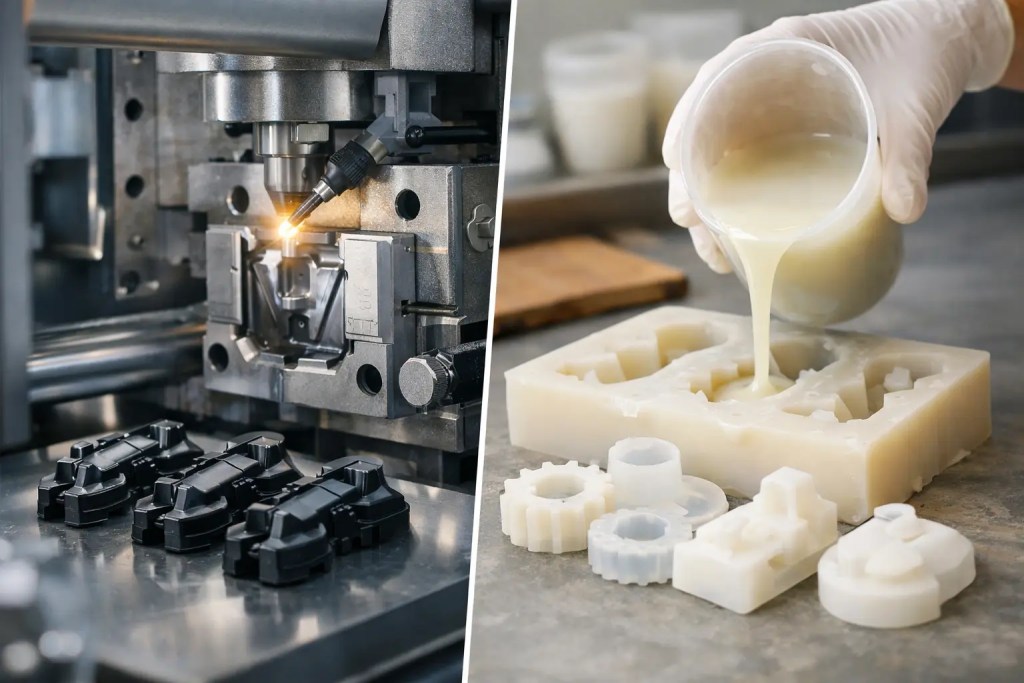
Injection molding uses a hard production tool, typically aluminum or steel, to inject molten thermoplastic into a cavity under pressure. It is built for repeatability, throughput, and consistent part quality over medium to high volumes. Once tooling is validated, cycle times are short and unit economics improve quickly.
Urethane casting, sometimes called vacuum casting, starts with a master pattern and a silicone mold. Liquid polyurethane resin is poured or injected into the mold, often under vacuum, to reduce air entrapment and improve surface quality. The process is suited to short runs, cosmetic prototypes, and bridge production where teams need parts quickly before committing to hard tooling.
At a high level, urethane casting reduces time and upfront investment. Injection molding reduces unit cost at scale and gives access to true production thermoplastics. That sounds simple, but the trade-offs are more specific than that.
How the processes differ in practice
Tooling and startup cost
The biggest dividing line is tooling. Injection molding requires a machined mold designed around gate location, shrink behavior, ejection, draft, and cooling. Even for relatively simple geometries, this is a meaningful capital expense. If the design changes after tool release, rework can add cost and time.
Urethane casting uses silicone molds made from a master model, often produced by SLA or CNC. Tooling is far less expensive and much faster to create. That makes it a practical choice when the design is not fully frozen or when stakeholders need market-test units, engineering samples, or pilot-run parts without the commitment of a metal mold.
Lead time
If speed to first parts is the target, urethane casting usually wins. A silicone mold can be produced in days, and parts can follow shortly after. For teams moving through validation, industrial design approval, or customer sampling, that shorter startup time can remove weeks from the schedule.
Injection molding has a longer front-end timeline because the mold must be designed, machined, assembled, and trialed. However, once the process is running, it produces parts far faster than urethane casting. So the lead-time question depends on whether you are measuring time to first article or time to hundreds or thousands of parts.
Volume and cost per part
For low quantities, urethane casting is typically more economical overall because there is little tooling burden to absorb. That advantage narrows as order quantity increases. Silicone molds wear out relatively quickly, and cycle efficiency is lower, so part cost stays comparatively high.
Injection molding works the opposite way. The initial investment is higher, but the cost per part drops as volume increases. For recurring demand, this usually becomes the more cost-effective process. The exact crossover point varies by geometry, material, tolerances, and mold complexity, so it should be evaluated case by case rather than assumed from a generic threshold.
Material differences matter more than many teams expect
One of the most common mistakes in injection molding vs urethane casting decisions is treating the materials as roughly equivalent. They are not.
Injection molding uses production thermoplastics such as ABS, polypropylene, nylon, polycarbonate, POM, and many filled or certified grades. If your application depends on a known resin data sheet, long-term wear performance, regulatory compliance, heat resistance, or chemical resistance, injection molding has a clear advantage.
Urethane casting uses polyurethane systems formulated to simulate some properties of production plastics. Some cast resins can mimic ABS-like stiffness, rubber-like flexibility, or transparent appearance, but they are still cast urethanes, not identical substitutes for molded engineering polymers. For fit checks, appearance models, and many functional prototypes, that is acceptable. For demanding end-use environments, it may not be.
This distinction is especially important for parts exposed to UV, elevated temperatures, repeated mechanical load, or aggressive fluids. If the part will be used for validation testing, make sure the selected process produces material behavior that is close enough to the final application to support reliable decisions.
Surface finish, detail, and consistency
Urethane casting can produce excellent cosmetic surfaces, especially when the master pattern is well finished. It is a strong option for show models, enclosure prototypes, and parts that need near-production appearance in small quantities. Color matching and transparent or tinted effects are also possible, though they may vary slightly from batch to batch.
Injection molding offers more stable repeatability over longer runs. Surface finish is defined by the metal tool and maintained consistently as the tool produces more parts. Texture, gloss, and feature replication are generally more controlled once the process window is established.
Part-to-part consistency is where injection molding becomes difficult to ignore for production programs. Urethane casting can deliver high-quality parts, but silicone mold wear and manual process variation can gradually affect outcomes. If your project requires thousands of identical components with documented process control, injection molding is better aligned with that requirement.
Tolerances and design constraints
Both processes have design rules, but they fail differently.
Injection molding requires proper draft, wall thickness control, rib design, gate strategy, and attention to sink, warpage, and knit lines. Designing for molding early prevents expensive tool changes later. When engineered correctly, it supports repeatable tolerances and stable output over long production runs.
Urethane casting is more forgiving in the early stages. It can reproduce complex geometry from a good master pattern without the same level of tooling engineering. That flexibility is useful during development. Still, silicone molds are less dimensionally stable than metal tools, and shrink behavior can vary by resin system. If a component has tight tolerance interfaces, sealing features, or critical snap fits, those details need careful review before relying on cast parts.
When urethane casting is the better choice
Urethane casting is usually the right fit when a program is still moving. If you need 10 to 50 parts for functional review, investor samples, customer pilots, or pre-production builds, the lower startup cost and shorter lead time are hard to beat.
It is also a good bridge between additive manufacturing and mass production. Teams often use 3D printing to prove geometry, then urethane casting to obtain higher-quality small batches for testing or limited deployment. That staged approach keeps iteration fast while postponing the cost of a hard tool until the design is stable.
For hardware startups and R&D teams, this can be the most practical path. It preserves capital, reduces procurement friction, and gives engineers real parts to evaluate before production tooling is locked.
When injection molding is the better choice
Injection molding is the stronger option when demand is known, the design is frozen, and the part must perform as a true production component. If you are planning repeat orders, need certified or application-specific thermoplastics, or require consistent quality across larger quantities, the economics and process control justify the tooling investment.
It also becomes the better decision when quality documentation, repeatability, and long-term supply planning matter. Procurement teams generally prefer a process that can scale predictably rather than one that must be reconsidered every time volume increases.
For parts moving into commercial release, this often shifts the question from Can urethane casting make the part to Should it be the long-term process. Those are not the same thing.
A practical way to decide
If your design is still changing, start with urethane casting. If your annual volume is rising and material performance is critical, move toward injection molding. If you are between those points, compare total cost, not just quoted part price.
That comparison should include tooling amortization, expected design revisions, lead time to first acceptable parts, material risk, cosmetic requirements, and the operational cost of supplier changes later. A reliable manufacturing partner should be able to review your CAD, flag features that may create molding issues, and recommend whether bridge production makes sense before hard tooling begins.
At Additive3D Asia, that process-led approach matters because the right answer is rarely just about manufacturing capability. It is about choosing the process that matches the current maturity of the product, the target volume, and the quality requirements without creating avoidable delays or rework.
The best manufacturing decision is not the one with the lowest upfront price. It is the one that keeps your program moving with the fewest surprises.