
A polished prototype can still fail a program if the process choice is wrong. That is the real question behind sla vs urethane casting: not which method is better in general, but which one gives your team the right balance of speed, finish, repeatability, and unit economics for the stage you are in.
For engineering teams, the decision usually shows up when appearance matters, timelines are compressed, and the next step after prototyping is still uncertain. Both processes can produce high-quality polymer parts with fine detail and strong visual appeal. The differences emerge in how those parts are made, how they scale, and how predictable they remain across a batch.
SLA vs urethane casting: the process difference
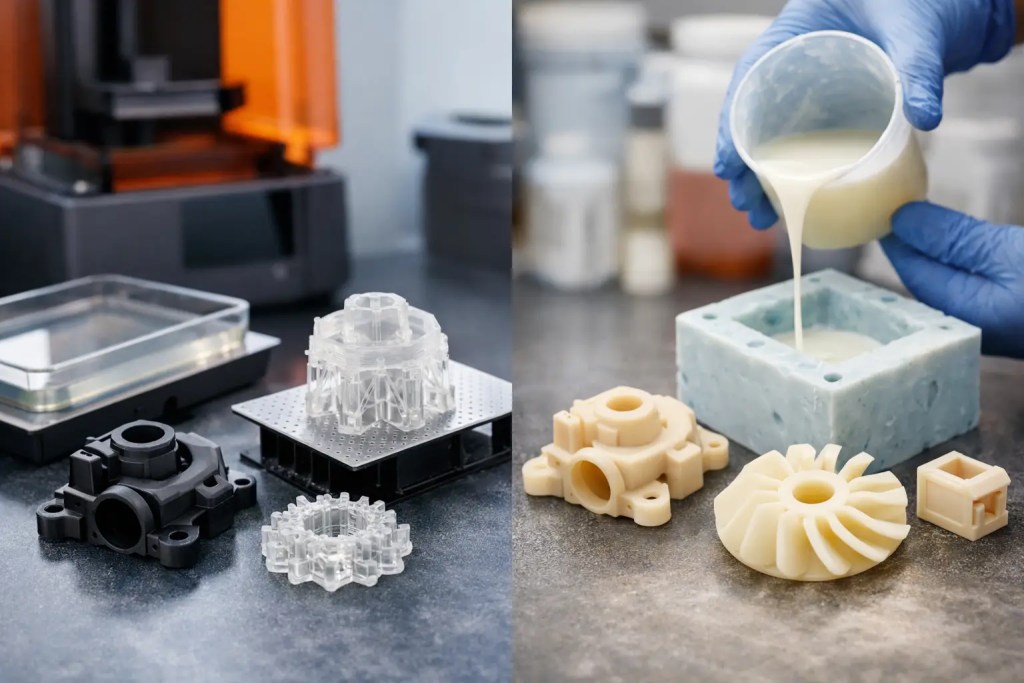
SLA, or stereolithography, builds a part layer by layer by curing liquid photopolymer resin with a light source. It is a direct digital process. You prepare the CAD file, orient the model, print the part, remove supports, and complete post-curing and finishing. There is no mold, so design changes are relatively fast to implement.
Urethane casting starts differently. A master pattern is created first, often by CNC machining or high-resolution 3D printing such as SLA. That master is used to make a silicone mold. Polyurethane resin is then poured or vacuum-cast into the mold to create production parts. Because the mold is sacrificial and has a limited life, this process sits between prototyping and hard-tooling production.
That difference matters operationally. SLA is usually faster for one-off parts and early iterations. Urethane casting makes more sense when you need multiple parts with consistent appearance and material behavior, but not enough volume to justify injection molding.
When SLA is the stronger choice
SLA is commonly the fastest route when your team needs a precise visual prototype, a fit-check model, or a low-quantity functional part with fine features. Since there is no mold to create, the setup burden stays low. If your design changes every two days, that speed matters more than per-unit optimization.
SLA also performs well for parts with complex geometry, enclosed features, embossed text, and surfaces that need a clean cosmetic starting point. Good process control can deliver excellent dimensional accuracy and sharp detail, which is why the method is widely used for housings, medical enclosures, concept models, and presentation-grade prototypes.
The trade-off is material behavior. SLA resins can look excellent, but they do not always behave like production thermoplastics. Some are brittle, some are UV-sensitive over time, and some are best suited to validation work rather than repeated field use. There are engineering-grade resins with better toughness, heat resistance, or flexibility, but material selection still requires care.
Another point is scale. Printing one SLA part is efficient. Printing fifty may still be feasible, but that does not mean it is the most economical route. As quantities rise, labor, finishing time, and machine allocation can shift the cost equation.
Where urethane casting gains an advantage
Urethane casting is often the better fit when the prototype phase is stabilizing and the business needs short-run production parts. That may mean ten units for executive review, fifty units for pilot deployment, or a few hundred housings for market testing. In that range, casting can offer better batch consistency and lower unit cost than repeatedly printing individual SLA parts.
It also provides broader flexibility in material feel and end-use similarity. Polyurethane systems can be selected to simulate ABS, PP, rubber-like elastomers, and transparent materials more closely than many standard SLA resins. For teams validating customer touchpoints, assembly force, overmold-like softness, or color and finish in a near-production context, that is a major benefit.
The surface finish can be excellent because each cast part reproduces the mold surface. If the master pattern is well-finished, the resulting parts can look close to molded components. Pigmented resins can also support color-matched parts without painting in some cases, which reduces secondary work.
The limitation is that urethane casting is not tooling-free. You need the master and the silicone mold first. That adds upfront time and cost. It also means every design revision can trigger a new mold cycle. If geometry is still changing frequently, casting becomes less efficient.
Cost is not just about the quote
In sla vs urethane casting decisions, teams often compare only the initial quote. That is rarely enough.
For one to five parts, SLA is usually more cost-effective because there is no mold cost to absorb. You send the file, print the part, finish it, and move on. The economics are straightforward.
With urethane casting, the first few parts carry the burden of master creation and mold fabrication. That makes the startup cost higher. Once the mold exists, however, each additional part becomes less expensive relative to repeating the same SLA print and finishing cycle.
This is why quantity matters, but so does design stability. A cast program with three rounds of engineering changes can erase its cost advantage quickly. On the other hand, a frozen design with a forecast of thirty to one hundred units can shift strongly in favor of casting.
Procurement teams should also consider hidden costs. If your program requires painted finishes, threaded inserts, overmold simulation, or cosmetic consistency across a batch, urethane casting may reduce manual rework. If your priority is immediate turnaround with minimal setup, SLA often wins even if the per-part price looks higher on paper.
Accuracy, finish, and repeatability
SLA has a strong reputation for fine detail and tight tolerances, especially for small to medium parts. It is often the better choice for intricate geometries, clear edges, and features that need to be checked directly against CAD. Proper orientation and support strategy still matter, and post-processing can affect final dimensions, but the process is highly capable for precision prototype work.
Urethane casting depends on the quality of the master and the mold. A well-made master can produce excellent visual consistency, yet silicone molds can wear over repeated cycles. That means dimensional repeatability may shift slightly from the first cast to the last, especially on demanding geometries or thin walls.
For appearance-focused parts, casting often has the edge in batch uniformity. For single-part precision and rapid revision loops, SLA is usually the more controlled option. Neither process replaces production injection molding when the requirement is very high-volume statistical process control, but both serve an important role before hard tooling makes sense.
Lead time and program speed
If your team needs parts this week and the design is still moving, SLA is typically the fastest path. It fits compressed development cycles because there is no intermediate tooling step. A CAD update can move directly into production.
Urethane casting becomes competitive when the design is stable enough to justify mold creation. The first delivery usually takes longer because of the master and silicone tooling workflow. After that, producing multiple units can be faster and more efficient than queueing repeated SLA builds and finishing operations.
This distinction matters for launch planning. Early R&D favors digital processes. Pilot builds, sales samples, and controlled pre-production runs often favor casting.
A practical way to decide
If you are choosing between the two, start with three questions. First, how many parts do you need now, not eventually? Second, how stable is the design? Third, do the parts need to look like prototypes or behave like near-production components?
Choose SLA when quantity is low, geometry is changing, and speed to first article is the top priority. It is especially effective for form and fit validation, cosmetic models, and engineering reviews.
Choose urethane casting when quantity is moderate, the design is largely frozen, and you need better batch consistency, production-like materials, or a more realistic bridge to injection molding. It is often the stronger option for pilot runs, customer samples, and low-volume commercial parts.
In practice, many programs use both. SLA generates the master pattern, validates geometry, and shortens the early iteration cycle. Once the design is approved, urethane casting takes over for short-run production. That handoff is efficient because it aligns process choice with program maturity instead of forcing one technology to cover every stage.
For teams managing development risk, that is usually the right mindset. Process selection is not about loyalty to a machine category. It is about choosing the manufacturing route that gives you dependable parts, controlled cost, and the fewest surprises at the next decision gate. If you frame sla vs urethane casting that way, the better option usually becomes clear before the first part is even built.