
If you need 20 parts next week, injection molding is usually the wrong place to start. If you need 20,000 parts with stable unit economics, vacuum casting is usually the wrong place to stay. That is the practical reality behind vacuum casting vs injection molding – two processes that can produce similar-looking plastic parts, but with very different cost structures, lead times, and production intent.
For engineers and sourcing teams, the decision is rarely about which process is “better.” It is about matching the process to the stage of the product, the expected volume, the material requirements, and the risk you can afford in the timeline. A process that is efficient for validation can become expensive in production, while a process built for scale can slow down a program if used too early.
Vacuum casting vs injection molding: the core difference
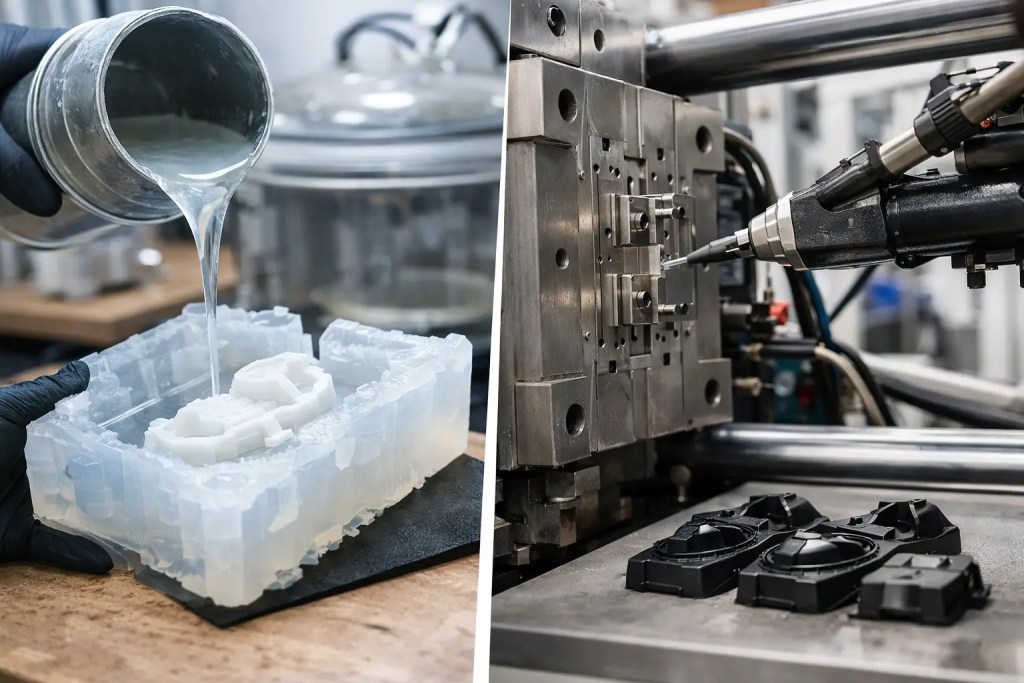
Vacuum casting is a low-volume manufacturing process that uses a master pattern and silicone mold to produce polyurethane parts. It is typically chosen for prototypes, pilot builds, sales samples, and short production runs where appearance and functional testing both matter. Tooling is fast and relatively low cost, but mold life is limited.
Injection molding uses a machined metal tool, usually aluminum or steel, to inject thermoplastic resin under pressure. It requires higher upfront investment and longer setup time, but once the mold is ready, it delivers repeatable parts at high volume with low per-part cost.
The simplest way to frame vacuum casting vs injection molding is this: vacuum casting reduces entry cost and accelerates early production, while injection molding rewards volume with consistency and scale.
Where vacuum casting makes more sense
Vacuum casting is often the better choice when a design is still moving. If your team expects geometry changes after initial fit checks, user testing, or pilot feedback, committing to hardened injection molding tooling too early can lock cost into the wrong revision.
Because silicone tooling can be produced quickly from a master pattern, vacuum casting supports fast iteration. It is especially useful when you need parts that look close to final production quality, including smooth surfaces, transparent options, soft-touch materials, or overmold-like effects. For investor samples, product demos, enclosure validation, and limited pre-launch builds, that flexibility matters.
The economics also favor vacuum casting at low quantities. You avoid the larger upfront tooling expense, which makes it easier to justify short runs. That is why many hardware teams use it in the space between 3D printing and mass production.
There are limits. Silicone molds wear out, so part-to-part consistency will not match a well-built injection mold over long runs. Material choices are also based on castable polyurethane systems designed to simulate production plastics, not always the exact thermoplastic grade you would use later. If your program depends on final resin certification, high thermal loads, or very tight process capability across thousands of parts, vacuum casting starts to lose ground.
Where injection molding wins
Injection molding is the right answer when the product design is stable and demand is real. Once you move into recurring production, the high tool cost is amortized across many parts, and the unit price drops sharply. That changes the total cost picture fast.
It also provides better repeatability. Metal tooling holds geometry more consistently over higher volumes, and production controls around pressure, cooling, and cycle time can be tuned for predictable output. For consumer products, medical housings, industrial enclosures, and components that need traceable, repeatable production, this matters more than the initial setup burden.
Another advantage is access to true production thermoplastics. Injection molding supports a broad resin ecosystem, including ABS, PC, PP, nylon, TPE, and filled engineering grades. If your part needs a specific heat deflection temperature, chemical resistance profile, UL rating, or long-term mechanical behavior, injection molding gives you a more direct path to the target material.
The trade-off is timing and commitment. Tool design, DFM review, machining, T1 sampling, and revision loops all take time. If the CAD is still shifting or your demand forecast is uncertain, injection molding can introduce cost before the program has earned it.
Cost is not just tooling vs unit price
Many teams compare the two processes using only upfront tooling cost. That is too narrow.
Vacuum casting is cheaper to start, but the per-part cost stays relatively high because mold life is limited and production is more manual. Injection molding is expensive to launch, but highly efficient once volumes increase. The break-even point depends on part size, complexity, resin choice, finish requirements, and annual demand.
A simple housing at 50 units may clearly favor vacuum casting. The same housing at 5,000 units almost certainly favors injection molding. Between those points, the answer depends on how many design changes are still likely and whether the parts are for validation or sellable production.
There is also the cost of delay. If waiting for injection mold tooling pushes testing, customer approval, or launch dates, the “cheaper” unit economics may not help the broader business case. For many teams, speed to usable parts has measurable value.
Lead time and program risk
Lead time is often the deciding factor in vacuum casting vs injection molding.
Vacuum casting can move quickly because the tooling route is simpler. Once a master is prepared, silicone molds can be made fast, and parts can follow shortly after. That makes it useful for bridge production when your product cannot wait for hard tooling.
Injection molding has a longer front-loaded timeline. Even with efficient toolmaking, you still need mold design, machining, trial shots, and approval cycles. The reward is better throughput later, but the early schedule is less forgiving.
Risk follows the same pattern. Vacuum casting lowers risk during development because modifications are easier and less expensive. Injection molding lowers risk in scaled production because the process is more stable once qualified. Early-stage teams usually need flexibility. Mature programs usually need control.
Material and quality considerations
This is where decisions need engineering discipline rather than visual comparison.
Vacuum cast parts can look excellent and often perform well enough for fit, form, and many functional tests. But material data is not always equivalent to a molded engineering thermoplastic. If your part must survive repeated mechanical loading, elevated temperatures, chemical exposure, or regulatory validation, simulated material properties may not be enough.
Injection molded parts are generally the better choice for final-use performance validation because they use the intended resin and production process. That improves confidence in test data and production transfer.
Quality expectations should also be set correctly. Vacuum casting can achieve very good surface finish and fine detail, especially for low-volume aesthetic parts. Injection molding is stronger on repeatability, gate-controlled filling, and long-run consistency. If your quality plan emphasizes process capability, repeatable tolerances, and documented production control, injection molding aligns more naturally.
A practical selection framework
If the design is still changing, volumes are low, and you need parts quickly for pilot use, vacuum casting is usually the more efficient route. If the design is frozen, the annual demand is established, and the material must match final production resin, injection molding is usually the better investment.
For many products, the smartest approach is not choosing one forever. It is sequencing both correctly. Teams often use 3D printing for early concept and geometry checks, vacuum casting for appearance-quality prototypes and short runs, then injection molding once the design and demand justify hard tooling. That staged approach reduces waste and keeps procurement aligned with product maturity.
A manufacturing partner with both additive and conventional capabilities can help make that handoff cleaner because the recommendation starts with your part requirements, not with a single process trying to fit every job. At Additive3D Asia, that process selection logic is part of the value – moving from prototype to production with the right method at the right time, under an ISO 9001:2015 quality framework.
The best process is the one that fits the current decision, not the final destination. If you treat manufacturing as a sequence of gates rather than a single commitment, you usually get to production faster with fewer expensive corrections.