
A prototype that worked in testing can still fail at handoff to production. The usual problem is not the part geometry. It is choosing the wrong manufacturing process for the next 500 to 10,000 units. Short run injection molding sits in that gap between prototyping and full-scale tooling, where unit economics, lead time, and repeatability all matter at the same time.
For engineering and procurement teams, this is rarely a simple cost comparison. The right decision depends on how stable the design is, how many parts are needed, what material performance is required, and how much risk the schedule can tolerate. Short run injection molding is valuable because it gives teams access to production-grade thermoplastics and consistent part-to-part output without committing too early to high-volume tooling.
What short run injection molding is really for
Short run injection molding is a low-volume molding approach designed for pilot production, bridge manufacturing, market validation, and early commercial launch. In practice, that usually means producing enough parts to support assembly builds, customer shipments, regulatory testing, or initial sales before demand is proven.
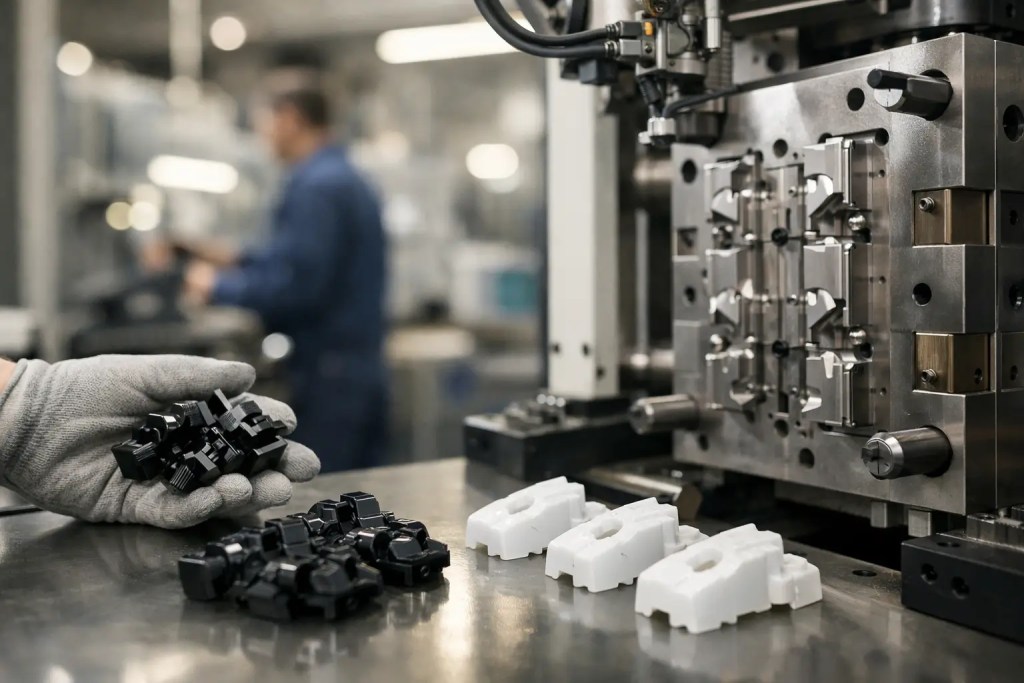
The main advantage is that it moves a part closer to its final production state. Unlike many prototype processes, molding uses the actual thermoplastic family, actual gate strategy, and actual cooling behavior that will influence the final part. That matters when you need reliable data on fit, function, snap features, sealing surfaces, or cosmetic consistency.
This is also why short run molding often becomes a bridge process. A team may begin with additive manufacturing for early design iterations, shift to molding for a few hundred or a few thousand parts, and only later invest in hardened production tooling once geometry and demand are more stable. That phased approach reduces capital exposure while keeping the launch moving.
Where short run injection molding fits in the product lifecycle
The best use case is not simply “low volume.” It is low volume with production intent. If a part needs to behave like a molded part in the field, this process deserves serious consideration.
Pilot builds and validation runs
Before a product reaches full release, teams often need functional units built under realistic manufacturing conditions. Pilot runs help validate assembly time, packaging, field performance, and serviceability. If those units are made with a process that behaves differently than final production, the test data can be misleading. Short run injection molding helps close that gap.
Bridge production during scale-up
Tooling for mass production can take time, especially if the part requires multiple cavities, cosmetic tuning, or secondary operations. A short run tool can keep shipments moving while the long-term production tool is being finalized. That is often the difference between hitting a launch window and missing it.
Low-volume end-use parts
Some parts never justify high-volume tooling at all. Industrial equipment spares, specialized housings, service parts, and regional product variants may have stable but modest demand. In those cases, short run injection molding can be the most practical long-term manufacturing method.
The trade-offs engineers should evaluate
Short run molding is not automatically the cheapest or fastest option. It performs best when the part and volume align with the process.
Tooling cost is the first trade-off. Even a lower-cost aluminum tool is still a tooling commitment, so it makes less sense for parts that are likely to change after the next test cycle. If CAD is still moving every week, additive manufacturing or urethane casting may preserve more flexibility.
Lead time is the second trade-off. Once the tool is built, molded parts can be highly efficient. But the upfront timeline for tool design, machining, sampling, and adjustment still exists. If a team needs parts in days rather than weeks, molding may not be the right first move.
The third trade-off is design discipline. Molding rewards good part design and punishes shortcuts. Draft, wall thickness, gate location, ejector placement, knit lines, sink risk, and shrink behavior all affect results. A part that looked acceptable as a printed prototype may need engineering changes before it becomes moldable and repeatable.
How short run injection molding compares with other processes
The strongest process decisions come from comparing manufacturing methods by outcome, not by habit.
Versus 3D printing
3D printing is usually the faster option for early prototypes and design iteration. It avoids tooling, supports fast revisions, and can produce complex geometry quickly. For jigs, fixtures, concept models, and low-quantity functional parts, it often wins on speed and flexibility.
Short run injection molding becomes more attractive when you need tighter consistency across a larger batch, better economics at repeated quantities, or production thermoplastics with molded surface quality. It is also a better fit when the part’s final use depends on molded behavior rather than printed behavior.
Versus urethane casting
Urethane casting is useful for cosmetic prototypes and small-volume parts when teams need better surface finish and material options than basic prototyping can provide. It is often a practical step before tooling.
However, cast materials do not always match the performance profile of true production thermoplastics. For parts that need stronger material traceability, more stable repeatability, or a clearer path to production conditions, short run injection molding is usually the stronger option.
Versus full production tooling
High-volume tooling delivers the lowest unit cost at scale, but it requires greater upfront investment and a higher level of design confidence. If volume is still uncertain or product revisions are still likely, that investment can arrive too early.
Short run tooling reduces that exposure. It gives teams a way to produce saleable parts while learning from real-world demand and product feedback. The trade-off is that per-part cost may remain higher than a mature high-volume mold program.
Design considerations that affect success
Short run injection molding works best when manufacturability is addressed before the tool is cut. That sounds obvious, but many schedule slips begin with prototype geometry being pushed into tooling without enough process review.
Wall thickness should be as uniform as possible to reduce sink, warpage, and uneven cooling. Sharp internal corners should be relieved with radii where performance allows. Draft should be built in early rather than added later as a compromise. Small undercuts may be possible, but each one introduces complexity, cost, or cycle-time impact.
Material choice also needs to be tied to function, not just availability. A housing for indoor electronics may have very different requirements than a clip, latch, or enclosure exposed to heat, chemicals, or impact loading. Resin selection should account for stiffness, elongation, thermal resistance, flammability needs, and cosmetic expectations. If the part will move into larger-scale production later, selecting a material family with a clear supply path is also prudent.
Tolerance planning matters as well. Molding can achieve repeatable dimensions, but not every feature should be held to the same standard. Critical interfaces should be identified clearly, and noncritical surfaces should allow realistic processing variation. That reduces both tooling complexity and unnecessary inspection burden.
What a reliable supplier should bring to the project
For short run programs, capability breadth matters because process choice is often part of the engineering problem. A supplier that only offers molding will naturally try to solve every problem with molding. A partner with additive, machining, casting, and molding under one quality system can make a better recommendation based on geometry, quantity, material, and timeline.
That is especially useful when a project is still transitioning from prototype to production. One part may be ready for molding, while another is better produced by MJF, CNC machining, or urethane casting for the current phase. A mixed-process approach can protect schedule without forcing premature tooling decisions.
Quality systems are equally important. For engineering and procurement teams, ISO 9001:2015 certification is not just a marketing line. It signals documented workflows, traceability, controlled inspection practices, and a repeatable production framework. On low-volume industrial projects, that discipline often matters more than chasing the lowest quote.
At Additive3D Asia, this is where the value of an integrated digital manufacturing platform becomes practical. Teams can move from prototyping to short-run production using the same operational partner, with manufacturability guidance, process selection support, and globally shipped parts from a controlled production environment.
The right question is not “Is molding cheaper?”
The better question is whether molding reduces overall project risk. If the answer is yes, the tooling cost often makes sense.
For some programs, the risk is technical. You need molded parts to verify snap-fit behavior, assembly repeatability, or environmental performance. For others, the risk is commercial. You need enough production-quality parts to launch, but not enough certainty to commit to hardened tooling. In both cases, short run injection molding is less about low volume and more about making the next production step with control.
If your team is deciding between printing more prototypes and building a tool, pause and look at what the next batch actually needs to prove. That usually points to the right process faster than any unit-price spreadsheet.