
SS316L metal 3D printing is usually considered when a machined stainless part starts creating bottlenecks – long lead times, high setup cost for low volumes, or geometry that is expensive to produce conventionally. For engineering teams, the real question is not whether 316L can be printed. It is whether the printed route will meet mechanical, corrosion, dimensional, and commercial requirements with enough repeatability to justify production.
That is where process selection matters. With metal laser powder bed fusion, often specified as selective laser melting, SS316L can move beyond concept models into functional prototypes, jigs, fixtures, and end-use components. The material is familiar, but printed performance depends on orientation, wall thickness, support strategy, post-processing, and inspection discipline.
Why SS316L metal 3D printing is widely specified
316L is already a standard engineering stainless steel for good reasons. It offers strong corrosion resistance, good toughness, and stable performance across a broad range of industrial environments. The low-carbon chemistry helps reduce the risk of sensitization, which supports welded and thermally processed applications.
In additive manufacturing, those same traits make SS316L a practical entry point for metal parts that need more than visual validation. It is commonly selected for brackets, manifolds, custom tooling, surgical or laboratory hardware, and replacement components where designers want stainless steel performance without the restrictions of subtractive manufacturing.
The key advantage is not simply that the alloy can be printed. It is that geometry can be consolidated. A multi-part assembly may become a single component. Internal channels that are difficult to drill may become manufacturable. Weight can be reduced through lattice or topology-optimized features while preserving structural intent.
That said, the best results come when geometry is designed for additive rather than copied directly from a machined part. Printing an existing CNC design in SS316L may work, but it often fails to capture the cost and performance advantages that justify additive in the first place.
What engineers should expect from the process
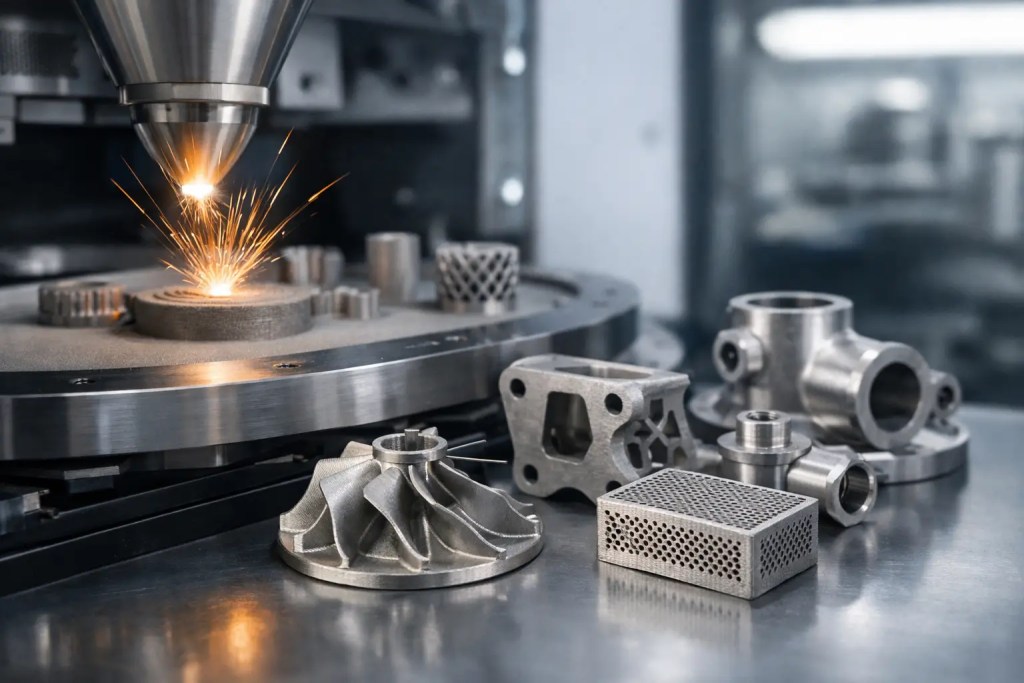
SS316L metal 3D printing generally uses fine stainless powder fused layer by layer with a laser in an inert environment. This enables high feature resolution and dense parts, but it also introduces process realities that affect outcomes.
First, thermal behavior drives part quality. Local heat input, scan strategy, and geometry all influence residual stress, distortion, and support requirements. Long flat sections may warp if unsupported. Thin walls can be produced, but they require careful evaluation against part height and surrounding features. Heavy sections next to fine details may create uneven thermal conditions that complicate print stability.
Second, surface finish is functional but not automatically cosmetic. As-printed SS316L surfaces are typically suitable for many industrial uses, especially hidden or internal features, but sealing faces, sliding interfaces, or customer-facing surfaces may require machining, blasting, polishing, or other secondary finishing.
Third, tolerances should be specified with manufacturing intent. Additive can achieve strong dimensional control, but critical fits often benefit from machining stock on selected features. Threads, bearing seats, and gasket surfaces are common examples. A hybrid strategy is often the most reliable approach – print the complex geometry, then machine the critical interfaces.
Where SS316L performs best
The strongest use cases are the ones where material performance and geometric freedom matter at the same time. For prototyping, SS316L is valuable when polymer models are no longer enough and the team needs to validate load, heat, chemical exposure, or installation behavior in the actual metal.
For tooling and factory support hardware, the material is often used for custom fixtures, grippers, guides, and inspection aids. Stainless steel is a practical choice in production environments that involve moisture, cleaning chemicals, or repeated handling. Additive also helps when the tool must fit around a difficult assembly path or integrate multiple functions into one body.
For end-use parts, the business case improves when production quantities are low to medium, design revisions are still likely, or internal features create major machining cost. Fluid-handling components are a common example. If a part benefits from integrated channels, reduced assembly steps, or custom routing, additive may reduce both part count and procurement complexity.
Medical, laboratory, food-adjacent, and industrial equipment teams also look at SS316L when corrosion resistance and cleanliness matter. The exact suitability depends on geometry, surface condition, and finishing requirements, so application review should be grounded in performance criteria rather than alloy name alone.
Design rules that change the result
A reliable SS316L part is usually designed with the process in mind from the beginning. Orientation is one of the biggest decisions because it affects support contact, surface quality, distortion risk, and build time. A favorable orientation may reduce supports on critical surfaces and improve consistency, but it might increase height and therefore print cost. There is rarely a single perfect answer.
Wall thickness also needs discipline. Very thin features may be printable, but they are more sensitive to heat buildup, damage during support removal, and variation after finishing. Heavier walls improve stability, yet they add cost and can increase residual stress if not managed correctly.
Internal channels deserve early review. Additive makes them possible, not automatic. Channel diameter, shape, powder removal access, and support-free design all matter. If trapped powder cannot be evacuated, the feature may not be usable. If the channel geometry causes unsupported overhangs, quality may degrade. Engineers get the best results when internal flow paths are designed with both printability and cleaning access in mind.
This is where an engineering-led manufacturing workflow makes a difference. A supplier that reviews STL or STEP files for manufacturability before release can prevent avoidable redesign loops and reduce the risk of late-stage surprises.
Post-processing is part of the plan, not an afterthought
Printed metal parts rarely leave the machine and go straight into service. Support removal, stress relief, surface finishing, machining, and inspection are part of the production route. For SS316L, these steps strongly influence final performance.
Stress relief helps stabilize the part after printing. Support removal must be controlled so that critical surfaces are not damaged. Surface finishing improves roughness, appearance, and, in some applications, cleanability or corrosion behavior. Machining brings interfaces into tighter tolerance where needed.
This is also where production discipline separates sample success from repeatable delivery. If a part requires the same post-processing path every time, that route should be documented and controlled like any other manufacturing process. For teams sourcing externally, it is more efficient to work with a partner that can manage metal printing, machining, and finishing under one quality system rather than handing parts between multiple vendors.
When SS316L metal 3D printing is the wrong choice
Not every stainless part should be printed. If geometry is simple, volumes are high, and machining or casting already delivers the target cost and lead time, additive may not improve the outcome. The same applies when cosmetic finish expectations are high but no secondary finishing budget exists.
There are also cases where another alloy is better aligned to the job. Higher hardness, elevated temperature performance, magnetic behavior, or specific regulatory requirements may point elsewhere. Material selection should start with the operating environment and functional load case, then move to process economics.
The most expensive mistake is using additive because it is available, not because it fits the part. The most effective use of SS316L comes from a clear production rationale – fewer assemblies, faster iterations, lower tooling dependency, or geometry that conventional methods handle poorly.
Choosing a manufacturing partner for SS316L parts
For buyers evaluating suppliers, machine access alone is not enough. The critical questions are whether the vendor can control the full manufacturing route, document repeatable workflows, and advise on design trade-offs before production starts.
An ISO 9001:2015-certified process environment adds value because it supports traceability, inspection consistency, and standardized quality control across quoting, build preparation, production, and finishing. That matters when the same part moves from prototype to pilot run to end use.
It also helps to work with a supplier that supports adjacent processes. Some SS316L parts will be best printed and machined. Others may start in additive for speed, then shift to another method as volumes increase. A broader manufacturing platform gives engineering and procurement teams more room to make decisions based on part performance and lifecycle cost rather than forcing every job into one process. At Additive3D Asia, that decision-making is built into the workflow, from file review through production and global shipment.
If you are evaluating SS316L for a new component, treat it like an engineering decision, not a material checkbox. The strongest results come when geometry, tolerances, finishing, and inspection are defined together early enough to avoid redesign after the first build.