
When a prototype has to arrive fast, fit correctly, and survive functional testing, an HP MJF printing service review should focus on manufacturing outcomes rather than marketing claims. For engineering teams, the real question is simple: can the service deliver repeatable parts, predictable lead times, and process control that hold up from early iteration to short-run production?
HP Multi Jet Fusion has earned its place because it sits in a practical middle ground. It is faster and more production-friendly than many legacy polymer printing methods, while producing stronger and more uniform parts than filament-based processes. That does not make it the right choice for every geometry or every finish requirement, but it does make it one of the most useful technologies for functional polymer components.
HP MJF printing service review: what actually matters
A meaningful HP MJF printing service review starts with four criteria: part performance, dimensional consistency, throughput, and service reliability. Engineers rarely buy a printed part because the process sounds advanced. They buy because they need a bracket, enclosure, duct, fixture, or assembly aid that works in the field or on the line.
On part performance, MJF is strong. Standard PA12 parts typically offer a good balance of stiffness, toughness, and chemical resistance, making them suitable for housings, clips, jigs, and many end-use components. PA11 can be a better fit where higher ductility and impact resistance matter. Compared with many resin-based processes, MJF parts are generally better suited for mechanical use. Compared with SLS, the difference is often less about whether the part is usable and more about production speed, surface character, and consistency across larger quantities.
Dimensional consistency depends on more than the machine. Nesting strategy, cooling control, orientation planning, and post-processing discipline all affect the result. A capable service bureau should understand shrink behavior, feature limits, and how to protect tolerances across repeat builds. If a supplier can only talk about printer specs, that is not enough. Industrial output depends on workflow control, not just equipment.
Throughput is where MJF often stands out. The process is well suited to batch production because multiple parts can be nested efficiently in one build. That helps compress lead times for prototype sets and low-volume production orders. For teams trying to reduce iteration cycles without adding in-house capacity, this matters more than lab-style print speed claims.
Service reliability is the final filter. A good provider should quote quickly, flag manufacturability issues early, and maintain stable quality procedures from file intake through shipment. That is especially important when MJF parts feed into broader assemblies or regulated internal workflows.
Where HP MJF performs well
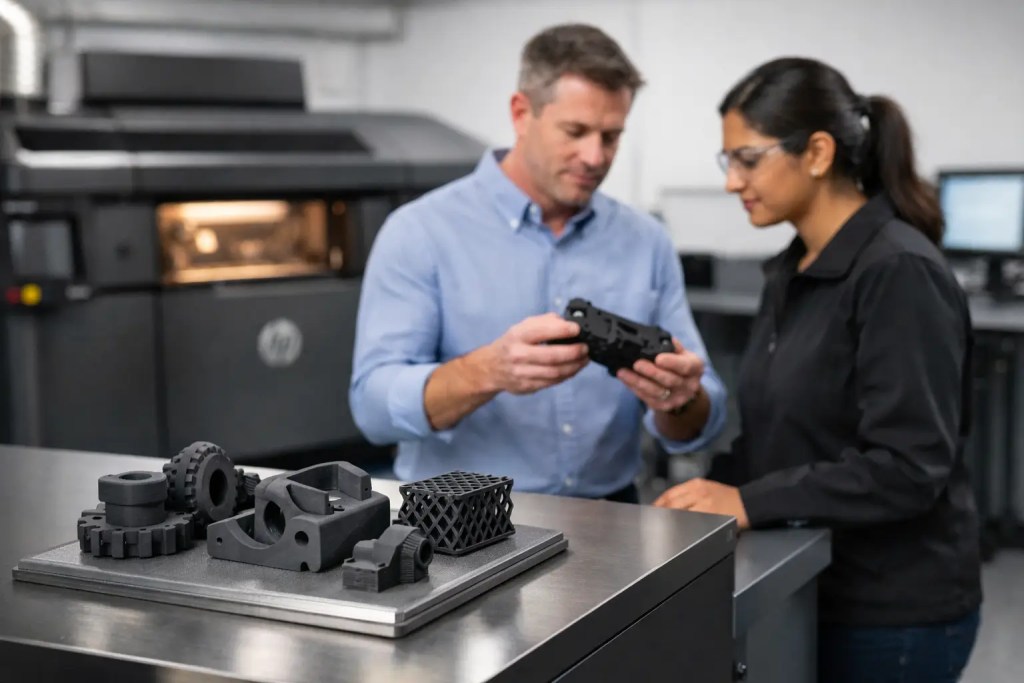
MJF is a strong choice for functional prototypes that need to behave like real parts. Snap-fit housings, cable guides, mounting brackets, robotic end-effectors, fluid handling components, and custom production aids are common examples. The process is also effective for bridge production when tooling is not yet justified or demand is still uncertain.
One reason engineers favor MJF is the combination of mechanical utility and production flexibility. You can move from one prototype to ten design iterations, then into small-batch production without changing the core process. That shortens qualification time and reduces redesign risk tied to switching technologies midstream.
Geometry freedom is another advantage, though it has limits. Internal channels, lattices, and consolidated assemblies are feasible, and the powder bed supports complex forms without extensive support structures. Still, very thin walls, long unsupported features, and cosmetic Class A surfaces require careful review. MJF is a manufacturing process, not a shortcut around design rules.
Surface quality is usually described as fine and matte, with a slightly textured feel. For many engineering applications, that is acceptable as printed. If the part is customer-facing or requires a more refined cosmetic finish, secondary processing may be needed. Dyeing, bead blasting, smoothing, machining of critical interfaces, or coating can improve appearance and function, but they also affect cost and schedule.
HP MJF printing service review: trade-offs to understand
No process review is complete without trade-offs. MJF is excellent for many nylon parts, but it is not universal.
If you need transparent parts, very high detail with smooth visual surfaces, or presentation models with sharp cosmetic fidelity, SLA may be the better fit. If you need very large parts at lower cost and can accept more visible layer lines, FDM may be sufficient. If your requirement is metal-grade temperature performance or structural load beyond polymer capability, metal additive manufacturing or CNC machining becomes the more realistic path.
Cost is another area where context matters. For one-off prototypes, MJF is often competitively priced because it balances speed and functional quality well. For very high volumes, injection molding will eventually overtake it on unit economics once tooling cost is absorbed. The crossover point depends on geometry, quantity, material, and how often the design changes. For low-to-mid volume production, MJF remains attractive because it avoids tooling lead times and preserves design flexibility.
Tolerance expectations also need to stay grounded in the process. MJF can achieve good dimensional results for many mechanical parts, but critical mating features may still require design offsets or post-machining. Engineering teams should define which dimensions are truly critical instead of applying tight tolerances everywhere. That leads to better manufacturability and lower cost.
How to evaluate a service bureau, not just the technology
The machine matters less than the operating system around it. A strong MJF supplier should have a clear intake and review process for STL or STEP files, provide fast pricing, and identify risks before production starts. That includes wall thickness concerns, trapped powder, hole sizing, orientation effects, and finishing constraints.
Material options are also part of the review. PA12 is the standard choice for many functional parts, but an experienced provider should explain when PA11 or another polymer process is the better route. A service that pushes one machine for every job creates risk. A manufacturing partner should match process to application, even when that means recommending SLS, SLA, FDM, CNC machining, or molding instead.
Quality systems are not optional for serious programs. ISO 9001:2015 certification signals that the provider operates with documented procedures, traceability, and corrective action discipline. That does not guarantee a perfect part every time, but it does reduce variability and creates a stronger foundation for repeat work.
Post-processing capability is another practical differentiator. Many MJF parts do not stop at depowdering. They may need dyeing, media finishing, tapped holes, inserts, machining, or assembly support. Working with a supplier that can handle these steps in a controlled workflow reduces handoff delays and quality drift between vendors.
This is where a bureau such as Additive3D Asia fits the needs of engineering and procurement teams. The value is not just access to HP MJF. It is the combination of instant quoting, formal quality control, multiple additive and conventional processes, and a production workflow designed to move from prototype to repeatable supply without vendor fragmentation.
When HP MJF is the right call
Choose MJF when the part needs real-world mechanical performance, lead time matters, and quantities sit between single prototypes and molded production. It is especially effective for fixtures, housings, covers, connectors, customized production tools, and short-run end-use polymer parts.
It is also a strong option when designs are still moving. If geometry may change after testing, the lack of tooling keeps iteration practical. That can save more time and budget than chasing a slightly lower unit cost too early.
On the other hand, if your project is heavily cosmetic, highly transparent, extremely large, or headed straight to mass production with a stable design, another process may deliver a better outcome. Good engineering review means selecting the process that fits the requirement, not forcing the requirement into the process.
Final assessment
A credible HP MJF printing service review should land on this point: MJF is one of the most effective polymer manufacturing options for teams that care about speed, functional performance, and short-run scalability. Its strengths are real, but they show up fully only when the service provider has disciplined workflows, material knowledge, and quality systems behind the machine.
If you are evaluating suppliers, ask fewer questions about printer branding and more about repeatability, DFM feedback, finishing control, and how they support the transition from prototype to production. The best service is not the one that prints fastest on paper. It is the one that helps your parts arrive ready to work.