
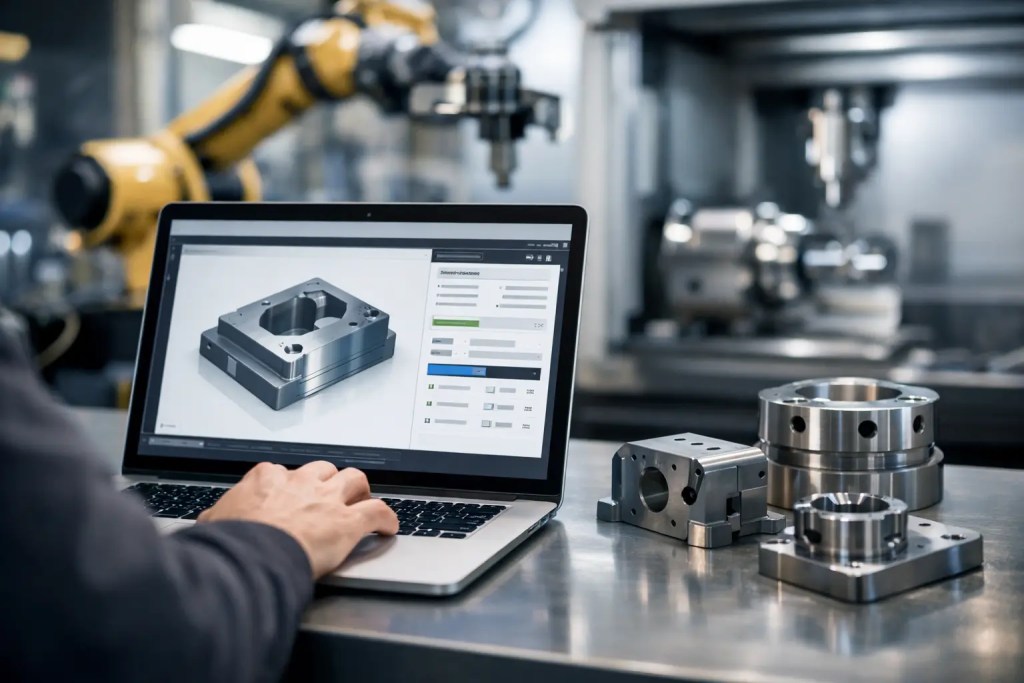
A CAD upload should not trigger a three-day email chain just to determine whether a part can be made. The future of instant quoting platforms is moving beyond rapid price estimates toward a more disciplined manufacturing decision system: one that evaluates geometry, material, process capability, lead time, and quality requirements before production begins.
For engineers and procurement teams, that change matters because the quote is often the first practical test of a supplier’s capability. A low number without process context can create expensive downstream problems. A useful quote identifies the viable production route, exposes manufacturability risks early, and sets realistic expectations for cost, tolerances, finish, and delivery.
Why Instant Quotes Must Become Manufacturing Decisions
Early instant-quote tools largely focused on one task: calculating a price from part volume, bounding-box dimensions, material, and quantity. That remains useful for simple prototypes. It is not enough for functional parts, fixtures, production bridges, or end-use components where orientation, wall thickness, support strategy, finishing, inspection, and material behavior can all affect the final result.
The next generation of platforms will need to combine automated analysis with manufacturing rules that reflect actual shop-floor constraints. For example, a PA12 Multi Jet Fusion part may be economical and durable for a functional enclosure, while SLA may be the better choice for a high-detail visual model. A component requiring heat resistance, corrosion performance, or load-bearing strength may require AlSi10Mg or SS316L through metal SLM, CNC machining, or a hybrid process.
The platform should not treat these options as interchangeable catalog entries. It should explain the production consequence of each choice. Engineers need to know whether a lower-cost process changes the achievable tolerance, surface texture, isotropy, lead time, or inspection approach.
The Future of Instant Quoting Platforms Depends on Better CAD Intelligence
The most valuable improvement will be deeper interpretation of uploaded geometry. STL files provide a triangulated surface model, but STEP files can carry more design intent, including features that help identify holes, fillets, pockets, and mating surfaces. As platforms process both file types more effectively, the quote can become more specific before a manufacturing engineer manually reviews the job.
Automated DFM Will Move From Warnings to Recommendations
Current design-for-manufacturability checks often flag thin walls, enclosed volumes, unsupported overhangs, sharp internal corners, or dimensions beyond a process envelope. The next step is actionable guidance.
Rather than simply reporting that a wall is too thin for SLS, a platform may identify the affected region, recommend a minimum thickness for the selected material, and show whether changing the process would preserve the original geometry. If a machined feature drives excessive setup time, the system can indicate which dimensions or corner radii are contributing to cost.
This does not remove the need for engineering review. Complex assemblies, tight GD&T requirements, cosmetic surfaces, sealing interfaces, and safety-critical applications still require human judgment. Automated DFM is most useful when it helps teams resolve predictable issues before the order reaches production planning.
Feature-Level Pricing Will Improve Quote Accuracy
Volume-based pricing is a starting point, not a complete production model. Two parts with similar size and material can have very different manufacturing costs. One may require difficult support removal, threaded inserts, multiple finishing operations, critical inspection points, or special packaging. Another may be ready to produce with minimal intervention.
Feature-level pricing will account for these differences earlier. The result should be fewer quote revisions and a stronger link between the initial price and the released manufacturing route. For purchasing teams, predictability is often more valuable than the lowest preliminary estimate.
Material and Process Selection Will Become More Contextual
A capable quoting platform will increasingly ask for the information that geometry alone cannot reveal. Is the part a fit-check prototype, a production jig, a fluid-contact component, a cosmetic housing, or a load-bearing assembly? Does it need UV stability, flame resistance, chemical resistance, electrical insulation, or a specified surface finish?
Those inputs allow the system to narrow options intelligently. PA11 may be appropriate where ductility and impact performance are priorities. PA12 can suit durable, dimensionally stable functional parts. SLA resins may serve detailed patterns or presentation models, while CNC machining may be the preferred route for tight tolerances and specific engineering-grade materials. The correct answer depends on the application, quantity, and risk associated with failure.
Material recommendations must also remain transparent. A platform should state why a process is recommended and what trade-off it introduces. For instance, a lower-cost additive process may be suitable for a short-run fixture but not for a part with a highly visible Class A surface. Clear rationale helps engineering, quality, and procurement teams make a decision without reopening the sourcing process.
Quotes Will Connect Directly to Capacity and Quality Controls
Speed has limited value if the promised date is disconnected from actual capacity. The future platform will draw from live production information: machine availability, material inventory, post-processing workload, inspection requirements, and shipping cutoffs. This will make quoted lead times more credible, especially when demand changes quickly.
For industrial buyers, quality information should become part of the quoting experience as well. A quote may identify the planned process, material lot controls, inspection level, critical dimensions, finishing specification, and documentation available for the order. These details are not administrative extras. They define whether a part can move from prototype evaluation into a controlled production workflow.
An ISO 9001:2015-certified manufacturing partner has standardized processes for managing these handoffs. At Additive3D Asia, the objective of an instant workflow is not merely to accelerate checkout. It is to move a manufacturable part into a defined production path with appropriate process selection, quality controls, and global fulfillment.
More Data Does Not Mean Fully Automatic Approval
There is a practical limit to automation. A platform can detect many geometric conditions, estimate process time, and apply pricing logic consistently. It cannot always infer the full functional intent of a component or the consequences of a tolerance stack across an assembly.
The best systems will use automation for repeatable decisions and route exceptions to manufacturing engineers quickly. This hybrid model avoids two common failures: slow manual quoting for every job, and unchecked automation that approves parts without considering real production risk.
Procurement Will Become Less Fragmented
Many product teams still request separate quotes for 3D printing, machining, molding, finishing, and assembly-related work. This creates vendor fragmentation, repeated file transfers, inconsistent specifications, and lost time when a prototype needs to transition into a higher-volume process.
Future quoting platforms will be organized around the part lifecycle rather than a single technology. A team may begin with an SLA appearance model, validate function in MJF PA12, machine a tight-tolerance mating component, and later evaluate injection molding for volume production. The digital record should carry key specifications, revision history, and prior manufacturing feedback through each stage.
That continuity can reduce avoidable redesign work. It also gives procurement teams a clearer basis for comparing lead time, unit cost, tooling investment, and production risk at different volumes. Instant quoting becomes more valuable when it helps answer not only, “What will this prototype cost?” but also, “What is the most sensible path to 500 or 5,000 parts?”
What Engineering Teams Should Expect From a Platform
When evaluating an instant quoting platform, speed should be one criterion, not the only one. A credible system should provide clear process and material options, identify assumptions, and make it straightforward to request engineering support when requirements are not standard.
Teams should also verify how the supplier handles revision control, tolerances, post-processing, inspection, and shipment. A quote that omits these elements may still be suitable for an early concept model. It may not be sufficient for a production fixture, regulated component, or end-use part where consistency is required across multiple orders.
The strongest platforms will make routine sourcing faster while making exceptions more visible. That is the useful direction for digital manufacturing: less waiting for basic answers, more attention on the details that determine whether a part performs as designed.
For the next CAD upload, treat the quote as an engineering checkpoint. If it can show how the part will be made, what could affect the outcome, and when it can realistically ship, it is already doing more than pricing a file.